This article contains advertising. Our booking links are routed through a partner that adds commission tracking automatically, so if you book through one we earn a commission from the provider, at no extra cost to you. It never affects what we recommend. Affiliate disclosure
Three days is the length of trip that goes wrong most often, because it is just long enough to feel like you could fit everything in. You cannot. Three days in Osaka works beautifully if you accept the trade at the start — two days in the city and one day out of it, or three days in the city and no Kyoto at all — and it works badly if you try to bolt a temple morning onto a market afternoon onto a castle evening across two prefectures.
What follows is clock-shaped: actual hours, actual walking distances, actual stations. It is built around the way Osaka is laid out rather than around a list of sights, which is why it moves south to north to out. Times assume you are staying somewhere on the Midosuji line, which is the only real accommodation advice this page will give you.
The shape of three days
Osaka divides into Minami (south — Namba, Dotonbori, Shinsaibashi, Shinsekai) and Kita (north — Umeda, the station district, Nakanoshima), with Osaka Castle sitting east between them. Minami is the loud, food-first, neon half. Kita is the tall, tidy, department-store half. Trying to mix them in one day means crossing the city twice.
So: Day 1 is Minami, Day 2 is the castle and Kita, and Day 3 is your choice — Kyoto, Nara, Universal Studios Japan, or a slower second pass at Osaka itself. That last option is more popular with people on their second visit than you might expect.
Before you start
- Buy an ICOCA card at the airport or your first station. It works on everything and on the vending machines and lockers as well.
- Do not buy an Osaka Amazing Pass yet. It costs around ¥3,500 for a day and it only pays off on a packed sightseeing day with an early start — several of its attractions, the Umeda Sky Building included, give free entry only before 15:00. Day 2 is the day it might be worth it.
- Carry ¥10,000–15,000 in cash. The best places on this itinerary do not take cards.
- Stand on the right of the escalator. Kansai does it the opposite way to Tokyo. Full ground rules in Osaka travel tips.
Day 1 — Minami: markets, neon and fried things
08:30 — Kuromon Market
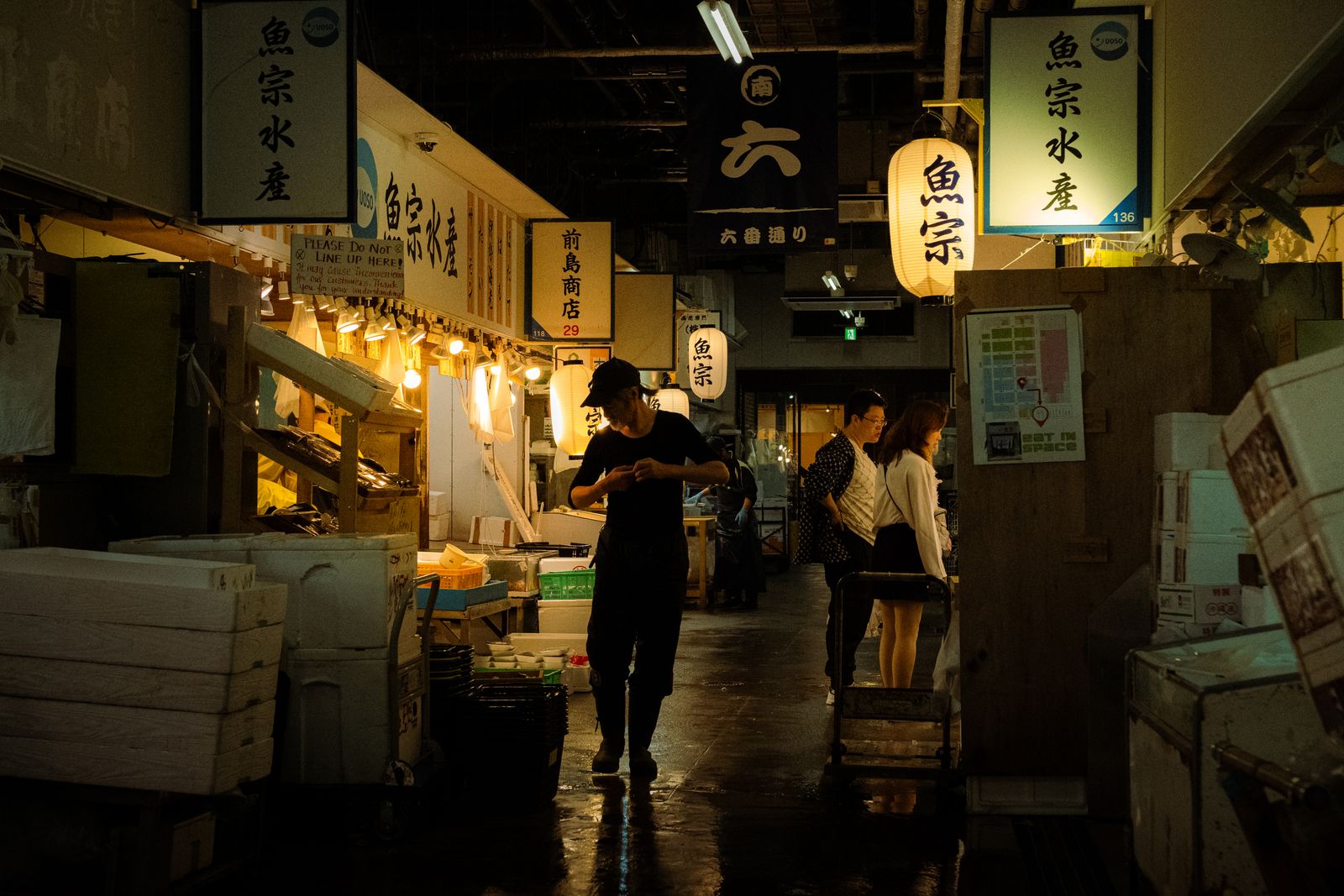
Start at Nippombashi or Namba and walk into Kuromon Market, the covered food street that has fed Osaka’s restaurants for two centuries. Go early, genuinely early. By eleven it is a slow-moving tourist queue; at half past eight the vendors are unhurried and the produce is at its best.
Eat as you go — grilled scallops, uni, tamagoyaki, fruit skewers. Budget ¥2,000–3,000 and treat it as breakfast and second breakfast. Stand beside the stall you bought from rather than walking with food; that is the local convention.
10:00 — Hozenji Yokocho and the lanes
Walk fifteen minutes north-west into the lanes behind Dotonbori. Hozenji is a tiny temple whose statue is entirely covered in moss because visitors have been throwing water on it for four hundred years. It takes four minutes and it is the best free thing in Minami. The stone-paved alley beside it, Hozenji Yokocho, is what Osaka looked like before the neon.
11:00 — Dotonbori in daylight
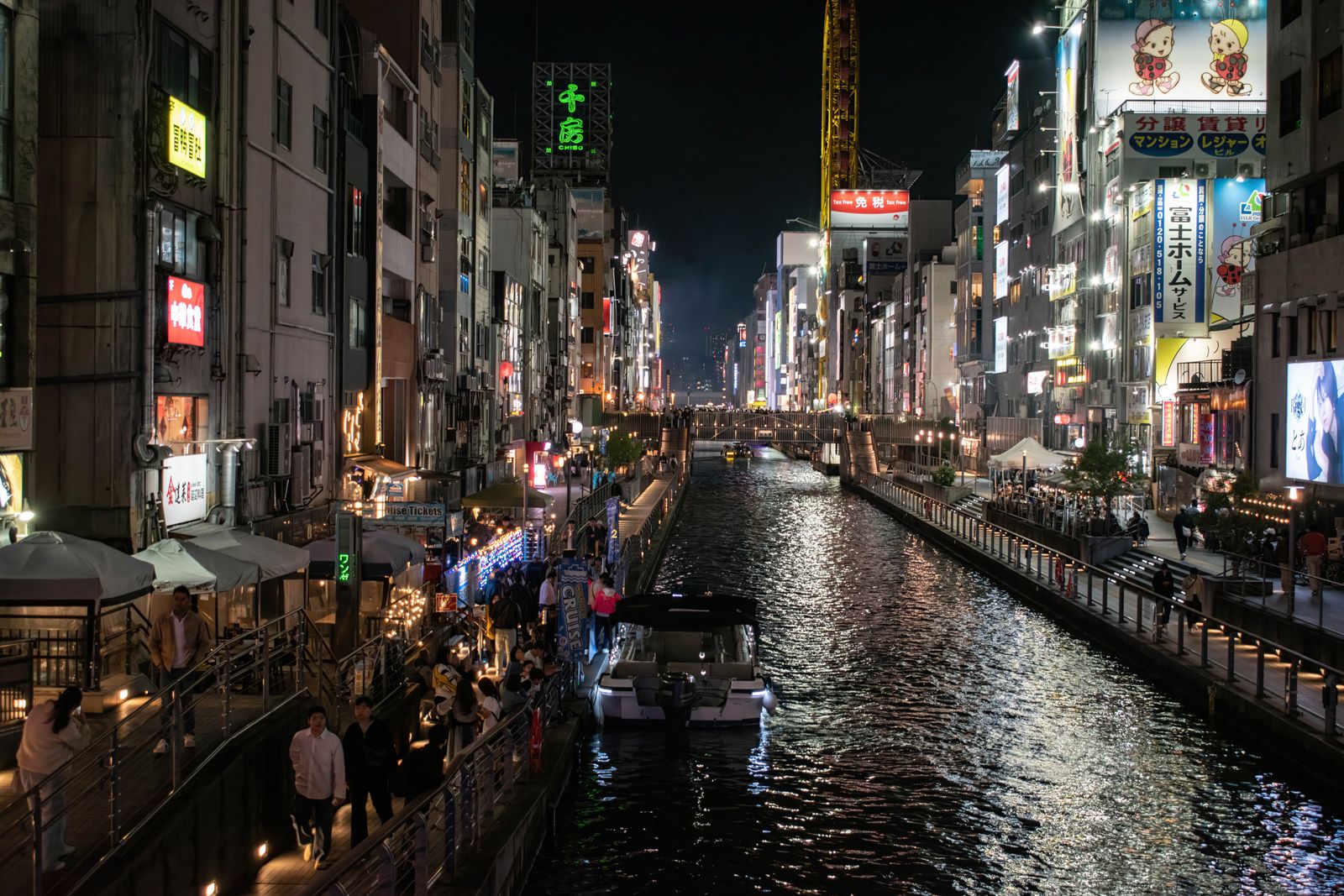
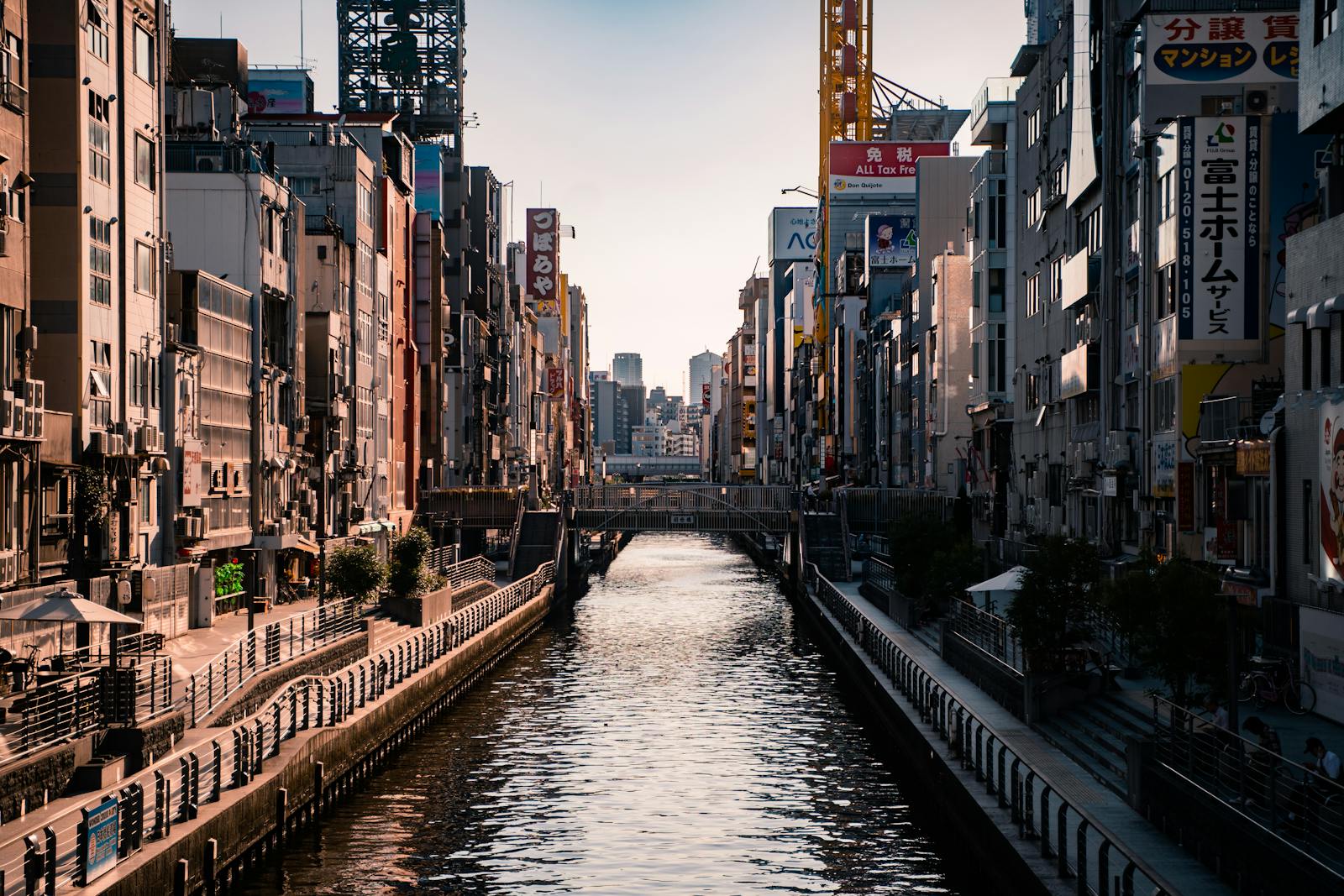
Do the canal now, not only at night. The famous photograph — the Glico running man from the Ebisubashi bridge — is the same picture at every hour, and the crowds are half what they will be at eight. More importantly the side streets are open and calm, and that is where the food actually is.
The honest advice: do not queue forty minutes for takoyaki on the main strip. You are queuing for a sign. Walk one street back, or into Sennichimae, and eat as well for a quarter of the wait. Our Dotonbori guide names the places worth stopping at, and the takoyaki guide settles the argument.
12:30 — Lunch: okonomiyaki
Lunch sets in Osaka cost roughly half what the same food costs at dinner, and this is the meal to spend that saving on. Find an okonomiyaki counter in Namba or Shinsaibashi, sit at the hotplate, and let them cook it — the DIY version is for tourists and it is worse.
14:00 — Shinsaibashi and Amerikamura
Walk north up the Shinsaibashi-suji covered arcade, which runs for the better part of a kilometre and is genuinely useful in rain or in July. Cut west into Amerikamura when you have had enough of chain stores — vintage clothing, record shops, street fashion and a considerably younger crowd. An hour is right for both.
If shopping is not your thing, substitute the Tombori River Cruise: about ¥2,000 for twenty minutes, and a genuinely good way to see the canal from below.
16:00 — Shinsekai and Tsutenkaku
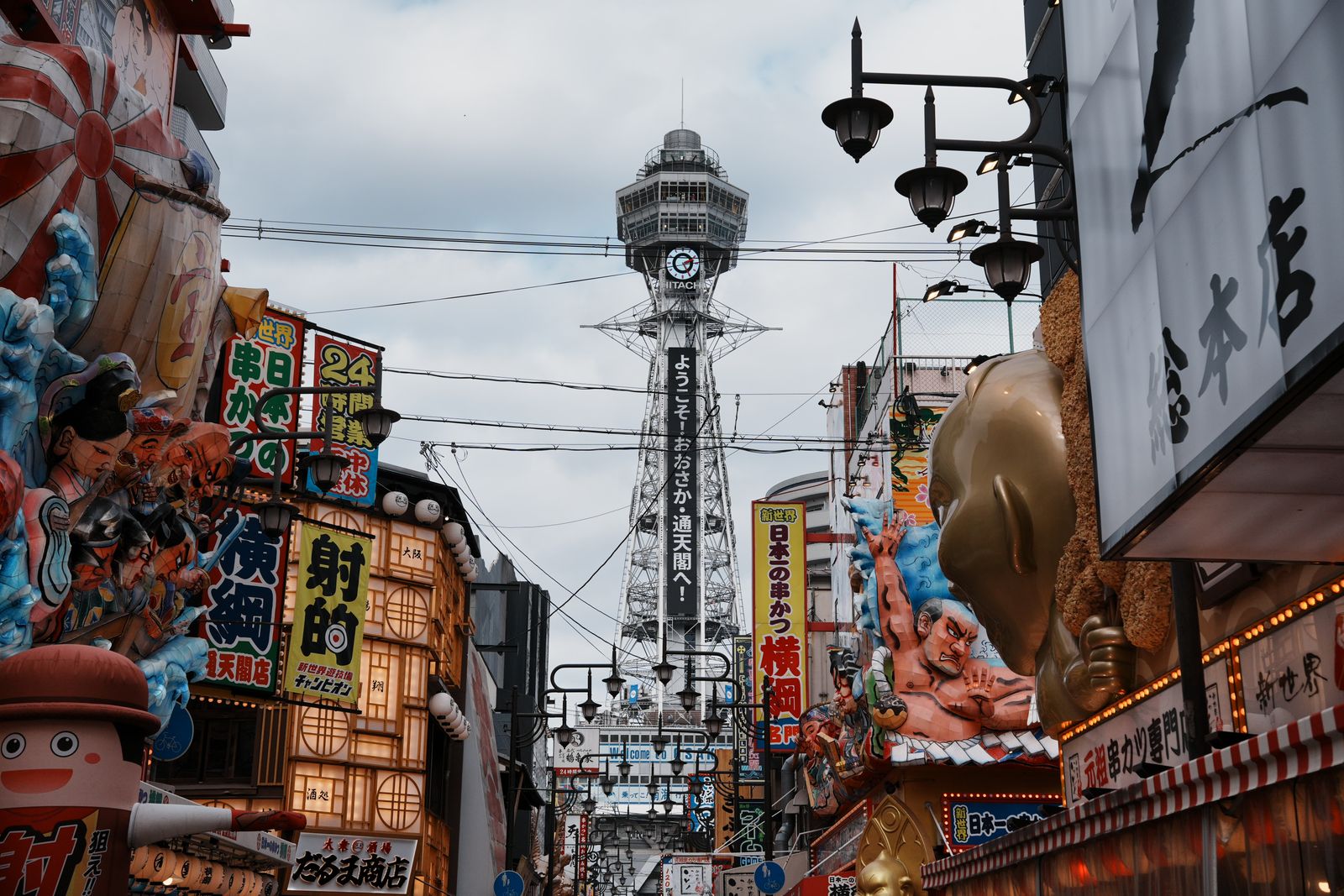
Six stops south on the Midosuji line to Dobutsuen-mae, about fourteen minutes from Umeda and much less from Namba. Shinsekai is the old, brash, cheerfully unfashionable Osaka — a district built in 1912 around a tower modelled on the Eiffel, then left alone. It is loud, garish and completely unlike the polished parts of the city.
Tsutenkaku Tower itself is optional; the view is not remarkable and there are better ones. What you came for is the street.
17:30 — Kushikatsu, and the one rule
Kushikatsu — skewered, breadcrumbed, deep-fried anything — was invented here for labourers, and it is still cheap and still excellent. Skewers run ¥100–200 each and a full meal is ¥1,500–2,500.
Do not double-dip in the sauce. The pot on the counter is communal, it is refilled but not replaced between customers, and the rule is posted on every wall in the district. Use the cabbage to spoon more on if you want it. Breaking this is the fastest way to be quietly judged in Osaka.
19:30 — Dotonbori at night, then a bar
Back north for the neon, which is worth seeing twice in one day because it is a different street after dark. Then choose your evening: the standing bars of Ura Namba for the good version of an Osaka night out, an izakaya if you want to sit down, or karaoke at ¥1,000–2,000 an hour if the group is that sort of group.
Watch the last train. The subway stops around midnight, not one in the morning, and a taxi across the city is not cheap — see Osaka taxis. If you are still going at midnight, late-night food is the better plan than a cab.
Day 2 — The castle, the sky and the north
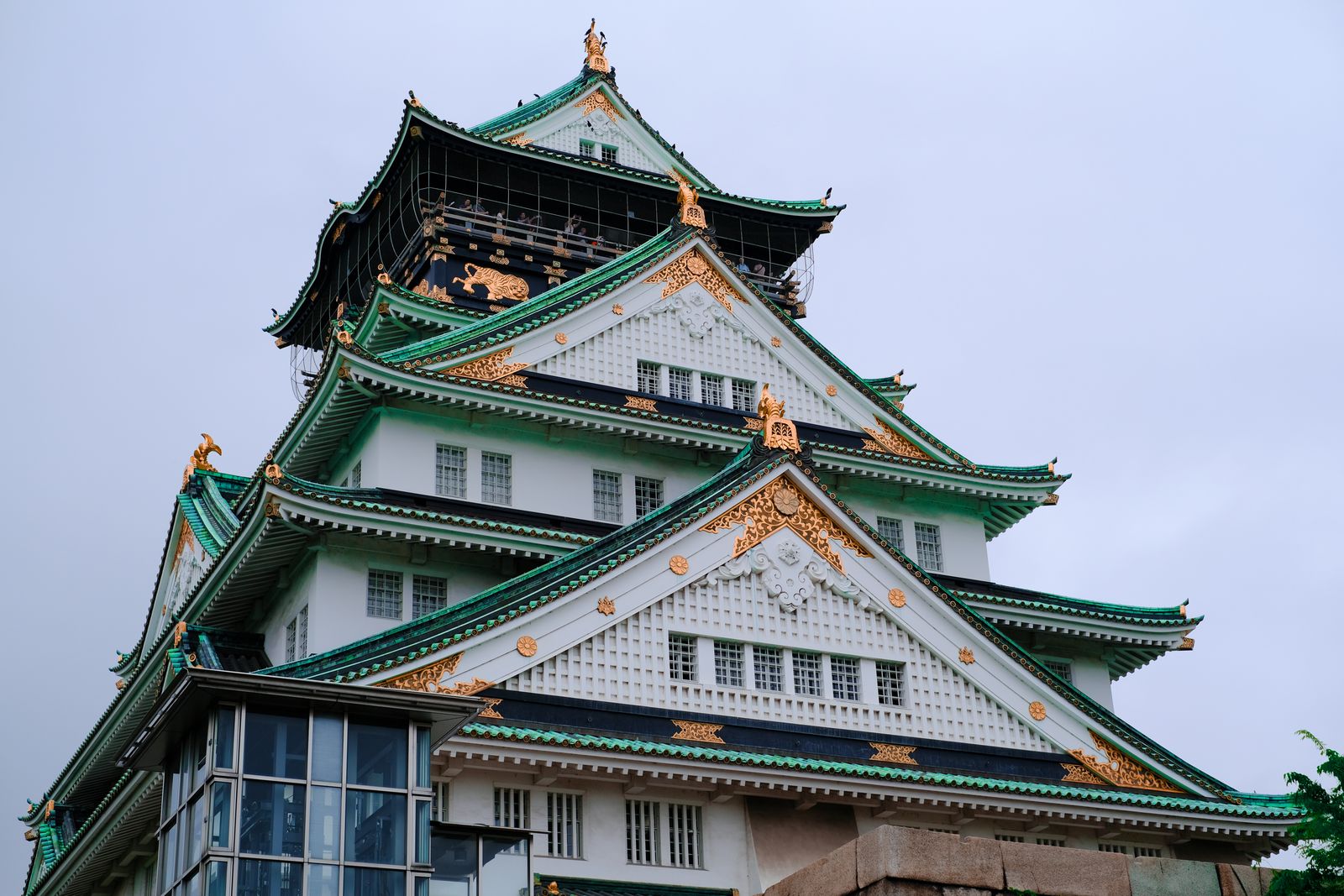
09:00 — Osaka Castle
Osaka-jo Koen or Tanimachi 4-chome station, then a walk through the park. Get there at opening; by eleven the plaza in front of the keep is a coach-tour car park.
The honest verdict on Osaka Castle: the grounds, the moats and the enormous stones of the outer walls are magnificent and free. The keep is a 1930s concrete reconstruction with a lift and a museum inside, admission around ¥1,200, last admission usually 16:30. It is a decent museum and it is not the castle you are imagining. If Himeji is anywhere in your plans, skip the interior here entirely and spend the time in the park. The history behind it is more interesting than the building.
11:00 — Nishinomaru garden or the Museum of History
Two good options within the same ten minutes. Nishinomaru garden gives the classic view of the keep across lawns — the best photograph on the site, and spectacular in cherry blossom season. Or cross to the Osaka Museum of History, whose upper floors look straight down at the castle and which is the better call in rain or heat.
12:30 — Lunch in Nakanoshima
Two stops west to Nakanoshima, the long island between two rivers that holds Osaka’s civic architecture, its rose garden and several of its museums. It is the calmest part of central Osaka and the best place on this itinerary to sit down for an hour. Lunch here is easy and unremarkable in the good way.
14:00 — Umeda
North to Umeda, which is a transport hub, a shopping district and a small city of underground passages that will get you lost. Two things are worth your time here.
The department store food halls — depachika — in Hanshin and Daimaru are among the best food shopping in Japan, and they discount heavily in the last hour before closing. See department stores. And on the thirteenth floor of Daimaru Umeda, beside JR Osaka Station, sits Nintendo OSAKA, the Pokémon Center and the Capcom store, if that is your sort of thing — our pop culture guide has the detail.
16:00 — The Umeda Sky Building
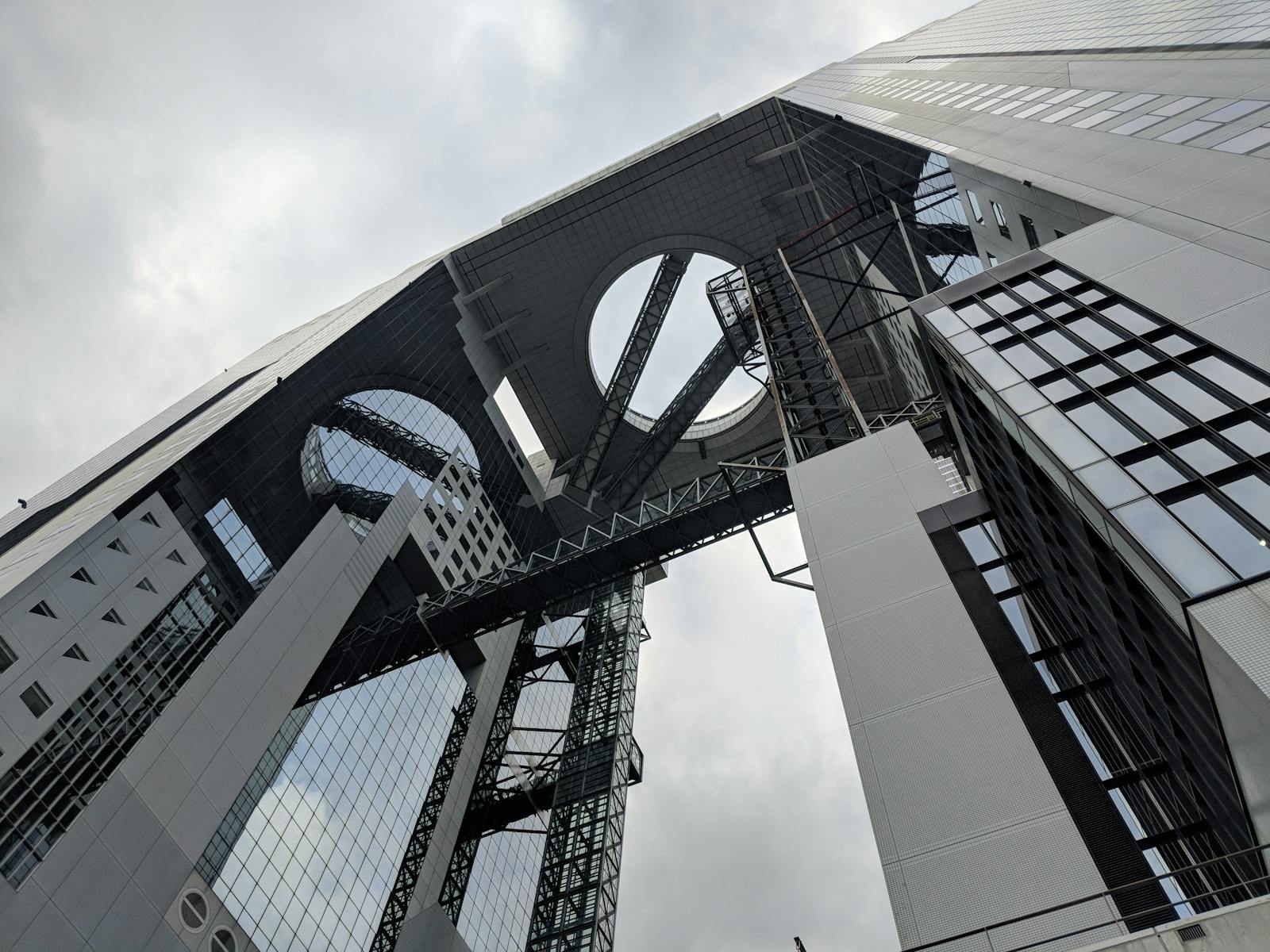
Two connected towers joined at the top by a floating observatory you reach on an escalator suspended between them, which is more unnerving than it sounds. Admission is around ¥1,500 for adults, a 2026 estimate worth checking before you go. Go up before sunset and stay through it — the rooftop deck is open-air, which is what makes it better than the enclosed alternatives.
Timing note: if you bought the Amazing Pass, entry here is free only before 15:00, dropping to roughly a ten per cent discount afterwards. That single rule is why an Amazing Pass day has to start early. Alternatives are compared in our observation decks guide; Abeno Harukas 300 opens until 22:00 and is higher but enclosed.
18:30 — Dinner in Kitashinchi, or back south
Kitashinchi is Osaka’s expense-account dining district: small, serious, expensive, and a completely different city from Dotonbori. Worth one dinner if the budget allows. If not, go back south and eat in Namba, or find a ramen counter and be happy for ¥1,000.
Day 3 — choose one
This is the decision the whole itinerary turns on, and the wrong answer is “a bit of several”.
Option A — Kyoto
Thirty minutes on the JR Special Rapid, around ¥600, trains every fifteen minutes. The mistake is trying to see Kyoto. You cannot, in a day. Pick one district and do it properly: Fushimi Inari at eight in the morning followed by southern Higashiyama and Kiyomizu-dera is the strongest single-day route, ending in Gion at dusk.
Go early enough to beat the coaches to Fushimi Inari — before eight, and it is a genuinely different place. See our Kyoto day trip guide and Osaka to Kyoto.
Option B — Nara
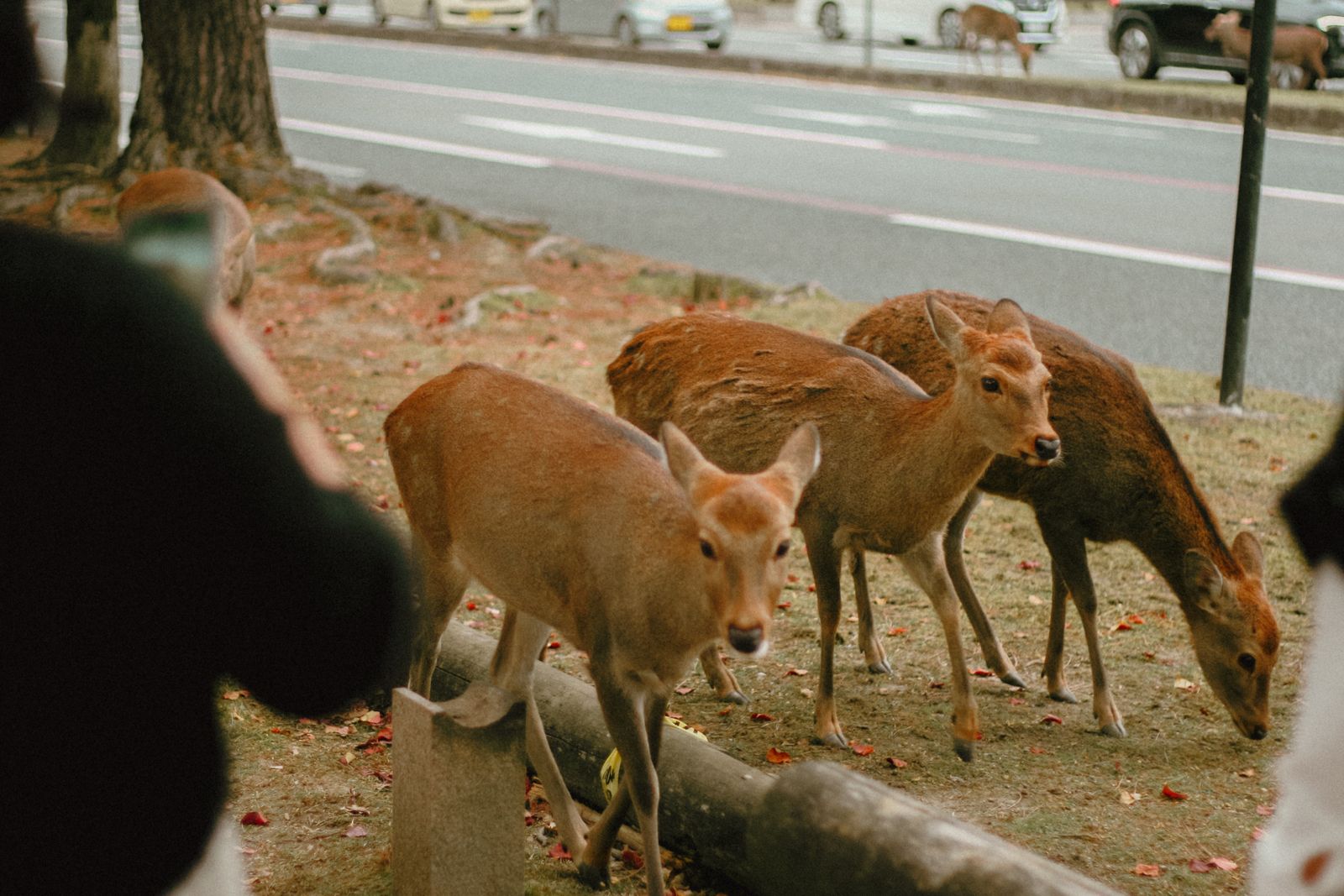
Forty minutes from Osaka-Namba on the Kintetsu line, which lands closer to the park than JR does. Todai-ji’s Great Buddha, the deer, Kasuga Taisha’s lantern paths and Naramachi’s old streets are a comfortable four to five hours — a half day, which leaves you an Osaka evening.
Our recommendation for most three-day trips: Nara over Kyoto. It is shorter, calmer, cheaper, entirely walkable once you arrive, and it does not leave you feeling you have skimmed something enormous. Deer crackers cost about ¥200 a bundle and the deer can spot a bundle at thirty paces. See the Nara day trip and Osaka to Nara.
Option C — Universal Studios Japan
Fifteen minutes from Osaka Station, changing at Nishikujo, and a full day — there is no half-day version. This is the right call with children over about seven or if Super Nintendo World is a genuine reason you came to Japan.
Understand what it costs: a Studio Pass from about ¥8,900 plus, realistically, an Express Pass from about ¥10,800 on a busy day, and a whole day of a three-day trip. Read our USJ guide before you commit, because getting into Nintendo World requires planning done days in advance, not on the morning.
Option D — a third day in Osaka
Underrated, and the one experienced travellers pick. Osaka rewards a slow day more than it rewards a fourth city. Some shapes that work:
- Temples and quiet: Shitennoji, Japan’s oldest official temple, then Sumiyoshi Taisha with its extraordinary arched bridge, then Tennoji and Abeno.
- Bay and family: the Kaiyukan aquarium, around ¥2,700, one of the best in the world, plus the bay area.
- Neighbourhoods: Nakazakicho‘s converted wooden houses and cafes, then the hidden cafes, then vintage shopping.
- Food, seriously: an Osaka food tour or a cooking class, which is the single best way to understand why this city eats the way it does.
Where to base yourself for three days
On a three-day trip, the hotel decision is a time decision. Every change of line costs you ten minutes twice a day, which over three days is an hour you could have spent eating. The Midosuji line — the red one, running Umeda to Shinsaibashi to Namba to Tennoji — connects everything on this itinerary, so stay on it.
- Namba — the best base for this plan. You wake up inside Day 1 and you are three minutes from dinner every night. Loud at weekends. See Namba hotels.
- Shinsaibashi — slightly calmer, still walkable to Dotonbori, better for shopping. See Shinsaibashi hotels.
- Umeda — the right choice if you are day-tripping to Kyoto, Nara or Himeji, because the JR and private lines all leave from here. Less atmospheric at night. See Umeda hotels.
- Tennoji — cheaper, well connected, and handy for the airport. A reasonable trade if the budget is tight.
Business hotels are the sensible default at ¥9,000–15,000 a night: small, spotless, and reliably located. Hostels go from around ¥3,000, family hotels solve the room-size problem, and a ryokan night is worth one of the three if you want the tatami experience. The full comparison is in where to stay in Osaka.
Three days by season
The same itinerary behaves very differently across the year, and the adjustments are worth making rather than pushing through.
- Spring (late March–April). Cherry blossom turns Osaka Castle park and Nishinomaru garden into the best morning of the trip, and doubles the crowd everywhere. Start Day 2 at eight rather than nine. Cherry blossom in Osaka and the hanami guide have the timing, which moves by a week or more each year.
- Summer (June–September). Mid-thirties with heavy humidity. Run outdoor sections before eleven and after five, and use the covered arcades, the aquarium and the department stores for the middle of the day. This is not caution; it is how the city itself works in August. See Osaka in summer.
- Autumn (late October–early December). The best conditions of the year, and the colour peaks later than most visitors expect — often the third week of November inland. Nothing about the plan needs changing. See Osaka in autumn.
- Winter (December–February). Cold, dry, bright and pleasantly uncrowded. The observation decks are at their clearest, the illuminations are genuinely good, and Shinsekai in the cold with a plate of kushikatsu is one of the better Osaka evenings. See Osaka in winter.
Avoid Golden Week in late April and early May, Obon in mid-August and the New Year period if you have any choice; prices rise, accommodation vanishes and everything on this page doubles in queue length. The month-by-month picture is in best time to visit Osaka and the seasonal guide.
Arriving and leaving mid-day
Almost nobody gets three clean days, so here is how to absorb the loss.
Landing in the afternoon. Kansai Airport to Namba is about 38 minutes on the Nankai Rapi:t or 45 on the airport express — see Kansai Airport to Osaka. Drop bags, buy an ICOCA, and run Day 1’s evening only: Dotonbori after dark, kushikatsu, a bar. Then start Day 1 properly the next morning at Kuromon and compress the rest.
Flying out in the evening. Keep the last morning empty and low-stakes. Hotels will hold luggage after checkout, and if yours will not, the station lockers will — see luggage storage in Osaka. Do not schedule a day trip on a departure day; a delayed train from Kyoto is not the way to discover your flight has closed.
Two nights, three days. Common with regional flights. Treat it as Day 1 and Day 2, skip the day trip, and do not feel you missed anything — you saw Osaka, which is the point of coming to Osaka.
If you find you have a fourth day
The best fourth days are the ones that go deeper rather than further.
- Kobe, twenty-five minutes away, for the harbour, the Kitano houses and the Mount Rokko night view — the rare Kansai day trip that is better in the evening. See Kobe day trip.
- Himeji, an hour on the Special Rapid, for the only original castle keep on this scale in Japan — and the reason to skip Osaka Castle’s interior. See Himeji Castle day trip.
- Minoo Park, thirty minutes north, for a waterfall walk through maples and deep-fried maple leaves sold at the trailhead. Best in November. See Minoo Park.
- Koyasan, two hours south and worth a night rather than a day — the temple lodgings and Okunoin cemetery after dark are the whole point. See Mount Koya.
- A second, slower Osaka day in the parts of the city most visitors miss.
Variations
- Rain: swap Day 1’s afternoon for the Shinsaibashi arcade end-to-end and the aquarium, and Day 2’s castle for the Museum of History. See rainy day Osaka.
- With children: shorten every day by two hours, replace Shinsekai with the aquarium or Kids Plaza, and make Day 3 USJ. See Osaka with kids.
- Tight budget: the castle grounds, Shinsekai, the arcades and every temple on this page are free or nearly so. A day here costs ¥5,000–7,000 including food if you skip the observation deck — see free things to do and budget travel.
- Summer: move everything outdoors to before eleven and after five, and put the middle of the day underground or in a museum. Osaka in summer explains why this is not optional.
- Arriving late on day one: collapse Day 1 into an evening — Dotonbori, kushikatsu, a bar — and push Kuromon to the start of Day 2.
What this itinerary leaves out, deliberately
- Kyoto and Nara both. Two day trips out of three days means you visited Kansai, not Osaka.
- Tsutenkaku’s observation deck. The street below is the attraction.
- Osaka Castle’s interior, if Himeji is on your list.
- A second observation deck. One is a view; two is the same view.
- Expo City and the outer suburbs. Fine, and not what three days is for.
What three days costs
| Budget | Comfortable | Generous | |
|---|---|---|---|
| Accommodation, per night | ¥3,000–5,000 hostel | ¥9,000–15,000 business hotel | ¥25,000+ |
| Food, per day | ¥3,000 | ¥6,000–8,000 | ¥15,000+ |
| Transport, per day | ¥700 | ¥1,200 | ¥2,000 with taxis |
| Attractions, per day | ¥0–1,000 | ¥2,500 | ¥5,000 |
| Three-day total | about ¥25,000 | about ¥60,000 | ¥140,000+ |
Full workings in Osaka trip cost, and ways to cut it in money-saving tips.
3 days in Osaka FAQ
Is 3 days in Osaka enough?
For the city itself, comfortably — two days covers the centre well and the third is genuinely spare. It is not enough for Osaka plus Kyoto plus Nara; pick one day trip and do it properly.
Should I do Kyoto or Nara as my day trip?
Nara, for most three-day trips. It is closer, calmer, walkable and takes half a day rather than all of one, so you keep an Osaka evening. Choose Kyoto if temples and gardens are the reason you came to Japan, and then commit to one district.
Where should I stay for three days in Osaka?
Anywhere on the Midosuji line — Namba or Shinsaibashi for nightlife and food, Umeda for transport and shopping. See where to stay in Osaka, Namba hotels and Umeda hotels.
Is the Osaka Amazing Pass worth it for three days?
For one of them, possibly — Day 2 here, if you start early. It is around ¥3,500 a day and several attractions only give free entry before 15:00. It covers nothing outside the city, so it is useless on your day-trip day.
Can I fit Universal Studios Japan into three days?
Yes, as your entire third day. There is no shorter version, and Super Nintendo World needs entry arranged in advance. It costs you the day trip.
How much walking is this?
Fifteen to twenty thousand steps a day. Osaka is flat, which helps, but the distances inside stations are longer than they look on a map. Wear proper shoes.
What if I only have two days?
Do Day 1 and Day 2 as written and skip the day trip entirely. That is a good, complete short visit to Osaka, and it is a better trip than three rushed cities.
Where to go next
Other lengths are in the Osaka itinerary hub, which covers one to seven days. For the list-shaped version of what is here — everything ranked rather than scheduled — see things to do in Osaka, and the districts themselves in Osaka neighbourhoods.
Read Osaka travel tips before you fly and first-time Osaka tips if this is your first trip to Japan. Eating is covered in the Osaka food guide, and if the third day tempts you further afield, day trips from Osaka and our Kansai region guide have the options.
Three days here usually sits inside something longer. If you are assembling a full trip, our Japan 10 day itinerary slots this plan into days five to ten alongside Tokyo and Kyoto.