This article contains advertising. Our booking links are routed through a partner that adds commission tracking automatically, so if you book through one we earn a commission from the provider, at no extra cost to you. It never affects what we recommend. Affiliate disclosure
Sumiyoshi Taisha is the head shrine of all 2,300+ Sumiyoshi shrines across Japan and one of the country’s three most important Shinto shrines (with Ise Jingu and Izumo Taisha). Founded by tradition in 211 AD – making it pre-Buddhist, predating the introduction of Buddhism to Japan – the shrine is dedicated to three sea deities and the Empress Jingu, and is the spiritual home of sailors, fishermen and travelers. The architecture is unique: “Sumiyoshi-zukuri” style, designated National Treasure, predates Chinese Buddhist architectural influence and represents one of Japan’s three oldest indigenous shrine architectural styles. It sits 10 minutes south of Namba by Nankai train, further out than most of the city’s older religious sites, and the ride is part of the appeal. This 2026 guide covers everything visitors need to know.
Quick Facts: Sumiyoshi Taisha
- Address: 2-9-89 Sumiyoshi, Sumiyoshi-ku, Osaka 558-0045
- Access: 3-min walk from Sumiyoshi Taisha Station (Nankai Main Line, local trains; 10 min from Nankai Namba); Hankai Tramway Sumiyoshi-toriimae stop
- Hours: 06:00-17:00 (Apr-Sept); 06:30-17:00 (Oct-Mar). Outer gate closes at 16:00, inner Ogaki gate at 17:00 year-round
- Admission: FREE
- Founded: 211 AD (traditional date)
- Architecture: Sumiyoshi-zukuri (National Treasure) – predates Buddhist influence in Japan
- Visit duration: 45-60 minutes
- Famous for: Sea deity worship, Sorihashi Bridge, Sumiyoshi Matsuri (Jul 30-Aug 1), Hatsumode (~2.3M visitors)
How to Get to Sumiyoshi Taisha
By Nankai Main Line (Fastest)
From Nankai Namba Station, take a local train (only locals stop here) to Sumiyoshi Taisha Station – 10 minutes, JPY 240. The shrine is a 3-minute walk from the station’s east exit. Nankai is a private railway, so an Osaka Metro day pass does not cover the fare; our Osaka Metro lines and fares page shows where the subway network stops short.
By Hankai Tramway (Most Atmospheric)
Osaka’s only remaining streetcar runs from Tennoji to Sumiyoshi-toriimae stop directly outside the shrine entrance. Journey time 15 minutes, JPY 230 flat fare. Pay on board. The 1900s-era tram experience is half the appeal of visiting.
From Other Lines
- Hanshin/Hanwa: transfer at Sugimotocho or Tsurugaoka stations
- JR: Sumiyoshi Station (JR Hanwa Line) is a 12-minute walk
The Sumiyoshi-Zukuri Architecture
Sumiyoshi Taisha‘s four main halls (Honden) are designated National Treasures and represent one of Japan’s three oldest indigenous shrine architectural styles. Distinguishing features:
- Straight gabled thatched roof (vs. the curved roofs that came from China with Buddhism)
- Chigi finials: Crossed wood beams projecting above the roof ridge
- 5 katsuogi: Cylindrical wood billets sitting on the roof ridge
- Vermilion bargeboards against unpainted cypress walls
- No ornamentation on the eaves (Buddhist temples have elaborate carvings)
- Free-standing structure with no fenced precinct (later shrines added precincts)
The four main halls are arranged in a deliberate “anchor formation” – three behind one another, the fourth alongside the third – representing ships at anchor. This reflects the shrine’s role as protector of sea voyages.
The Sorihashi Drum Bridge
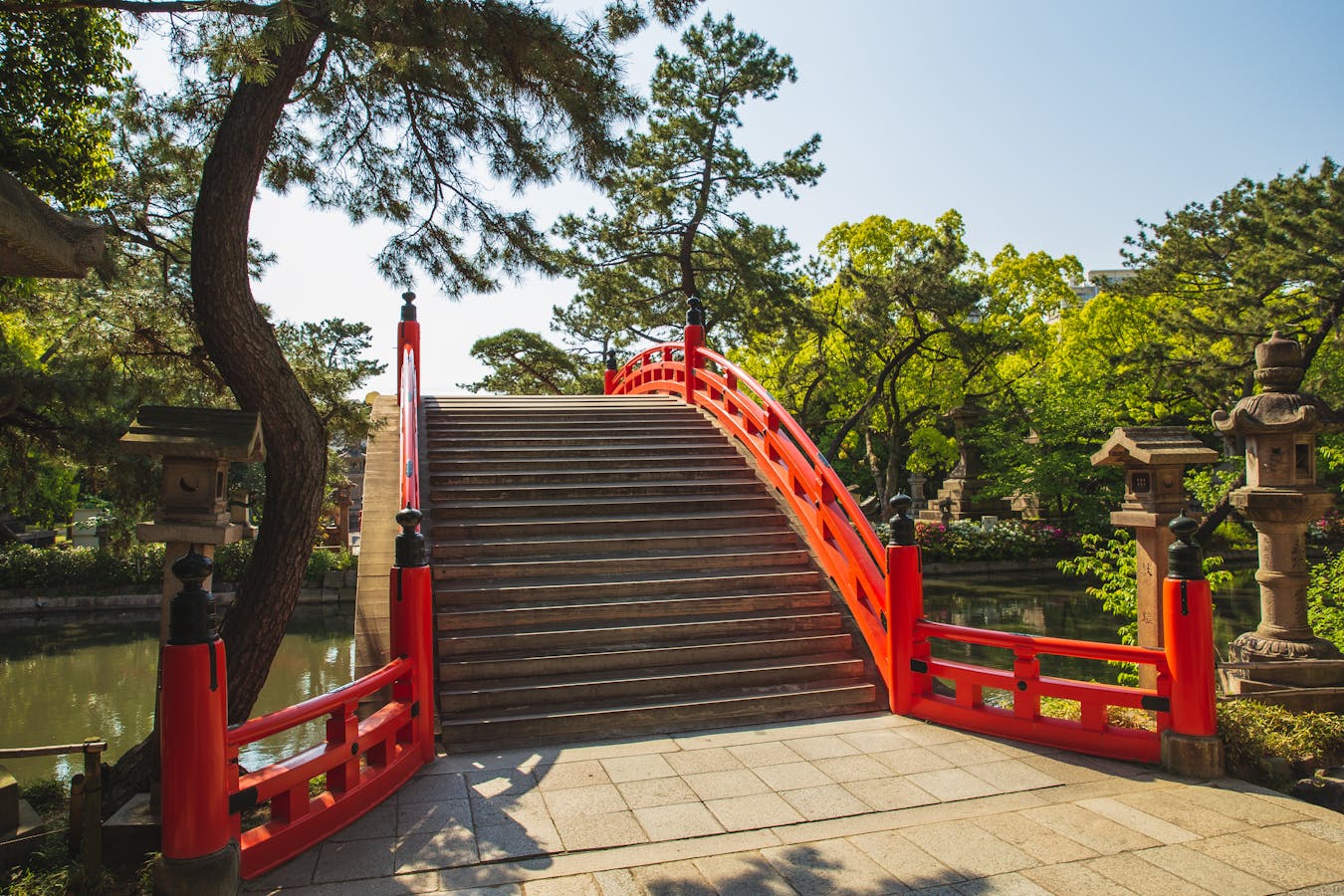
The arched red wooden bridge over the shrine pond is the Sumiyoshi Taisha image you have already seen. The bridge is steeply curved – climbing it is part of the spiritual ritual (the difficulty of the climb is meant to purify). Photogenic from any angle, especially with the morning sun behind it.

Hattatsu-Mairi: The Lesser-Known Pilgrimage
One of Sumiyoshi Taisha’s most distinctive practices is the Hattatsu-mairi: a pilgrimage made on the first Tatsu (Dragon) day of each month – the days come 12 days apart in the traditional Chinese calendar cycle. Pilgrims visit four sub-shrines on the grounds, collect bamboo charms (sasa) at each, and have them blessed for prosperity. Most foreign visitors miss this entirely – if you can time a visit to a Hattatsu day (calendar varies; check the shrine’s site), you’ll experience the shrine’s most actively practiced living tradition.
The Issun-Boshi Connection
Sumiyoshi Taisha is the setting of the Issun-boshi (One-Inch Boy) folktale – a thumb-sized boy whose parents prayed to the Sumiyoshi deities for a child, and who later sets off to Kyoto in a rice bowl boat with a sewing-needle sword. The story is one of Japan’s oldest folktales, and the shrine sells Issun-boshi-themed amulets.
Sumiyoshi Matsuri (July 30 – August 1)
One of Osaka’s three great summer festivals, Sumiyoshi Matsuri runs July 30 – August 1 each year. The highlight is the procession of the mikoshi (portable shrine) on August 1 – the Sumiyoshi mikoshi is one of the largest in Japan, weighing about 2 tons and 11 meters long. The procession travels 5km from Sumiyoshi Taisha to the Shukuin Tongu Shrine. Crowds reach hundreds of thousands. The festival is hot (Osaka’s most humid season), so dress accordingly. It closes out Osaka’s three great summer festivals, starting five days after Tenjin Matsuri, and the full Osaka festival calendar covers the rest of the year.
Hatsumode (New Year Visits)
Sumiyoshi Taisha is the second-most-visited shrine in Japan during the first three days of January, drawing approximately 2.3 million visitors. The atmosphere is dense and joyful but intensely crowded. If you’re in Osaka over New Year, the experience is uniquely Japanese – if you’re not a fan of crowds, visit on January 4-7 instead.
What to See on Your Visit
- Otorii (main entrance gate): Stone torii, photogenic from outside
- Sorihashi Drum Bridge: The photo everyone takes
- Four main halls (Honden): National Treasures, view from outside the shrine fence
- Sub-shrines: Particularly Tanekashisha (rice agriculture), visit during Hattatsu-mairi
- Sumiyoshi Park: Adjacent to the shrine; relaxing for a post-visit walk
- Shrine office: Multiple goshuin available – bring your stamp book
Etiquette at Sumiyoshi Taisha
- Bow once at the otorii (entrance gate) before entering
- Walk on the edges of the path, not the center
- Purify at the temizu basin: rinse left hand, then right, then mouth from cupped left palm, rinse left again, tilt ladle to clean
- At the haiden: toss a 5-yen coin (lucky), ring the bell, bow twice, clap twice, pray, bow once
- Photography permitted in outer grounds; main halls (interior) prohibited
- Modest dress (shoulders covered)
Best Time to Visit Sumiyoshi Taisha
- Early morning (06:00-08:00): Calmest atmosphere; the shrine is open from 06:00 in summer
- Cherry blossom season (early April): The grounds have several cherry trees; pair with Sumiyoshi Park for full hanami
- July 30 – Aug 1: Sumiyoshi Matsuri
- December 31 – Jan 3: Hatsumode (extremely crowded)
- Hattatsu days monthly: Hattatsu-mairi pilgrimage
- Avoid: Mid-day in summer (humid); festival peak times if you don’t like crowds
Combine With Other Stops
Sumiyoshi Park
Adjacent to the shrine – free public park with cherry trees, paths, and views of the small canal that historically marked the Osaka-Sakai border. Great for a 30-minute walk after the shrine visit.
Hankai Tram Loop
Take the Hankai Tram from Sumiyoshi-toriimae to the end of the line at Hamadera – a half-hour ride through residential Sakai with another beach-side park at the terminus. JPY 230 each way.
Sakai City
South of Sumiyoshi is Sakai, the largest of the Mozu kofun burial mounds (UNESCO World Heritage). 20 minutes by Nankai or train. Our Sakai knife-making day trip covers the workshops as well as the tombs.
Goshuin (Shrine Stamps)
Sumiyoshi Taisha offers multiple goshuin – the main shrine stamp plus stamps for sub-shrines on the grounds. Cost JPY 300-500 per stamp. The shrine office (juyosho) is to the right of the main hall. Bring your goshuin-cho stamp book.
Practical Tips
- Cash for amulets and goshuin (no card)
- Restrooms on the grounds are clean and free
- Vending machines for drinks at the entrance
- No food or restaurants on the shrine grounds; small family restaurants near the station
- The Hankai Tram is a delight – even if you arrive by Nankai, take the tram for one stop on the way out
- Avoid mid-summer afternoons (35°C+ humidity)
- The shrine is wheelchair accessible at all main paths
Final Word: Sumiyoshi Taisha
Sumiyoshi Taisha is one of the most historically significant Shinto sites in Japan and a profound counterpoint to the busier Osaka of Dotonbori and Umeda. The architecture predates Buddhist influence in Japan, the rituals (especially Hattatsu-mairi) are still actively practiced, and the Hankai Tram journey to reach it adds a 1900s atmosphere most foreign visitors miss. Build a half-day around it – shrine, drum bridge, sub-shrines, Sumiyoshi Park, tram ride – for one of the most rewarding non-touristy days available in Osaka.