This article contains advertising. Our booking links are routed through a partner that adds commission tracking automatically, so if you book through one we earn a commission from the provider, at no extra cost to you. It never affects what we recommend. Affiliate disclosure
Buy an ICOCA card within an hour of landing and you will barely touch a paper ticket for the rest of your trip. It is a prepaid tap-to-pay card from JR West, the railway that runs the Kansai region, and it works on every subway, train, and bus you are likely to ride in Osaka, Kyoto, Kobe, and Nara. The same card also works in Tokyo, Nagoya, Sapporo, Fukuoka, and on nearly every other transit network in the country. You tap in, you tap out, the right fare comes off automatically. No fare maps, no working out whether a trip costs 180 or 240 yen at a vending machine while a queue forms behind you.
Here is the honest version of the ICOCA story for 2026: where to buy one, what it costs, how to load and recharge it, the one thing that trips up most visitors (you cannot top up a plastic card with a credit card), how it stacks up against Suica and PASMO, and how to claim your deposit back when you leave. If you are weighing it against the sightseeing passes, that comparison is here too.

ICOCA card at a glance (as of 2026)
- Who runs it: JR West, the Kansai region operator.
- Cost to buy: 2,000 yen total. That is 1,500 yen of usable balance plus a 500 yen deposit you get back.
- Where to get one: The JR ticket office at Kansai Airport, or a vending machine at any JR or subway station.
- Where it works: Every train, subway, and bus in Kansai, and the major networks nationwide including Tokyo.
- Topping up: Cash only on the physical card, minimum 1,000 yen, up to a 20,000 yen balance.
- Getting your deposit back: Any JR West ticket office on your way out.
- Shelf life: Stays valid for 10 years from the last time you use it.
- Phone version: Mobile ICOCA exists for iPhone and Apple Watch.
Why you want one on day one
The pitch is speed and the absence of small frustrations. Without an IC card, every single train ride starts with a fare-table check and a vending-machine transaction. With one, you walk to the gate and tap. That difference compounds fast over a week of subway hops.
One card also covers operators that otherwise live in separate fare systems. Osaka Metro, JR, Hankyu, Hanshin, Keihan, Nankai, Kintetsu, the Hankai tram out to Sumiyoshi Taisha. They all take ICOCA, which matters more than it sounds, because Osaka’s rail map is a patchwork of private lines and you will switch between them without thinking about it.
Then there is everything that is not a train. Tap it at 7-Eleven, FamilyMart, Lawson, and Daily Yamazaki for anything under 20,000 yen. Buy a cold coffee from a station vending machine with a tap. Pay for a station coin locker. The card slowly replaces the fistful of coins you would otherwise be juggling, and Japan still runs on a surprising amount of cash, so any cashless shortcut earns its keep.
Where to buy ICOCA in Osaka
Kansai Airport, before your first train
If you are arriving at KIX, get your card here and skip the faff downtown. The JR Ticket Office, marked Midori-no-Madoguchi, sits on the second floor of Terminal 1 near the JR Haruka and Nankai platforms. Staff speak English and the queue is usually short outside the heaviest arrival waves. Reckon on five to ten minutes. Bring cash, at least 2,000 yen. A few machines take credit cards, but not reliably, so do not count on it.
Buying here means your very first ride into the city, whether that is the Nankai Rapi:t or the JR Haruka, runs off the card. For the full rundown of those routes and what they cost, see the Kansai Airport to Osaka transfer guide.
Any station vending machine
Did not grab one at the airport? No problem. Every JR station and every Osaka Metro station has IC card vending machines. Look for the blue and green machines labelled ICOCA or IC Card, switch the touchscreen to English, and follow the prompts. It is the same five-minute job, just done at Umeda or Namba instead of the airport.
The collectible designs
JR West puts out anime tie-ins and seasonal designs now and then, and the airport machines often carry them. The everyday card features ICOCA-chan, a duckbilled platypus mascot. They all function identically, so this is purely a souvenir decision.
Mobile ICOCA, iPhone only
JR West runs a Mobile ICOCA app for iPhone and Apple Watch, live since spring 2023. You add the card straight into Apple Wallet and top it up with a credit card through Apple Pay, which sidesteps the cash-only headache of the plastic version. The limitation is the obvious one: it is iPhone only. Android users in 2026 still need a physical card.
- Upside: nothing physical to lose, and you recharge with a credit card.
- Catch: iPhone and Apple Watch only.
How to actually use it
At the fare gates
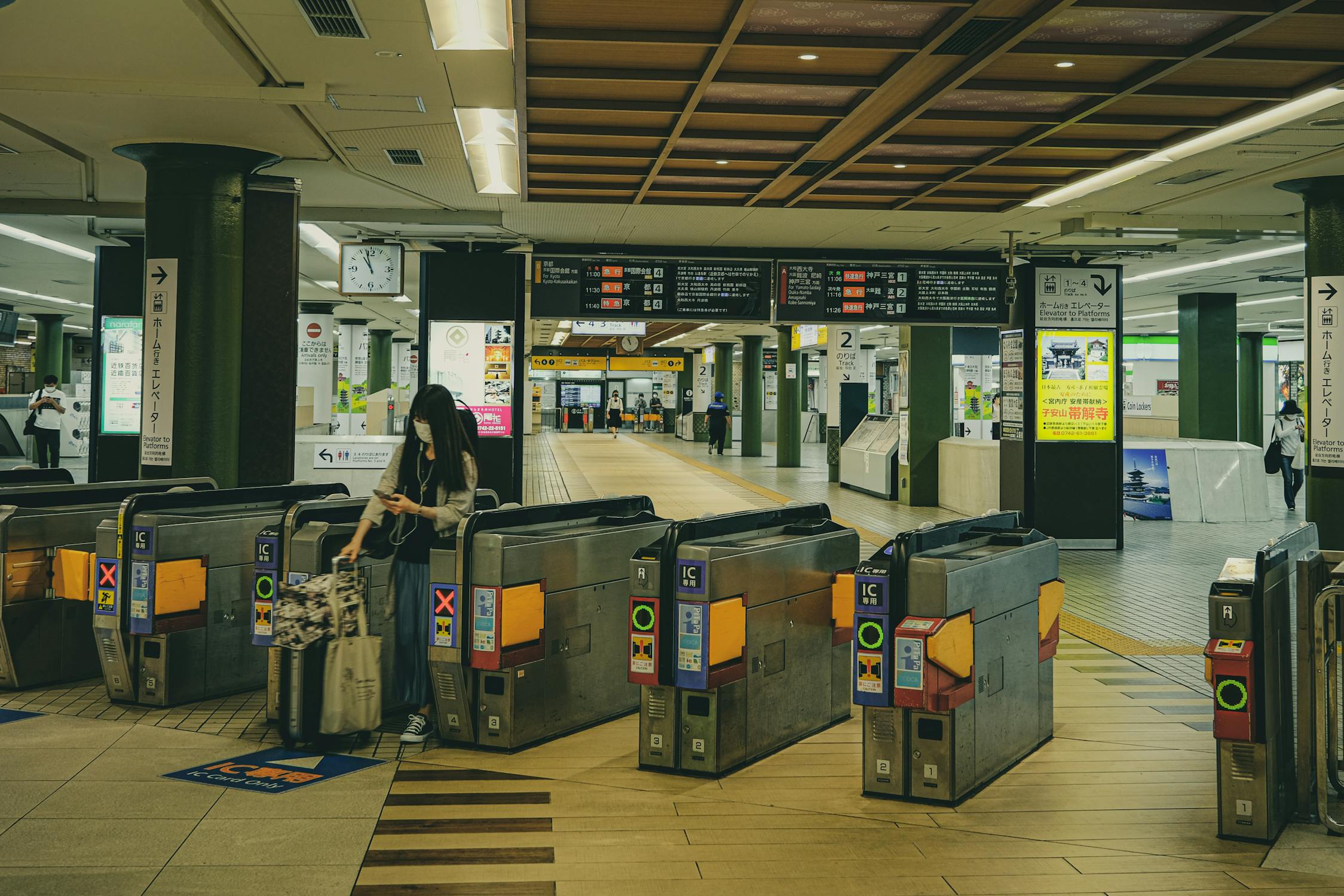
- Walk up to the gate.
- Tap the card flat on the blue or green sensor panel.
- The gate opens and the little screen flashes your remaining balance.
- At your destination, tap again on the way out.
- The fare for the distance you travelled comes off automatically.
Hold the card flat for a beat rather than waving it. A glancing swipe sometimes does not register, and then you get the polite beep of shame and a gate that stays shut.
At a convenience store
Put your things on the counter, and when the cashier asks how you are paying, just say “ICOCA” or point at the card. Tap it on the reader by the register. The receipt prints with your new balance on it. The whole thing takes seconds and needs almost no Japanese.
At vending machines
The newer drink machines around stations have an IC reader on the front. Tap the card, hit the button for your drink, and the fare comes off. Older machines tucked into residential streets often still want coins, so keep a little change on you.
How to recharge
At a station
- Find an IC charge machine, which is not the same as the regular ticket machine, though they sit side by side.
- Slot the card in.
- Feed in cash. Bills only, 1,000 yen minimum, up to a 20,000 yen ceiling.
- Check the new balance on screen.
- Take the card back, now topped up.
At a convenience store
Even quicker. Step up to the register and say “ICOCA charge, 1,000 yen” or whatever amount you want. Hand over the cash, tap the card, done. Clerks at any 7-Eleven, FamilyMart, or Lawson do this dozens of times a day.
The thing that catches everyone out
You cannot top up a physical ICOCA with a credit card. Cash only, full stop. People assume a contactless card must take contactless payment and find out otherwise at a machine that only has a bill slot. Keep a few 1,000 yen notes set aside for recharges. The one exception is Mobile ICOCA on iPhone, where Apple Pay handles credit-card top-ups.
How much to load on it
Most single Osaka subway rides land somewhere between 190 and 290 yen, so the starting 1,500 yen covers a fair bit of moving around already. Here is a rough guide so you are not over-loaded with a card you then have to refund.
- One day: the 1,500 yen it comes with is plenty.
- Three days of heavy riding plus convenience-store taps: around 3,000 yen.
- A week: 5,000 to 7,000 yen.
- Ten days to two weeks: about 10,000 yen.
You can always add more at a station in 30 seconds, so when in doubt, load less. Getting an over-stuffed balance refunded is a minor errand you would rather skip on your last morning.
ICOCA, Suica, PASMO: any real difference?
For a traveller, no meaningful difference. They are the same technology issued by different companies for different home regions.
- ICOCA comes from JR West and is the Kansai default. Mascot: the platypus.
- Suica comes from JR East in Tokyo. Mascot: a penguin.
- PASMO comes from the Tokyo private railways.
All three work across the country. If you already picked up a Suica or PASMO in Tokyo, keep using it in Osaka and skip buying anything new. An ICOCA bought in Osaka works the other way round in Tokyo just as well. The only reason to specifically reach for ICOCA is that your trip starts in Kansai.
Getting your deposit back
- Go to any JR West ticket office, the Midori-no-Madoguchi counter.
- Hand over the card.
- Staff give you the remaining balance plus the 500 yen deposit.
- A 220 yen handling fee comes out of any leftover balance, so spend the card down first.
- Leave it untouched for 10 years and it expires, deposit gone with it.
The fee quirk is worth a second look. If you walk in with a near-zero balance, the deposit comes back clean. If you have, say, 1,800 yen sitting on it, they subtract 220 yen before refunding. The neater move is to buy your last bottle of water and your last train ride off the card so the balance is close to nothing, then refund. Or just keep the card. It is good for a decade, and a lot of repeat visitors do exactly that.
Where ICOCA will not help you
- Smaller restaurants and shops that are still cash-only, which is more of them than you would expect.
- Temple and shrine offerings. Those coin boxes want actual coins.
- Older vending machines in quieter neighbourhoods, no reader on the front.
- Many small hotel and ryokan check-ins.
- Taxis, though most take regular credit cards, and you do not tip here anyway.
A few things worth knowing
- Keep a buffer. Try to leave at least 500 yen on the card so a higher-than-expected fare does not leave you stuck at an exit gate.
- Carry a backup 10,000 yen in cash for the cash-only places the card cannot touch.
- Travelling as a group? Everyone needs their own card. One ICOCA cannot pay for two people through a gate.
- Kids ride for less. A Kodomo ICOCA for children aged 6 to 11 applies the half-price child fare automatically.
- Lost card: report it at a JR West office. A registered, personalised card can be reissued; an anonymous one generally cannot, so the balance is gone.
- Staying a month or more? Mobile ICOCA on iPhone is worth it just for credit-card top-ups.
ICOCA versus the sightseeing passes
ICOCA is a pay-per-trip card, which makes it the right default for most people because it never goes to waste. You only ever pay for the rides you take. The day passes are a different bet entirely: you pay a flat fee up front and win only if you ride or visit enough to clear it.
- ICOCA: pay as you go, no break-even to hit. Best for normal, irregular days.
- Osaka 1-Day Metro Pass (around 820 yen): unlimited Osaka Metro, bus, and ferry. Pays off once you make roughly four or more subway hops in a day.
- Osaka Amazing Pass: bundles unlimited Metro with free entry to dozens of paid attractions. It only wins on a packed sightseeing day with several admissions.
The smart combination most visitors land on: run an Osaka Amazing Pass on your one big attraction day, and use ICOCA for everything else. If your trip stretches beyond the city into Kyoto, Nara, or Kobe, weigh the rail passes in our JR Pass and Kansai pass guide instead, since ICOCA covers the fare but not the discount on longer hauls.
ICOCA card FAQ
How much does an ICOCA card cost?
2,000 yen to start. That breaks down to 1,500 yen of balance you can spend plus a 500 yen deposit that comes back when you return the card.
Where can I buy an ICOCA card?
At the JR West ticket office in Kansai Airport, or from a vending machine at any major JR or Osaka Metro station. Both take about five minutes.
Can I use an ICOCA card in Tokyo?
Yes. It works on Tokyo trains, subways, and buses, and on the major networks across the rest of Japan. One card does the whole country.
Do I still need an ICOCA if I have a JR Pass?
Usually yes. A JR Pass covers JR lines, including the Osaka Loop, but not the Osaka Metro subway or private railways like Hankyu and Nankai. For all of that you need an ICOCA, which is why most people carry both.
Can I recharge ICOCA with a credit card?
Not the physical card. That is cash only. Mobile ICOCA on iPhone is the exception, where you top up with a credit card through Apple Pay.
Can I keep my ICOCA for the next trip?
Yes, and plenty of people do. The card stays valid for 10 years from its last use, so you can leave a small balance on it and skip the buy-and-refund routine next time.
Plan the rest of your Osaka transit
The ICOCA is the foundation. Once you have it, the next thing to learn is the network it runs on. Start with the Osaka subway map guide to read the lines, then zoom out to the full Osaka transportation guide for buses, taxis, and intercity routes. First trip to the city? The first-time Osaka tips cover the small habits that make the trains painless. ICOCA is pay-as-you-go, so if you plan a heavy sightseeing day, check it against the fixed-price options in our Osaka day pass comparison.
The IC card is only one of three payment methods you will use here. For where cards work, how much cash to carry and which ATMs take foreign cards, see our guide to paying for everything in Osaka.