Osaka has a nickname locals are proud of: kuidaore no machi, roughly “the town where you eat yourself broke.” It earns it. The street food here is the densest in Japan, four hundred years of standing-counter eating, market stalls, and tachinomi standing bars crammed into a few neon blocks. You’ve got the inventor of takoyaki, a three-metre pork bun statue, oysters shucked at the counter, and beef tendon stewed soft in miso, most of it for the price of a coffee back home. An evening of eating your way around this city is one of the great cheap nights out anywhere.
This guide covers the parts that matter: what to eat, where to eat it, the etiquette that’ll keep you from embarrassing yourself, roughly what it costs, and the local picks the guidebooks tend to miss. Prices below are what stalls were charging as of 2026, so read them as ballpark, not gospel.

Where to eat, in one glance
Six districts do the heavy lifting. Here’s the quick character sketch of each.
- Dotonbori: the neon postcard. Takoyaki, okonomiyaki, crab, giant pork buns, grilled squid. Touristy, loud, unmissable.
- Kuromon Market: “Osaka’s kitchen.” Six hundred metres of covered stalls. Sashimi, oysters, wagyu skewers.
- Shinsekai: the home of kushikatsu. Cheap, gritty, atmospheric, and stuck pleasantly in the past.
- Tenjinbashisuji: Japan’s longest covered arcade, packed with cheap eats and old cafes.
- Umeda underground: the warren of food courts beneath Osaka Station. Sheltered, fast, full of office workers.
- Hozenji Yokocho: a lantern-lit alley off Dotonbori for tiny standing bars and a quieter mood.
What to actually order
You could spend a week eating here and not repeat a dish. These are the ones to prioritise, starting with the three Osaka treats nothing else can replace.
The konamon trinity
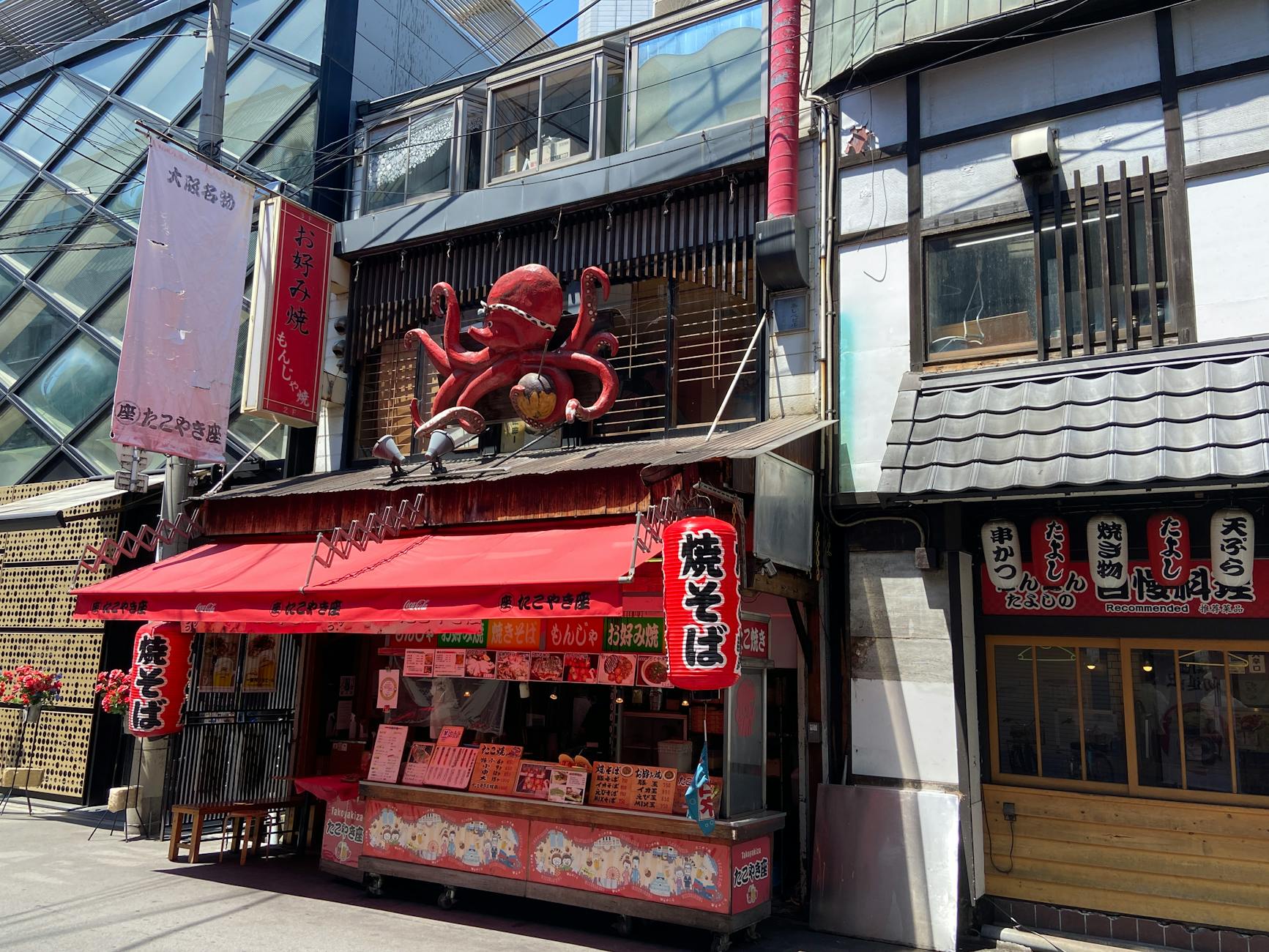
- Takoyaki: wheat-flour balls with octopus, scallion, and ginger inside. Around ¥600 for eight. Best at Wanaka, Juhachiban, or the original Aizuya.
- Okonomiyaki: a cabbage-packed savoury pancake with pork or seafood, cooked on the teppan. ¥1,000 to ¥1,500. Mizuno, Chibo, and Kiji are the names to know.
- Kushikatsu: breaded, deep-fried skewers of almost anything. ¥110 to ¥300 a stick. Daruma and Yaekatsu in Shinsekai are the originals.
The snacks worth a detour
- Butaman (551 Horai pork buns): steamed buns stuffed with pork, ¥190 each. Osaka’s answer to fast food, and the smell on the train is unmistakable.
- Ikayaki: squid pressed flat on a teppan with a sweet-savoury sauce, ¥300 to ¥500. The stall in the Hankyu Umeda depachika has a permanent line for a reason.
- Crab skewer: snow crab leg on a stick from Kani Doraku on Dotonbori, around ¥800.
- Negiyaki: okonomiyaki’s lighter cousin, green onion instead of cabbage, about ¥1,200. Fukutaro does a good one.
- Tonpei-yaki: a thin pork-and-egg omelette with sauce, usually a side at okonomiyaki shops.
- Doteyaki: beef tendon stewed for hours in miso, ¥400 to ¥600 at izakayas. Underrated, and exactly what you want with a cold beer.
Something sweet
- Rikuro Ojisan cheesecake: a whole jiggly cheesecake, warm from the oven, for ¥865. Cult status, and yes, a line.
- Pablo cheese tart: mini or full-size, with the half-baked version as the signature.
- Taiyaki: fish-shaped pancakes filled with sweet bean, ¥150 to ¥250.
- Tamago sando: egg salad on pillowy shokupan, about ¥200 from any Lawson or FamilyMart. Don’t underestimate it.
- Calbee Plus: made-to-order hot potato chips, around ¥500.
- Mochi-cream: soft serve wrapped in mochi, from a few stalls around Dotonbori.
Market plates
- Wagyu skewers at Kuromon, grilled in front of you, ¥800 to ¥1,500 each.
- Oysters shucked to order, ¥300 to ¥500 apiece.
- Sashimi on a stick, ¥500 to ¥800.
- Tamagoyaki, the rolled omelette, ¥300 to ¥500.
- Premium fruit, melon slices and strawberries plated like jewellery, ¥500 to ¥1,500.
Dotonbori: the neon centre
The four-hundred-metre canal is the most famous food strip in the country, and the stretch between Ebisubashi and Tazaemonbashi bridges is wall-to-wall stalls. The giant moving crab, the Glico running man, Wanaka’s takoyaki: this is the shorthand image of Osaka. It’s touristy, sure. Go anyway, but go hungry and graze. The smart play is one or two small things at each of four or five stalls rather than one big sit-down meal, so you taste more and waste less.
- Best time: 18:00 to 21:00, when the neon’s at full blast.
- Don’t miss: Wanaka takoyaki, Kani Doraku crab, 551 Horai buns, Rikuro cheesecake, Daruma kushikatsu.
- Nearest station: Namba.
Kuromon Market: Osaka’s kitchen
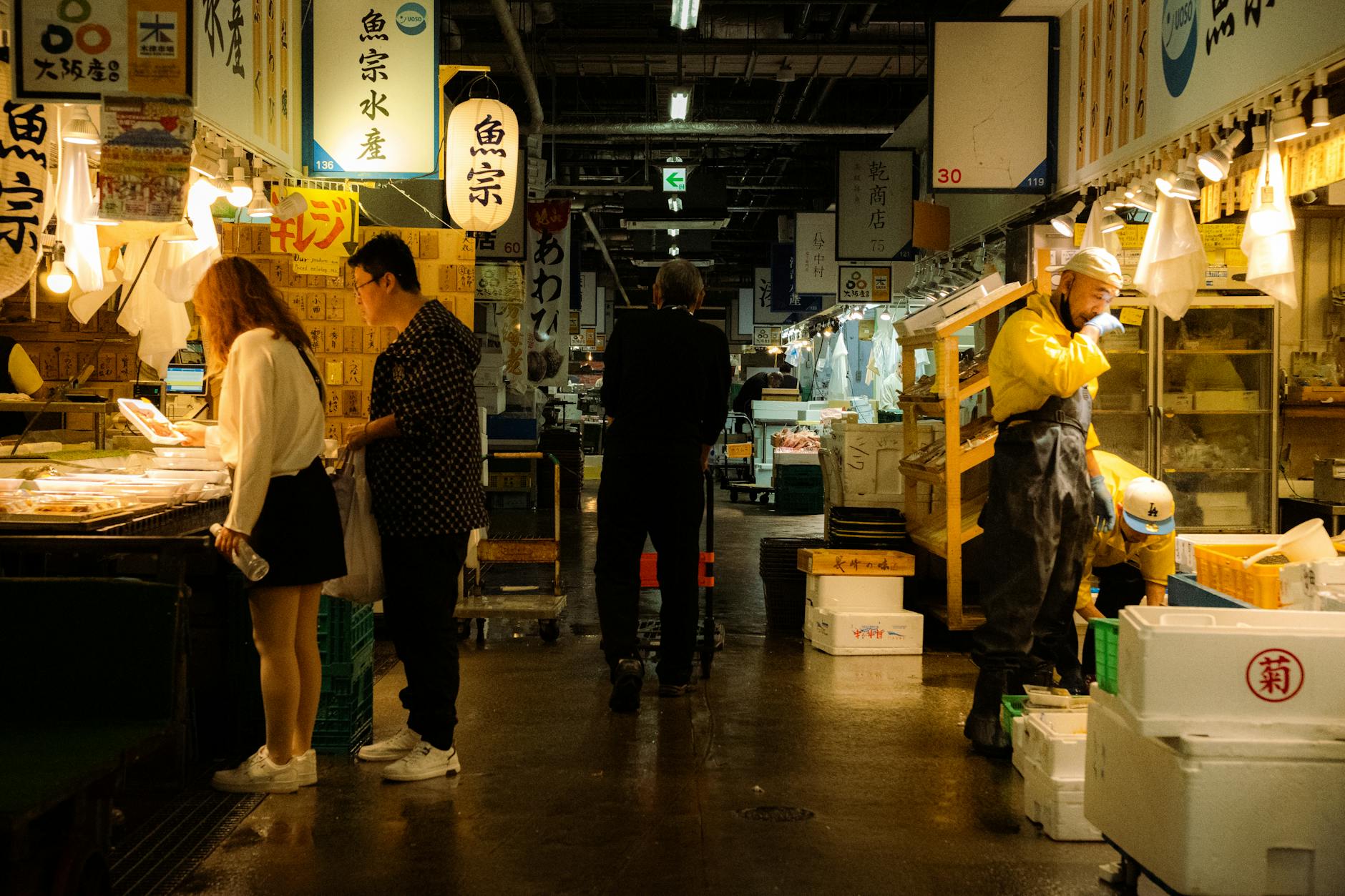
This six-hundred-metre covered market in Nipponbashi has supplied the city’s chefs since 1822. These days it’s split roughly half and half: professional suppliers on one side, tourist-friendly stalls on the other. You come for the fresh stuff eaten on the spot, sashimi skewers, oysters cracked open at the counter, wagyu grilled to order, and fruit presented so carefully it feels like a gallery. Go late morning when it’s busiest and the turnover keeps everything fresh.
- Hours: roughly 9:00 to 18:00.
- Best time: 11:00 to 14:00.
- Budget: ¥2,000 to ¥3,500 a person across four or five stalls.
- Nearest station: Nipponbashi.
Shinsekai: the old town
Shinsekai feels like Osaka half a century ago, and that’s the whole appeal. It’s grittier, cheaper, and more characterful than the polished canal, with Tsutenkaku Tower standing over the middle of it. Kushikatsu Daruma, going since 1929, and Yaekatsu, from 1949, anchor the scene, and a dozen smaller standing counters spread out from there. Order skewers, a bowl of doteyaki, a cold beer, and settle in. Just remember the one rule of the communal sauce pot.
- Best for: kushikatsu, doteyaki, cheap beer, retro photos.
- Cash only at most of the small shops.
- Nearest station: Dobutsuen-mae or Ebisucho.
Tenjinbashisuji: the locals’ arcade
At 2.6 kilometres, this is the longest covered shopping arcade in Japan, and tucked along it are hundreds of cheap eats: old-school kissaten cafes, ramen counters, kushikatsu shops, takoyaki stalls. It’s a genuine local shopping street, far less touristy than Dotonbori, and walking its full length while grazing is a two-to-three-hour project you can do for under ¥3,000. This is where you eat to see how Osaka actually feeds itself day to day.
Umeda underground: the all-weather option
The Whity Umeda, Hankyu Sanbangai, and Sanbankan complexes under Osaka Station hide dozens of fast counter spots, everything from ¥800 ramen to a ¥2,000 grilled-eel set. It’s heaving with office workers at lunch, completely weather-proof, and dead central. Ideal as the first or last meal of an Osaka day, especially when it’s raining sideways outside.
Hozenji Yokocho: the lantern alley
Two blocks off Dotonbori sits an eighty-metre cobblestone lane lined with paper lanterns and tiny izakayas. At its heart is the Mizukake Fudo statue, mossy and dripping because visitors keep ladling water over it to make wishes. The whole alley feels closer to the Edo period than to 2026. Eat a few small dishes here as a deliberate contrast to the neon roar around the corner; it’s the same city in a completely different key.

How grazing actually works here
If you’ve never done a standing-counter food crawl, the rhythm is simple once you’ve seen it. You don’t sit down and order a meal. You walk up to a stall, point or order one or two items, pay, and eat them right there in the few feet of space around the counter. Then you move to the next place and do it again. Nobody expects you to linger, and nobody minds if you eat just one thing and leave.
Two small habits make it smoother. First, have rough cash ready before you order, since fumbling for a card at a cash-only stall holds up the line behind you. Second, keep a small plastic bag in your pocket for the odd wrapper or skewer you can’t bin straight away. Beyond that, follow your nose and watch where the locals stop. The best meal of your trip might be a ¥190 pork bun eaten standing on a corner, and that’s exactly the point of the place.
Timing your eating day
Osaka’s food districts run on different clocks, and lining them up right means you’re always eating something at its best. Mornings belong to the markets. Kuromon is freshest and liveliest from late morning, and by mid-afternoon some of the seafood stalls start packing up, so don’t leave it till evening. The covered arcades like Tenjinbashisuji are an all-day, all-weather bet, good for a long graze whenever.
Dotonbori is an evening animal. It’s fine by day, but the neon, the crowds, and the energy only switch fully on after dark, so save it for after six. Shinsekai works both ways: atmospheric in the late afternoon light, and properly lit once Tsutenkaku comes on at night. If you’re planning a single big eating day, a clean run is markets at lunch, arcade grazing in the afternoon, then Dotonbori and Shinsekai as the sun goes down. That sequence keeps you moving and keeps everything in its prime window.
The etiquette, which actually matters
Street food in Japan comes with a handful of conventions. They’re easy, and following them is the difference between blending in and being the obvious tourist.
- Don’t walk and eat. Stand at the stall, eat there, then move on. This one’s close to non-negotiable.
- Bin your trash at the stall. Public bins are genuinely scarce. The vendor has one; use it.
- Never double-dip. At kushikatsu shops the sauce is communal. One dip per skewer, before you bite. Break this and you’ll get a look.
- A quiet “itadakimasu” and “gochisousama” before and after is a small, appreciated gesture.
- Don’t tip. It isn’t done.
- Carry cash. Plenty of small stalls take nothing else. Keep a ¥10,000 note and some coins on you.
What it all costs
This is cheap eating by any standard, and you control the spend by how you graze. A single snack runs a few hundred yen; a proper sit-down at a famous okonomiyaki shop is the priciest thing you’ll do. Here’s the rough shape of it.
- One snack stall: ¥300 to ¥800.
- A small meal at a standing counter: ¥800 to ¥1,500.
- Sit-down at a famous okonomiyaki shop: ¥1,500 to ¥3,000.
- A Dotonbori grazing crawl: ¥2,500 to ¥4,000.
- A Kuromon buy-and-try round: ¥2,000 to ¥3,500.
- A generous full eating day: ¥4,000 to ¥6,000 a person.
A four-hour evening crawl
Want a route that strings the best of it together? This one runs from early evening to closing time and hits three districts. Adjust to taste.
- 17:30: arrive at Namba Station, walk over to Hozenji Yokocho.
- 17:45: ladle water over the Mizukake Fudo, then a small dish at any tiny izakaya, around ¥1,000.
- 18:30: on to Dotonbori for Wanaka takoyaki, ¥600.
- 19:00: a 551 Horai pork bun, ¥190, and a Rikuro cheesecake to share, ¥865.
- 19:45: hop the subway to Shinsekai, about ten minutes, for Daruma kushikatsu, roughly ¥2,000 for twelve skewers.
- 21:00: Tsutenkaku lit up overhead, then back toward Dotonbori for a late ramen, about ¥900.
- 22:00: done. Total spend somewhere around ¥5,500 to ¥6,500, and one of the better cheap nights out in Asia.
Prefer a guide?
If you’d rather have someone who knows the backstreets do the navigating, a few operators run solid food tours. They’re not cheap, but a good guide gets you past the language barrier and into places you’d walk right past.
- byFood Osaka Foodie Tour: about three hours, five or six stops, ¥7,500 to ¥10,000.
- MagicalTrip Dotonbori Backstreet tour: a local English-speaking guide and stops well off the tourist track.
- Osaka Local Foodie Bar Hopping tour: izakaya-focused, built for adults.
- Klook Kuromon Market walking tour: ¥6,000 to ¥8,000.
Eating here with dietary limits
Osaka street food is built around wheat batter, pork, and fish stock, so some diets take real planning. A clear-eyed look at where you stand:
- Vegetarian: doable with effort. Vegetable kushikatsu, plain okonomiyaki without pork, a tamago sando, taiyaki, and the fruit at Kuromon all work.
- Vegan: hard, because dashi (fish stock) hides in nearly every batter and broth. Your best bet is the Buddhist temple cafes outside the food districts.
- Gluten-free: equally tough, since wheat batter is everywhere. Sashimi at Kuromon is the safe harbour.
- Halal or kosher: beef tallow in the frying oil rules out most kushikatsu shops. A handful of specialist restaurants exist, but you’ll need to research ahead.
Osaka street food: FAQ
What is the most famous Osaka street food?
The “konamon trinity” defines it: takoyaki, okonomiyaki, and kushikatsu. All three were either invented in Osaka or made famous here, and you’ll find them on practically every food street in the city.
Which district has the best street food?
Dotonbori is the most famous and the easiest to graze. Kuromon Market wins for fresh seafood and produce. Shinsekai is the pick for kushikatsu and old-Osaka atmosphere. Most people hit at least two of the three.
How much should I budget for a street food night?
Around ¥3,000 to ¥6,000 a person for a full evening of grazing across multiple stalls. Single snacks run ¥300 to ¥800, and sit-down dishes ¥1,000 to ¥3,000.
Is Osaka street food safe to eat?
Yes. Japan’s food-safety standards are very high, and even the smallest standing counters keep clean kitchens. Stomach trouble from street food here is rare.
Can I eat while walking?
Better not to. The convention is to eat beside the stall, bin your trash there, then move on. Walking around eating is read as a bit rude, and on a packed Dotonbori you’ll be in everyone’s way anyway.
Do vendors take cards?
The bigger and chain vendors usually do. Small standing counters and family-run stalls are often cash only, so carry ¥10,000 to ¥20,000 for a street food night to be safe.
What to skip, and how not to get caught out
Not everything on a packed food street is worth your stomach space. A few honest steers to keep your eating sharp.
- The flashiest Dotonbori stalls aren’t always the best. Some of the most photogenic spots coast on location and lighting. The giant signs draw the crowds; the food behind them is sometimes ordinary. Watch where the local office workers queue instead.
- Skip the second mediocre takoyaki. If the first plate from a random stall is gummy or light on octopus, don’t double down. There’s a better counter within a block, always.
- Premium fruit is a treat, not a meal. A ¥1,500 melon slice at Kuromon is gorgeous and genuinely good, but it’s a luxury splurge. Know that going in.
- Watch the per-piece market pricing. Some Kuromon stalls price seafood by the piece at numbers aimed squarely at tourists. Glance at the sign before you commit, and you’ll eat just as well for less a stall over.
- Don’t over-order at the first stop. The whole game is grazing. Fill up on one big plate early and you’ll miss four other things you wanted. Small portions, keep moving.
Plan the rest of the eating
Street food is the beating heart of an Osaka trip, but there’s more on the plate. Dig into the best takoyaki in Osaka for the full octopus-ball rundown, line up a bowl from the best ramen in Osaka guide, and use the complete Osaka food guide to fold okonomiyaki, kushikatsu, and the markets into the rest of your days.