Here is the short version: in Osaka you almost never need a taxi, and when you do need one it works beautifully. The subway and trains cover the city so well, and so cheaply, that a cab is usually the lazy choice rather than the smart one. But there are nights when it is exactly right. The trains in Osaka stop running around midnight, and when you are standing outside a Namba izakaya at 1am with two friends and tired feet, the math changes fast.
So treat the taxi as a tool for specific jobs: the after-midnight ride home, the airport run when you are hauling three suitcases, the 800-metre hop in driving rain. Used that way it is genuinely useful. Used as your default it will quietly drain your trip budget. This guide walks through what a ride actually costs in 2026, which apps are worth installing, how to hail one off the street and skip the booking fee, and the small etiquette things that trip up first-timers (the doors, for one, open on their own).

What a taxi actually costs in 2026
Meters in Osaka start at ¥600 the moment you sit down, which buys you the first 1.3 km. After that it ticks up ¥80 for every 200 metres, and the same ¥80 every minute or so when you are crawling in traffic and the wheels aren’t turning. Between 22:00 and 05:00 the whole meter runs 20 percent higher. If you book through an app rather than flagging one down, add a ¥300 to ¥400 dispatch fee on top. Tolls, if your driver takes an expressway, get passed straight to you.
None of that tells you much until you put real trips against it. A few honest numbers, with the subway alternative in brackets so you can see the gap:
- Umeda to Namba (about 5 km): ¥1,300–¥1,800. The Midosuji subway does the same run for ¥240 in roughly 8 minutes.
- Umeda to Osaka Castle: ¥1,500–¥2,000. Subway is ¥240, about 9 minutes plus a walk.
- Namba to the Aquarium (Kaiyukan): ¥1,800–¥2,500. Subway ¥240, around 25 minutes.
- USJ to Namba: ¥3,500–¥5,000. Train ¥240, about 25 minutes.
- Kansai Airport (KIX) to Namba: ¥16,000–¥18,000. Do not do this. More on the airport below.
- Late-night Umeda to Namba with the surcharge: ¥1,560–¥2,160, and by this hour the last train has usually gone anyway.
The pattern is obvious. For point-to-point hops inside the city the subway wins on price by a factor of five to ten, every single time. Where a taxi earns its fare is in the situations where the subway isn’t an option, or where splitting one fare across four people brings the per-head cost down to something reasonable.
The ride apps, ranked by how useful they actually are

One thing to understand before you download anything: ride-hailing in Japan is not what it is in most countries. There is no fleet of private cars driven by app workers. Every one of these apps simply summons a licensed taxi from an existing company and routes the booking and payment through your phone. So whatever you open, the car that pulls up is a proper metered cab with a professional driver. The apps differ in their interface, their English support, and a few extras, not in the vehicle.
GO — the one to install first
GO is the Japanese default and the app most locals use. It speaks English, pulls cars from the major fleets, tracks your ride on a map, and lets you pay by saved card so you never touch cash at the end. If you only put one taxi app on your phone, make it this one. You still pay the meter plus the ¥300–¥400 dispatch fee, but the reliability is worth it when you are away from a main road and can’t see an empty cab.
Uber — familiar, identical underneath
Uber works in Osaka, and if you already have the app and your card is loaded, it is a perfectly fine choice. Just know that it is doing the same thing GO does: dispatching a regular taxi. The fare comes out the same, the dispatch fee is the same ¥300–¥400. The only real reason to use it over GO is that the interface is already familiar and set up.
DiDi — worth it for the fixed fare
DiDi has English support and one feature the others are weaker on: fixed-fare rides that lock the price before the driver sets off. That is genuinely handy when traffic is unpredictable and you don’t want a meter creeping up while you sit at lights. If you are heading somewhere at a notoriously slow time of day, it is worth a look for the certainty alone.
S.RIDE and NearMe — narrower uses
S.RIDE is a Japanese app that grew up in Tokyo and has been spreading into Osaka. It works, but its English is thinner than GO or Uber, so it is a backup rather than a first choice. NearMe is a different animal entirely: it specialises in shared airport transfers you book ahead at a fixed per-person price. That makes it irrelevant for getting around town but genuinely useful for the KIX-to-hotel run, which we will come back to.
Flag one down and skip the booking fee
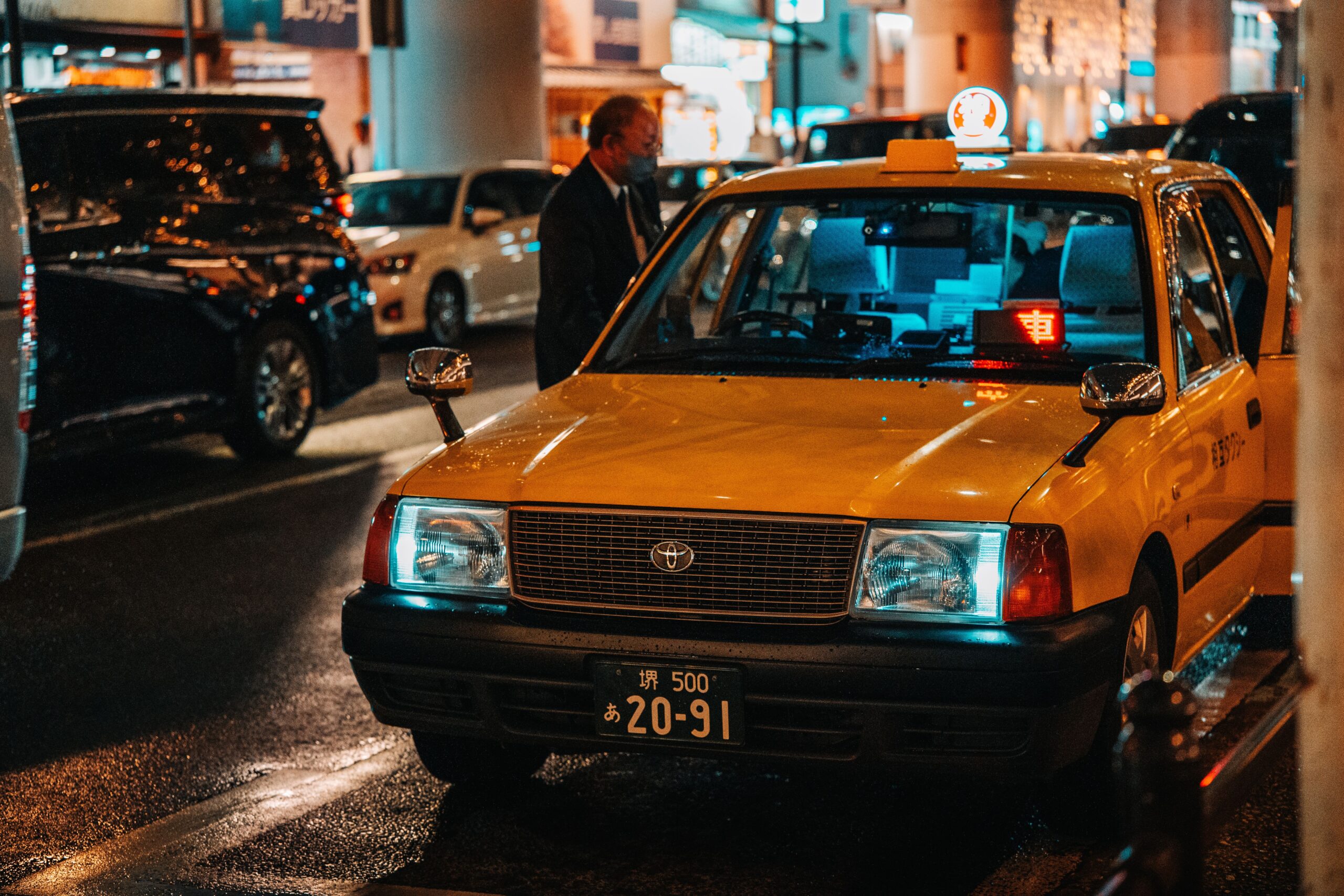
That ¥300–¥400 dispatch fee only applies when an app calls the car. Wave one down on the street and you pay the meter and nothing else. In central Osaka, around Umeda, Namba, Shinsaibashi and the main thoroughfares, empty cabs cruise past constantly, around the clock. There is rarely any need to book.
Reading whether a cab is free is simple once you know the trick. Look at a small illuminated sign in the lower corner of the windscreen. A red character (空車, meaning vacant) means it is available. Stick out a hand and the driver will pull over and the rear left door will swing open on its own. That is it.
Street-hailing is the right call most of the time. Lean on the apps when you genuinely can’t, and those moments are easy to predict:
- You can’t explain the destination out loud and want the app to handle it.
- You are out in a quieter suburb where empty cabs don’t cruise past.
- You want a fixed-fare quote before you commit (DiDi).
- It is hammering down rain and standing on a kerb waving your arm has lost its appeal.
Whichever way you summon the car, have the destination ready in Japanese on your phone, or at minimum pulled up on a map. A pin a driver can glance at removes any doubt, and it is the single thing that makes a language gap a non-issue.
When a taxi beats the train, and when it doesn’t
Rather than a rule, think in scenarios. There is a fairly short list of moments when a cab is the right answer in Osaka:
- After the trains stop. The last services run around midnight. Past that, a taxi is often the only way home short of waiting for the first train at dawn.
- Before the trains start. A pre-dawn flight or an early bullet train can leave you needing to move before the subway opens.
- Heavy luggage. Wrestling two big suitcases through ticket gates and up station stairs is miserable. A cab door-to-door is worth the fare here.
- A group of four. Split a ¥1,600 fare four ways and you are at ¥400 a head, right in subway territory, with door-to-door comfort thrown in.
- Short hops in real rain. A 1–2 km ride for around ¥800 can beat a 20-minute walk plus a ¥240 subway leg when the sky has opened. This is the taxi’s quiet sweet spot.
Outside those, take the train. The Osaka Metro is fast, runs every few minutes, and costs a fraction of a cab. If you are still working out the lines and transfers, our Osaka subway map guide lays out the colour-coded network and the transfers worth knowing. Pair it with an ICOCA card so every tap, on trains and in many cabs, comes off one balance.
Groups, families and the late-night maths
The single situation where a taxi flips from indulgence to obvious choice is four people heading the same way after the trains have stopped. A ¥1,600 fare split four ways is ¥400 a head, the same as the subway would have cost when it was running, and you skip the walk to the station and the wait on the platform. With three or four of you, the per-person sums on most in-city rides stop looking extravagant.
Families travelling with small children get a similar deal in reverse: the hassle saved is worth more than the fare. Wrangling a tired toddler and a stroller down station stairs and onto a packed Midosuji train at the end of a long day is its own special misery, and ¥1,500 to be dropped at the hotel door is money most parents will hand over gladly. Child seats aren’t standard, so a young child rides on a lap or belted in beside you; mention it if you book through an app and need something specific.
If your group is bigger than four, you are into two-cab territory or, for an airport run, a shared-ride service like NearMe that quotes a fixed per-person price for a larger vehicle. For everyday city moves with five or more, though, the subway usually still wins, splitting two taxi fares rarely beats five ICOCA taps.
Paying, and the no-tipping rule
Payment is refreshingly flexible. Cash always works. Most cabs take the major credit cards (Visa, Mastercard, JCB, Amex, Diners), though a small independent here and there may still be cash-only, so keep a few notes on you as backup. IC cards work too: tap your ICOCA, Suica or PASMO on the dashboard reader. A long list of QR wallets is accepted as well, PayPay, Rakuten Pay, d Barai, au Pay, Alipay, WeChat Pay and more, if that is how you usually pay.
And do not tip. It is not a thing in Japan and a driver may well chase after you assuming you forgot your change. If you need the fare for an expense claim, ask for a receipt: the word is レシート (reshito), and they will print one without fuss.
The small etiquette stuff that catches people out
- The rear left door is automatic. The driver opens and closes it from a lever up front. Don’t reach for the handle, and don’t slam it shut yourself. Just step in, and step out, and let it do its thing.
- Show, don’t tell. If there is no shared language, a map view on your phone with a dropped pin does the whole job. It reads the same in any language.
- Keep a Japanese version handy of your destination as a backstop, a hotel card or the name in characters.
- Buckle up and skip the small talk if the driver isn’t initiating it; chitchat isn’t expected.
- No smoking.
The airport: where a taxi is simply the wrong tool
A cab from Kansai International Airport into central Osaka runs ¥16,000–¥18,000 and can take well over 50 minutes in traffic. There is no scenario where this is the right call for one or two people. The alternatives are faster, vastly cheaper, and just as comfortable:
- Nankai Rapi:t Express: ¥1,490, about 38 minutes straight to Namba. The quick, cheap default.
- JR Haruka Express: ¥3,200, roughly 50 minutes to Tennoji and Shin-Osaka.
- Limousine bus: ¥1,600–¥1,800, around 50–70 minutes, and it drops at major hotels, so handy with luggage.
- NearMe shared ride: ¥4,000–¥5,500 per person at a fixed price, the closest thing to door-to-door without the eye-watering meter.
For the full breakdown of every airport route, including which one suits which arrival time, see our Kansai Airport to Osaka transfer guide.
Premium and specialty services
- MK Taxi: a premium fleet known for English-speaking drivers and high service standards. There is a minimum around ¥3,000, so it is not for short hops, but it shines for a polished airport pickup or an important transfer.
- Sightseeing taxis: half-day (4-hour) or full-day private tours by cab, roughly ¥30,000–¥45,000. Pricey, but for a family or an older traveller who would rather not navigate trains, it can be money well spent.
- Wheelchair-accessible cabs: available through GO and the larger fleets; flag the requirement when you book.
- Pet taxis: a handful of Osaka firms run these for travellers with animals.
Common routes at a glance
| From | To | Taxi (approx) | Subway alternative |
|---|---|---|---|
| Umeda | Namba | ¥1,300–¥1,800 | ¥240 / 8 min |
| Umeda | Osaka Castle | ¥1,500–¥2,000 | ¥240 / 9 min |
| Namba | Aquarium (Kaiyukan) | ¥1,800–¥2,500 | ¥240 / 25 min |
| USJ | Namba | ¥3,500–¥5,000 | ¥240 / 25 min |
| KIX | Namba | ¥16,000+ | ¥1,490 / 38 min |
| Umeda → Namba (late night) | — | ¥1,560–¥2,160 (+20%) | Last train ~midnight |
Osaka taxi FAQ
How much is a taxi in Osaka?
The meter starts at ¥600 for the first 1.3 km, then adds ¥80 every 200 metres. A typical 5 km ride across the city lands around ¥1,300–¥1,800. Between 22:00 and 05:00 the whole fare runs 20 percent higher.
Is Uber available in Osaka?
Yes, but Uber in Japan dispatches a regular licensed taxi rather than a private gig driver. The fare is the metered fare plus a ¥300–¥400 dispatch fee, the same as GO.
Are Osaka taxis safe?
Very. Drivers are licensed and the fleets are well run, the cars are clean and modern, and the meter is honest. There is no haggling and no detour-padding to worry about.
Do Osaka taxis take credit cards?
Most do, including Visa, Mastercard, JCB, Amex and Diners, and you can also tap an ICOCA or Suica on the dashboard reader. A few small independents remain cash-only, so carry some notes as a backup.
Should I tip an Osaka taxi driver?
No. Tipping isn’t customary in Japan, and a driver may chase after you to hand back what looks like forgotten change. Pay the meter and that is the whole transaction.
Can I take a taxi from KIX to central Osaka?
You can, but it costs ¥16,000 or more and takes 50-plus minutes. The Nankai Rapi:t (¥1,490) or a limousine bus (around ¥1,800) get you there faster for a fraction of the price.
Bottom line
Keep GO on your phone for the rare moment you need a car you can’t see, learn to read the red 空車 sign so you can flag one and dodge the booking fee, and remember the cab is for the after-midnight run, the heavy-luggage day, and the downpour, not for getting between sights. For everything in between, the trains have you covered. Plan the rest of your movements with the full Osaka transportation guide.