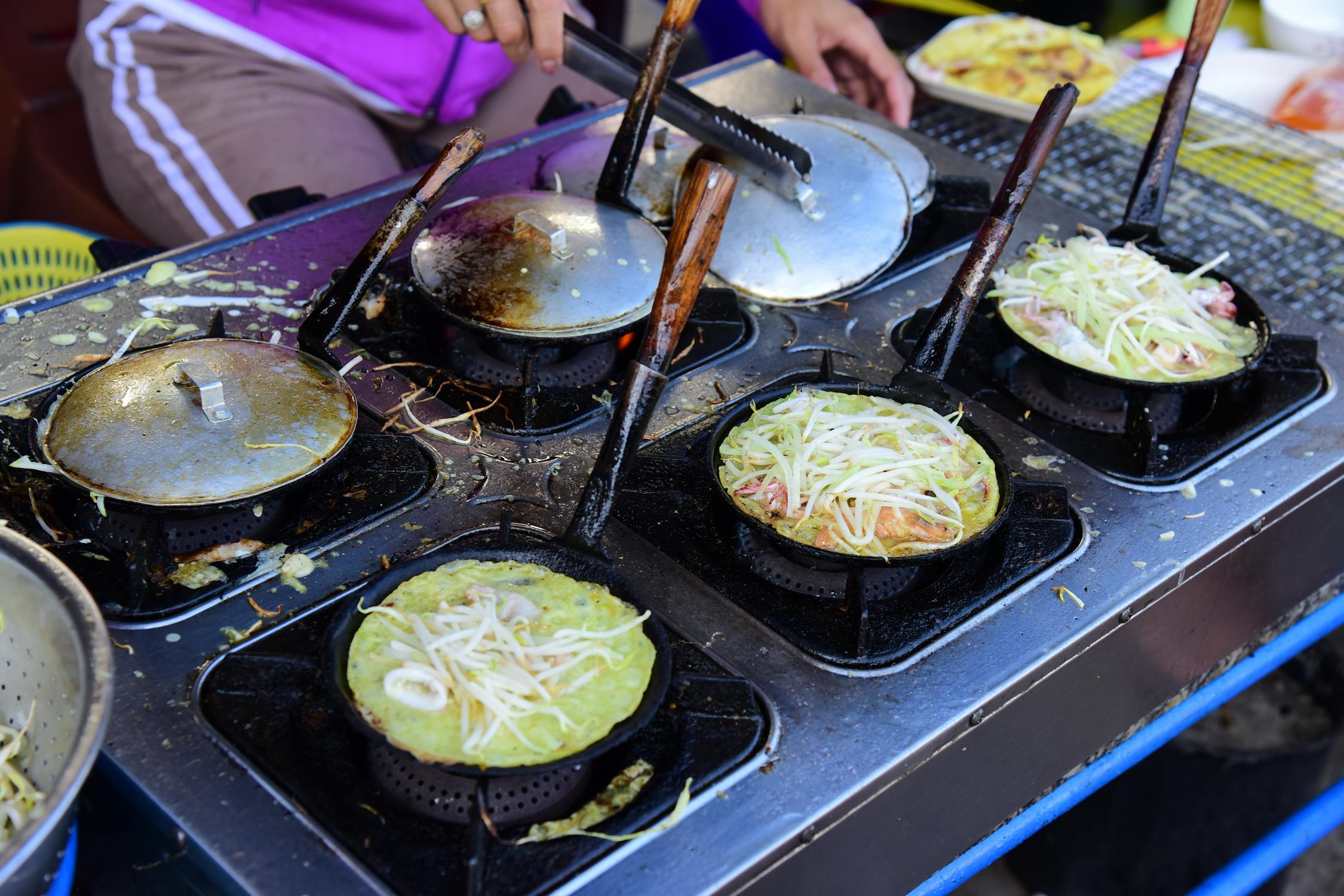
Okonomiyaki — “grilled as you like it” — is Osaka’s other defining dish, and people keep handing first-timers two lazy descriptions: “Japanese pizza” and “savoury pancake.” Both undersell it. The real thing is a wheat-and-egg batter loaded with a mountain of shredded cabbage and your choice of pork, seafood, beef, or vegetables, cooked on a hot teppan, then finished with thick brown sauce, mayonnaise, bonito flakes, and aonori seaweed. It’s hearty, endlessly customisable, and sits right at the centre of working-class Osaka food.
This 2026 guide rounds up the best okonomiyaki in Osaka — the Michelin-listed Mizuno that skips flour entirely, the Chibo flagship in Dotonbori that everyone’s heard of, the green-onion negiyaki at Fukutaro, the local-favourite Kiji tucked under the Umeda Sky Building — plus how to order, how to cook it if the shop hands you the spatula, and how to tell a good okonomiyaki shop from a tourist trap.
Pick your shop fast
- Most decorated: Mizuno (Dotonbori) — Michelin Bib Gourmand six years running.
- Most famous, still good: Chibo (Dotonbori) — the okonomiyaki everyone knows.
- Best negiyaki: Fukutaro (Namba) for the green-onion variant.
- Best near Umeda: Kiji under the Umeda Sky Building, and Botejyu’s branches.
- Most local: Yukari (Honmachi) and Kazuya (Tennoji).
- Most refined: Sanpei in Hozenji Yokocho.
Osaka vs Hiroshima: know the difference before you order
If you’ve read anything about okonomiyaki, you’ve run into the regional rivalry. Two camps. Osaka-style mixes the cabbage and ingredients straight into the batter and cooks it as one thick pancake, with your toppings of choice — pork, squid, kimchi, mochi — added before the flip. Hiroshima-style layers everything instead: a thin crepe base, then a tall pile of cabbage, then yakisoba noodles, then a fried egg, then the meat, stacked rather than stirred.
Both are great, and this is not a fight you need to pick a side in. In Osaka you’ll be served the local style by default, and a few specialist shops offer Hiroshima-yaki as an option. For a first okonomiyaki in this city, stick with the Osaka version. That’s what the city does best, and it’s what the shops are built around.
Where to eat it
Mizuno — the Michelin-listed original
Mizuno opened in Dotonbori in 1945 and has held the Michelin Bib Gourmand six years straight. Its signature is the Yamaimoyaki, where grated yamaimo (mountain yam) replaces the wheat flour entirely, giving an almost soufflé-light texture you won’t get anywhere else. The standard Pork Tama is excellent too. The catch is the queue, which can run past an hour at peak.
- Where: 1-4-15 Dotonbori, Chuo-ku.
- Hours: 11:00–22:00 daily; closed the first Monday of the month.
- Price: ¥1,400–¥2,800 per okonomiyaki.
- Order: Yamaimoyaki, Pork Tama, or the seafood Tokujo Yaki.
- Wait: 30 to 90 minutes on weekend evenings. Go at lunch.

Chibo — the famous flagship
Chibo is the most internationally known okonomiyaki name in Osaka, and the Dotonbori main branch is the flagship — multiple floors, English menus, and a kitchen-bar where you watch your pancake cooked in front of you. It’s crowd-friendly, consistent, and photogenic, which is exactly why it’s packed. The signature Modern-yaki folds yakisoba noodles into the pancake.
- Hours: 11:00–24:00.
- Price: ¥1,200–¥2,800.
- Order: Dotonbori-yaki (the house signature) or Modern-yaki with yakisoba.
Fukutaro — the negiyaki godfather
Fukutaro is the name to know for negiyaki, the variant that swaps cabbage for green onions. They pack roughly a pound of negi into a single pancake, and it’s earned its own Michelin Bib Gourmand nod. Less famous than Mizuno or Chibo, but if you want one okonomiyaki experience that’s genuinely different, this is it.
- Where: 2-3-17 Sennichimae, Chuo-ku.
- Hours: 17:00–24:00; closed Sundays.
- Price: ¥1,300–¥2,500.
- Order: the pork negiyaki.
Kiji — the Umeda local favourite
Down in the basement of the Umeda Sky Building, the Takimi Koji passage does a 1920s-European-street pastiche, and tucked inside it is Kiji, a tiny, atmospheric shop locals rate highly. The Kiji-yaki with pork and yakisoba is the order. The line can look long, but the shop turns over fast, so it moves quicker than it appears.
- Where: Takimi Koji, Umeda Sky Building basement.
- Hours: 11:30–21:00; closed Sundays.
- Price: ¥900–¥1,500.

Botejyu, Yukari, Kazuya, Sanpei
Botejyu claims to be the shop that first put mayonnaise on okonomiyaki back before the 1950s, and it has reliable, family-friendly branches with English menus across Dotonbori, Umeda, and Shinsaibashi. For something more local, Yukari is a 1950s holdout in the Honmachi business district, cooked on the table teppan in front of you and full of salarymen at lunch. Kazuya, down in Tennoji, is a family-run, cash-only spot where the tonpei-yaki (a thin pork omelette) is a standout alongside the okonomiyaki. And Sanpei, in the lantern-lit Hozenji Yokocho alley, does modern, seasonal interpretations — smaller portions, more polish, slightly higher prices.

How to order, and how to cook it yourself
Two things to sort first: which protein you want, and whether the shop cooks it or hands you the spatula. For the protein, “buta-tama” is pork, “gyu-tama” is beef, “mix” gets you pork, squid, and shrimp, and most shops will add cheese or kimchi on request. “Modern-yaki” means yakisoba noodles are built in. Then the format: some shops hand you the bowl and a table teppan to cook on yourself; others have a chef cook it on a counter griddle while you watch. The staff will make it clear which kind of place you’re in.
If you’re cooking it yourself, the sequence is forgiving. Mix the bowl thoroughly and pour it onto the hot teppan in a round. Leave it about five minutes, then lay your pork strips on top. Flip the whole thing with the metal spatula — the kotegaeshi move — and give it another three minutes. Add the sauce, mayo, bonito, and aonori, cut it into wedges with the spatula, and eat straight off the teppan, which keeps it hot to the last bite. Drink a beer or an oolong tea with it; a highball works too.
Variations worth trying
- Pork Tama (buta-tama) — the classic: pork belly and cabbage.
- Modern-yaki — with yakisoba noodles built in.
- Mix — pork, squid, and shrimp.
- Negiyaki — cabbage swapped for green onions. Lighter.
- Hiroshima-yaki — the layered Hiroshima style, at shops that offer it.
- Yamaimoyaki — mountain yam in place of flour. Mizuno’s specialty.
- Cheese-tama — cheese mixed in, an easy starter version.
- Kimchi-tama — spicy Korean kimchi, increasingly common.
- Tonpei-yaki — a thin pork-and-egg omelette, usually ordered on the side.
The sauce, the mayo, the toppings
Otafuku sauce is the standard finish — sweet, tangy, and dark — though some shops make their own. Kewpie mayo goes on in a lattice; traditional Osaka style is heavy with it, but you can ask to skip it. Aonori (green seaweed flakes) gets sprinkled over the top, and katsuobushi (bonito flakes) curl and wave in the heat, which is the photogenic moment everyone films. Beni-shoga, the red pickled ginger, sits on the side, optional.
A three-stop okonomiyaki crawl
If you want to taste the range in a day, this run hits three distinct styles for around ¥5,500.
- Lunch: Mizuno (Dotonbori) for the Yamaimoyaki and a Pork Tama — about ¥3,500 for two okonomiyaki.
- Snack: tonpei-yaki at Sanpei (Hozenji) for ¥800.
- Late dinner: Fukutaro for the negiyaki — ¥1,500–¥2,000.
Make your own: cooking classes
Several Osaka cooking schools run two-hour, English-friendly okonomiyaki classes for ¥4,000 to ¥6,000. You learn the batter ratios (cabbage to flour to dashi), the fold-and-flip, and you eat what you make. It pairs well with a takoyaki class for a half-day food workshop. Book through Klook, KKday, or Airbnb Experiences.
Practical tips
- Reserve where you can. Mizuno, Fukutaro, and the busiest Dotonbori spots run walk-in queues; some take bookings by phone (a few in English) or via TableCheck.
- Lunch beats dinner. Waits run 30 to 50 percent shorter at almost every shop.
- Wear clothes you don’t mind smelling of smoke. Some people bring a plastic bag for their jacket.
- Splitting for two? Order one okonomiyaki plus one tonpei-yaki to try two dishes at once.
- Cash and card: most major shops take cards now; the small spots are often cash-only, so keep ¥3,000–¥5,000 on hand.
How to tell a good okonomiyaki shop
A great okonomiyaki is light despite its size — fluffy in the middle, a little crisp where it met the griddle, never gluey. The difference comes down to cabbage and patience. Shops that use a lot of finely shredded cabbage and a relatively loose batter get air into the pancake; shops that skimp on cabbage and over-flour it produce a dense brick. You can often tell from the menu prices and the queue, but the real test is the first bite: it should hold together yet almost steam apart, not sit in your stomach like dough.
- Cabbage-forward, not flour-forward. The best versions are mostly cabbage bound by just enough batter.
- Let the chef cook it if they offer. At places like Mizuno, the staff cook it precisely; don’t insist on doing it yourself.
- Don’t press it flat. If you are cooking your own, resist mashing it with the spatula — that’s the rookie move that kills the texture.
- A long, fast-moving line usually beats an empty room, the same as with any Osaka food.
Where okonomiyaki sits in Osaka’s food culture
Okonomiyaki belongs to konamon — “flour things” — the family of cheap, filling, flour-based dishes that defined how working Osaka ate through the lean decades of the twentieth century. Takoyaki and kushikatsu are its siblings. The dish is democratic by design: a base of batter and cabbage that stretches a little meat a long way, customised to whatever was on hand or in the budget. That history is why even the Michelin-listed shops keep the format casual and the prices reasonable. This was never restaurant food; it was home-and-corner-shop food that happened to get very good.
It also explains the cook-it-yourself shops. Okonomiyaki started as something families made on a hot plate at the table, and the table-teppan restaurants preserve that domestic ritual. When a shop hands you the bowl, it isn’t cutting corners — it’s handing you the original experience. Lean into it, take your time over the flip, and treat the griddle as the centre of the meal rather than a thing you’re waiting on.
Pairing okonomiyaki with the rest of your evening
Okonomiyaki is heavy, so plan around it. One pancake plus a tonpei-yaki is plenty for two people as a meal; order more than that only if you’ve skipped lunch. It pairs naturally with beer or a highball, and because the Dotonbori shops sit in the thick of the entertainment district, it slots easily into a night that ends with a walk along the canal under the neon. If you’ve eaten at Mizuno or Chibo in Dotonbori, the Glico sign and the Hozenji Yokocho alley are both a few minutes’ stroll away to walk off the meal.
For a lighter night, the negiyaki at Fukutaro is the move — the green-onion version eats far less heavily than a cabbage-and-pork pancake, so you finish satisfied rather than stuffed. And if you’re doing a konamon crawl across a single evening, go okonomiyaki first while you’ve got the appetite for something substantial, then move on to a few takoyaki or kushikatsu skewers as the lighter follow-up rather than the other way around.
Counter seat or table teppan: which to choose
Both formats are everywhere in Osaka, and the right one depends on what you want from the meal. A counter seat where the chef cooks in front of you is the low-effort, high-consistency option — you get a perfectly cooked pancake and a front-row view of the technique without risking your own flip. At a famous shop like Mizuno, this is clearly the way to go; the staff have made tens of thousands of these and you haven’t.
The table teppan, where you cook it yourself, trades some consistency for a better time. It’s more fun in a group, it’s the authentic home-style ritual, and the staff will step in if you’re clearly heading for disaster. The main rule is patience: mix the bowl well, pour it in a neat round, and then leave it alone. The single biggest mistake first-timers make is pressing the pancake flat with the spatula, which squeezes out the air and gives you a dense, tough result. Flip it once, resist the urge to fiddle, and you’ll do fine.
Lunch or dinner: when to go
If you can swing it, eat okonomiyaki at lunch. The waits at the famous Dotonbori shops run roughly a third to a half shorter than at dinner, the lunch sets are often a touch cheaper, and you have the afternoon to walk off a heavy meal rather than going to bed full. The salaryman lunch crowd at the local shops like Yukari also tells you the food is good — these are people eating on their own time and money, every working day.
Dinner has its own case, though, especially in Dotonbori, where eating okonomiyaki amid the neon is part of the appeal and the night is young for a canal-side stroll afterward. If you go at dinner, arrive either early, before about 18:00, or late, after 21:00, to miss the worst of the queue. The one slot to avoid everywhere is peak weekend dinner, roughly 19:00 to 20:30, when an hour-plus wait at Mizuno is normal.
Okonomiyaki: FAQ
What’s the best okonomiyaki in Osaka?
The three most-recommended are Mizuno (Bib Gourmand, Yamaimoyaki), Chibo (the most famous and tourist-friendly), and Fukutaro (the negiyaki specialist). Most travellers hit at least one of the three.
How much does it cost?
¥900 to ¥2,800 per okonomiyaki, depending on the shop and ingredients. A lunch with a drink usually runs ¥1,500 to ¥2,000.
What’s the Osaka vs Hiroshima difference?
Osaka mixes the ingredients into the batter and cooks one pancake. Hiroshima layers them — crepe, cabbage, noodles, egg, meat. Both are good; in Osaka the local style is the default.
Do I cook it myself?
Depends on the shop. Some give you a table teppan and let you cook with staff guidance; others have a chef cook it on a counter griddle. Both are common in Osaka, so just follow the shop’s lead.
Is it vegetarian-friendly?
Most shops do a vegetable-only version, but the dashi in the batter and the bonito on top make strict vegetarianism trickier. Specialist shops will cater to it if you ask ahead.
What does “okonomi” mean?
“Okonomi” means “as you like it,” a nod to the build-your-own ingredient list. “Yaki” means grilled. Put together: grilled as you like it.
Plan the rest of your Osaka eating
Okonomiyaki is one of three Osaka dishes you shouldn’t skip. Knock out the other two with our best takoyaki in Osaka guide and the deep-fried-on-a-stick rundown in kushikatsu in Osaka, then step back to the full Osaka food guide for the rest of what the city does well.