You can see Osaka Castle floating above the treeline from half the trains in the city, and it does most of its work from a distance: a five-story keep in green-tiled roofs and gold trim, sitting on stone walls that have not moved since the 1600s. Up close, the keep is younger than it looks. The version you climb is a 1931 concrete reconstruction, essentially a museum dressed as a castle. That bothers some purists. It should not bother you. The history packed into the surrounding 106-hectare park, the new museum exposing buried 400-year-old stonework, and the view from the top floor still make this the most worthwhile half-day in central Osaka.
Here is the part most guides bury: the castle is two separate visits stacked on one site. There is the paid keep, with the elevator and the eight floors of exhibits. And there is the free park around it, which a lot of locals would argue is the better half. This guide treats both, with the prices, the station exits, the queue-skipping that actually works, and an honest read on when to go and when to stay away.

Osaka Castle at a glance
- Address: 1-1 Osakajo, Chuo-ku, inside Osaka Castle Park (Osakajo-koen).
- Keep hours: 9:00 to 17:00 daily, last entry 16:30. Open until 21:00 during the cherry blossom illuminations, roughly March 20 to April 12.
- Closed: December 28 to January 1.
- Adult ticket: ¥1,200, which covers the keep and the new Toyotomi Stone Wall Museum. Under-16s go free with ID.
- Park grounds: free, open around the clock.
- Time to budget: two to three hours for the keep, museum, and a wander through the grounds.
- Closest stations: Osakajokoen (JR Loop), Tanimachi 4-chome (Tanimachi/Chuo subway), Morinomiya (JR/Chuo).
- When to come: a weekday morning, 9:00 to 10:30. Or a spring evening during the illuminations if you want the showpiece version.
The history, in the three chapters that matter
You do not need a degree in the Sengoku period to enjoy the visit, but knowing roughly what happened here changes everything about standing on the lawn. The short version runs across three eras.
1583: Hideyoshi builds a statement
Toyotomi Hideyoshi rose from peasant origins to rule most of Japan, and he wanted a castle that said exactly that. He raised it on the ruins of the Ishiyama Hongan-ji temple: five stories above ground, three more below, gold leaf on the gables, and stone blocks bigger than anything the country had seen. It was finished in 1597. He died the next year, which is the kind of timing history seems to enjoy.
1614 to 1615: the sieges that ended the Toyotomi
Hideyoshi’s young son Hideyori inherited the castle, and the new shogun, Tokugawa Ieyasu, saw the family as a loose end. The Winter Siege of 1614 threw an army of roughly 200,000 at the outer walls, and the walls held. The Summer Siege of 1615 did not go the same way. Tokugawa forces broke through, the castle burned, and Hideyori took his own life inside. The Toyotomi line ended right here, in the smoke.
1620 onward: the Tokugawa burial and the modern rebuild
The Tokugawa shogunate rebuilt on top of the wreckage and deliberately buried Hideyoshi’s stone walls underneath their own, raising the new keep about 30 feet higher than the original. Lightning took that keep down in 1665, and for centuries the site sat as bare walls and turrets. Osaka’s citizens funded the current concrete reconstruction in 1928, and it went up in 1931. It came through WWII bombing even as the park around it was hammered. A 1997 renovation added elevators and air-conditioning. The latest chapter, the Toyotomi Stone Wall Museum, finally drags those buried 16th-century walls back into daylight.
Tickets, hours, and skipping the queue
The keep runs 9:00 to 17:00, last entry 16:30, and the schedule stretches at certain times of year. During the spring illuminations it stays open to 21:00. Golden Week (April 29 to May 5) and the mid-July to August holidays sometimes push closing to 19:00. The only hard shutdown is December 28 to January 1.
Pricing is refreshingly simple. Adults pay ¥1,200, and that single ticket now covers both the keep and the Stone Wall Museum. Children under 16 are free with ID. Osaka residents 65 and over get a discount with proof of age, and groups of 15 or more drop to around ¥1,080 a head. If you are doing a packed day of attractions, the Osaka Amazing Pass folds castle entry in with 30-plus other sites for ¥2,800 (one day) or ¥3,600 (two days).
Now the queue. The ticket window for the keep can run 30 to 60 minutes in cherry blossom season, across Golden Week, and on Saturday afternoons generally. On a peak spring weekend it has hit 90-plus. Three ways around it:
- Buy an e-ticket ahead of time through Klook, GetYourGuide, or the official museum site. You get a QR code and walk to the dedicated entrance past the line.
- Use the Osaka Amazing Pass and tap in at the gate.
- Turn up at 9:00 on the dot. The first 45 minutes after opening stay nearly queue-free even in peak season. This is the lazy person’s secret and it works every time.
Inside the keep: eight floors, top to bottom
The flow is counterintuitive. You take an elevator to the top and walk down through the exhibits, floor by floor. The whole thing is climate-controlled, there is English signage on every level, and free English audio guides sit at the ticket counter on a ¥500 deposit you get back on the way out.
- Floor 8, the observation deck. 50 meters up, with a 360-degree sweep over central Osaka: the Umeda towers, Abeno Harukas (the tallest building in Japan), and Mount Ikoma off to the east. Coin binoculars if you want them.
- Floor 7, Hideyoshi. Multimedia panels on his climb from nothing to the top.
- Floor 6. Closed off; it houses the climate equipment.
- Floor 5, the sieges. A miniature diorama of the 1615 Summer Siege, narrated in several languages. This is the floor where the history finally clicks for most people.
- Floor 4, Hideyoshi-era artifacts. Real arms, armor, and personal effects. Photography is banned here and the staff will quietly remind you.
- Floor 3, the Tokugawa rebuild. Models of the second castle complex and lifesize figures.
- Floor 2, castle architecture. Scale models of the gates, walls, and turrets, plus a try-on station for a samurai helmet and kimono (¥500) that kids love.
- Floor 1, shop and theater. A short documentary loops, and the gift shop runs well above the usual tat: licensed sake bottles, helmet replicas, the good souvenirs.
The Toyotomi Stone Wall Museum
This is the genuinely new reason to come, and the reason the “it’s just a concrete museum” line no longer holds. The Stone Wall Museum is a partly underground space inside the inner bailey that reveals the original 16th-century walls the Tokugawa buried after 1615. You walk down into it and stand in front of stone that has not seen daylight in 400 years, close enough to read the tool marks the Hideyoshi-era masons left behind.
It is bundled into the same ¥1,200 ticket, so there is no excuse to skip it. Give it an extra 30 to 40 minutes. There are very few places in Japan where you can put your eyes on verified Toyotomi-era construction, and this is one of them. Do not rush it on the way out.
The park: why the free half might be the better half
The grounds are free, open all hours, and easily worth as much of your time as the keep. This is where Osaka actually comes to relax. A run through the highlights:
- Nishinomaru Garden (¥200, ¥350 in blossom season). A 64,000-square-meter lawn with about 300 cherry trees and the best blossom views in central Osaka.
- Honmaru Plaza. The main lawn at the foot of the keep. Shoot it from the Sakuramon Gate for the cleanest angle.
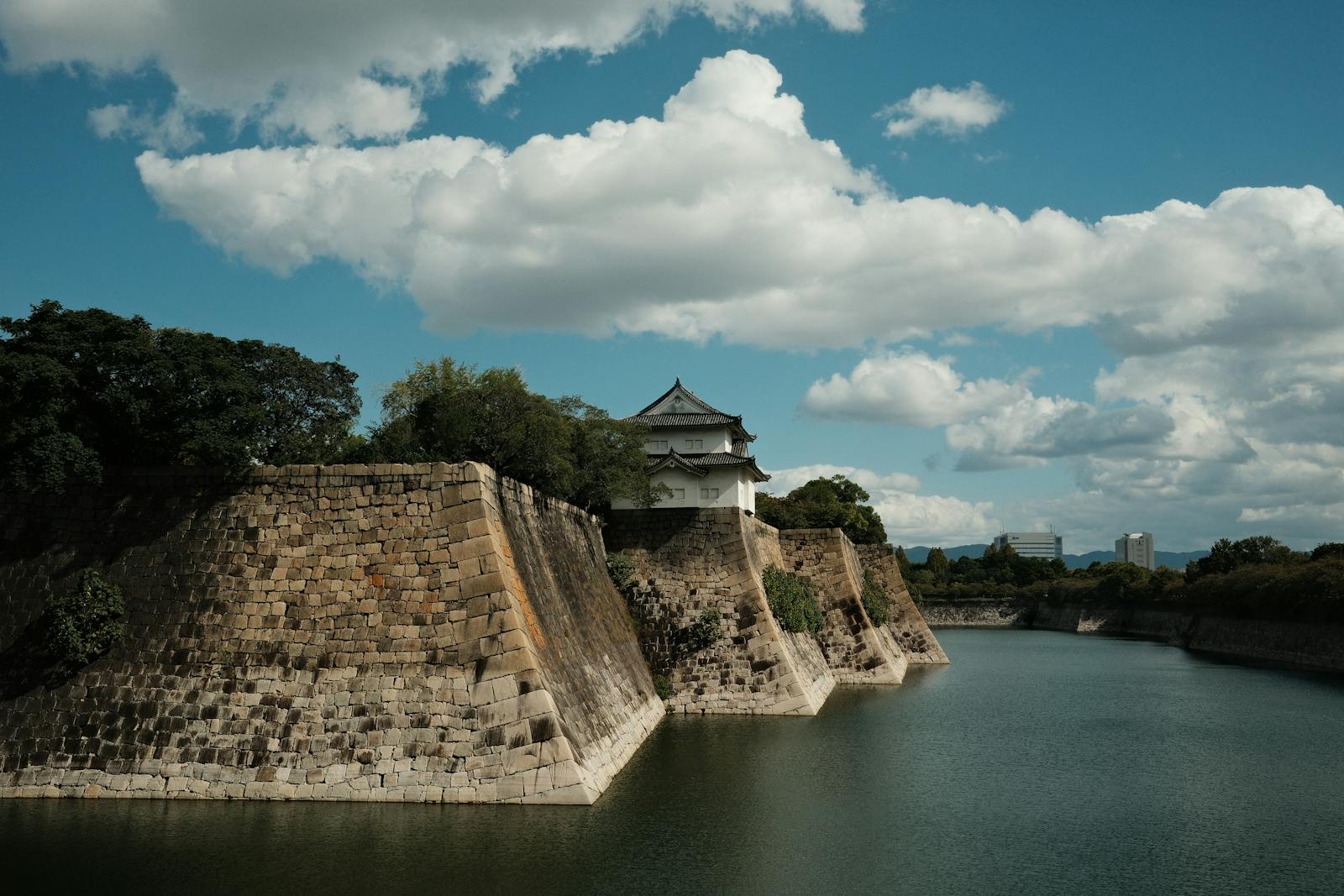
- The outer moat. Twelve meters deep, walled in colossal Tokugawa-era stone. Several of the “spectacle stones” top 100 tons each, which is the kind of fact that lands better when you are standing under them.
- The Plum Grove. East of the keep, around 1,270 plum trees that bloom in February, before the cherry crowds arrive. Quietly one of the best-timed visits of the year.
- Hokoku Shrine. Dedicated to Hideyoshi, just south of the keep. Free, atmospheric, and rarely busy.
- The Gozabune boat tour. A 20-minute ride on a gold-painted boat around the inner moat, ¥1,500. Save it for golden hour.
- Jo-Terrace Osaka. A modern food-and-shopping block at the Osakajokoen Station entrance, handy for a coffee before or a beer after.
Where to get the photo
Everyone wants the same shot. A few angles get it better than the spot where the crowd clumps.
- Gokurakubashi Bridge. The classic wooden-bridge frame. Come from the south side in late afternoon, when the light warms up the gold trim.
- Nishinomaru Garden lawn. The widest angle, and the only place you reliably get blossoms in the foreground.
- Sakuramon Gate platform. The “postcard” angle, with the keep and the Tako-ishi, or octopus stone, the largest castle stone in Japan.
- The top deck, facing out. Most people shoot the castle and forget the city behind them. Turn around.
- The inner moat reflection. On a still day, stand at the southwest corner and you get the keep mirrored in the water.
Cherry blossoms, and the honest version of them

Osaka Castle Park holds roughly 3,000 cherry trees across several varieties, which puts it in the top tier of hanami spots in the city. Peak bloom usually lands late March into early April. During that stretch, Nishinomaru Garden runs the famous evening illumination, the keep lit from below, food stalls down the lawn, the whole production. It is gorgeous. It is also rammed.
So plan around the crowd rather than pretending it is not there:
- Come before 10am or after 4pm. The middle of a spring Saturday is the one window to avoid outright.
- Buy the keep ticket online. On peak weekends the on-site line breaks 90 minutes and you will resent every one of them.
- Bring a tarp and a convenience-store bento. That is the local move, and the lawn is built for it.
- For the illumination, 19:00 to 20:30 is the sweet spot: dark enough to be dramatic, early enough that the last trains are not a worry.
If the spring chaos sounds like too much, late November is the quiet alternative. The foliage is excellent and the crowds are a fraction of blossom season. You trade a little spectacle for a lot of breathing room.

Getting there
The park has four useful stations, and which one you pick depends on the entrance you want.
- Osakajokoen (JR Loop Line) is the easy pick from Osaka Station. You come out at Jo-Terrace and walk about 10 minutes through the park to the keep.
- Tanimachi 4-chome (Tanimachi or Chuo subway) drops you closest to the south entrance and Hokoku Shrine, a 10-minute walk to the keep.
- Morinomiya (JR Loop or Chuo subway) is best for the southeast corner and the Plum Grove.
- Tenmabashi (Keihan or Tanimachi subway) suits arrivals from the Kyoto side, about 12 minutes through the park.
From Umeda or Osaka Station, the JR Loop Line gets you to Osakajokoen in about 9 minutes, no transfer. From Namba it is roughly 18: the Midosuji Line to Honmachi, then the Chuo Line to Tanimachi 4-chome. Either way the trains are frequent enough that you do not need to plan around them.
When to go, and when not to
- Best season: late March to early April for blossoms, or late November for foliage with elbow room.
- Best day: Tuesday through Thursday. Mondays sometimes draw school field trips.
- Best hours: 9:00 to 10:30 for small crowds and soft light, or 16:00 to 17:30 for golden-hour photos and the last quiet hour in the museum.
- Skip: spring Saturday afternoons, Golden Week (April 29 to May 5), and Obon in mid-August, when the heat in the unshaded park is genuinely rough.
Eating near the castle
- Jo-Terrace Osaka. The modern complex at Osakajokoen Station, with sushi, ramen, Italian, and a craft-beer hall. Mid-range and reliable.
- Miraiza Osaka-jo. A restored Western-style 1931 building inside the inner bailey, with premium dining including a samurai-themed restaurant. More about the setting than the value.
- Park food stalls. Takoyaki, yakisoba, and ice cream from outdoor vendors, out in force during blossom season.
- The convenience-store picnic. Onigiri and a beer from the Lawson at Osakajokoen, eaten on the lawn. Cheapest and, on a good day, the best.
Things worth knowing before you go
- Wear real shoes. The park is large and hilly, and you will cover at least 2 km from station to keep and back.
- Coin lockers sit at every park-entrance station, ¥400 to ¥600 a day.
- Accessibility: the keep has elevators on most floors, and the grounds are mostly paved, though a few stairways break that up.
- Strollers are fine in the park but need folding on the upper keep floors.
- Free restrooms are scattered through the park and inside the keep.
- “Osaka Free Wi-Fi” covers the grounds.
- Bring water in summer. Osaka humidity is no joke, and the vending-machine lines in the park get long.
Pairing the castle with the rest of your day
Half a day and the castle fills it on its own. With a full day, line it up with something in the same direction rather than crisscrossing the city.
- Castle morning, aquarium afternoon. The Chuo Line runs about 25 minutes straight to the bay. A big, easy family day, and our Osaka Aquarium Kaiyukan guide lays out the timing.
- Castle plus the Osaka Museum of History. The museum sits across from Tanimachi 4-chome Station, and its upper floors look straight at the keep.
- Castle morning, Dotonbori evening. Ride the JR Loop south to Namba for dinner and neon, the standard first-timer route.
- Castle plus a concert. If your dates line up, Osaka-jo Hall on the park’s east side hosts major arena shows.
If history is your thing, the castle slots neatly alongside the city’s other landmarks. Our guide to Osaka’s observation decks covers the higher viewpoints if the 50-meter keep leaves you wanting more, and for rainy-weather backup, the indoor things to do in Osaka roundup keeps the day on track.
Osaka Castle FAQ
How long do you need at Osaka Castle?
Two to three hours is the honest figure: an hour to ninety minutes inside the keep and Stone Wall Museum, half an hour to an hour in the grounds, plus the walk from the station. Add time if you are visiting in blossom season and want to sit on the lawn.
Is Osaka Castle worth visiting?
Yes, and more so since the 2025 Stone Wall Museum opened up real Toyotomi-era construction. The keep is a 1931 reconstruction, so the occasional purist calls it a museum in costume. Fair enough. The view, the depth of the history, and the park around it still earn the trip.
Can you go inside Osaka Castle for free?
The grounds are free, day and night. The keep interior, the museum, and the observation deck need the ¥1,200 ticket. Children under 16 enter free with ID.
Can I climb to the top of the keep?
You take an elevator to the 8th-floor observation deck, 50 meters up, then walk down through the museum floors. There is no original-style staircase to scale; the interior is steel-reinforced concrete.
What is the best time of year to visit?
Late March to early April for cherry blossoms, with the best photos and the biggest crowds, or mid-November for autumn color and far more space. Avoid summer afternoons, when the heat and humidity in the open park are punishing.
Is Osaka Castle the same as Osaka-jo?
Same place. Jo means “castle” in Japanese, so “Osaka-jo” and “Osaka Castle” point at exactly the same site.
Build the castle into a bigger plan
Osaka Castle anchors almost every first-timer’s itinerary, but it is one stop among dozens. Slot it into a wider plan with our things to do in Osaka guide, and if you are travelling with little ones, the half-day-here, half-day-there rhythm pairs neatly with a theme-park day at Universal Studios Japan. Give the castle a real half-day, time it before the blossoms peak or before the summer heat sets in, and you walk away with the photo every Osaka visitor is quietly after.