Osaka’s coffee scene gets overshadowed by Tokyo, which is a mistake, because in some ways it got there first. Hiraoka Coffee has been roasting on the same corner near Honmachi since 1921. Mill Pour kicked off the city’s third-wave moment back in 2010, years before specialty coffee felt mainstream. And the Showa-era morning set, a coffee that comes with toast, jam, butter and a boiled egg for the price of the coffee alone, is still served all over town. The Osaka cafes worth your time run the full span, from century-old kissaten to roasters where the barista will talk you through tasting notes if you let them.
This guide covers both ends and everything between: where to go, what to order, how the morning set works, and how to find a good cup when you don’t read Japanese. A cafe is also the right way to pace a day of heavier eating, so it pairs well with the street food guide and the rest of the Osaka food guide.

The short list, by what you want
- Best third-wave specialty: Mill Pour, in the Kitahorie/Yotsubashi pocket. The one that started it in 2010.
- Best for tasting notes: LiLo Coffee Roasters in Amerikamura.
- Best space to sit in: Takamura Wine & Coffee Roasters in Kitahorie, a warehouse split between coffee and natural wine.
- Oldest kissaten: Hiraoka Coffee near Honmachi, open since 1921.
- Prettiest kissaten: Marufuku Coffee in Sennichimae.
- Best morning set: Inoda Coffee in Hankyu Sanbangai, ¥980 for the full plate.
- Best if you need to work: % Arabica or Streamer Coffee Company.
- Best with a pastry: Bondi Bakehouse.
Osaka has two cafe cultures, and they barely overlap
Before you start picking places, understand that the word “cafe” covers two different animals here.
- Kissaten (喫茶店): postwar coffee shops, usually dim, often with a siphon brewer behind the counter and jazz or classical at low volume. People read the paper, nurse a cup for an hour or two, and in the older ones, smoke. The atmosphere is the product. The coffee is good, but it’s not the headline.
- Third-wave specialty: brighter, cleaner, built around single-origin beans, careful pour-over, and a barista who knows the farm. People come to drink and talk shop, then move on. Here the coffee absolutely is the headline.
You want one of each on your trip. They tell you completely different things about the city.
Mill Pour: where the third wave started
An early specialty-coffee evangelist opened this in 2010, and it’s the place most people credit with launching the scene. Multi-grinder bar, single-origin beans, pour-over done with real attention. It’s small and it takes its coffee seriously, so come to drink rather than to camp out with a laptop.
- Where: 1-12-21 Kitahorie, Nishi-ku.
- Hours: 11:00 to 19:00.
- Cost: ¥600 to ¥1,200 a cup.
- Order: whatever the barista is excited about that week. They’ll tell you if you ask.
LiLo Coffee Roasters: the talkative one
The flagship of Osaka’s most charismatic specialty brand, in Amerikamura. They run multiple roasters and multiple methods, V60, French press, AeroPress, espresso, and the baristas are trained to walk you through what you’re tasting without being precious about it. There are two locations: the original Amerikamura cafe, and the newer LiLo Coffee Kissa in Kitahorie, which splices kissaten nostalgia onto modern brewing.
- Where: Amerikamura (original); LiLo Coffee Kissa (Kitahorie).
- Hours: 12:00 to 22:00.
- Cost: ¥600 to ¥1,000 a cup.
Takamura Wine & Coffee Roasters: the one that looks the part
If you only have time for one photogenic stop, make it this. A former warehouse in Kitahorie, converted into a multi-floor space that does specialty coffee roasting and natural wine retail under one very high ceiling. Locals come for an espresso in the morning and a glass of wine in the afternoon, and the working roasters sit out in plain view. Industrial bones, good light, the kind of place you linger longer than planned.
- Where: 2-2-18 Kitahorie, Nishi-ku.
- Hours: 11:00 to 20:00.
- Best for: couples, a date, anyone who likes good design with their coffee.
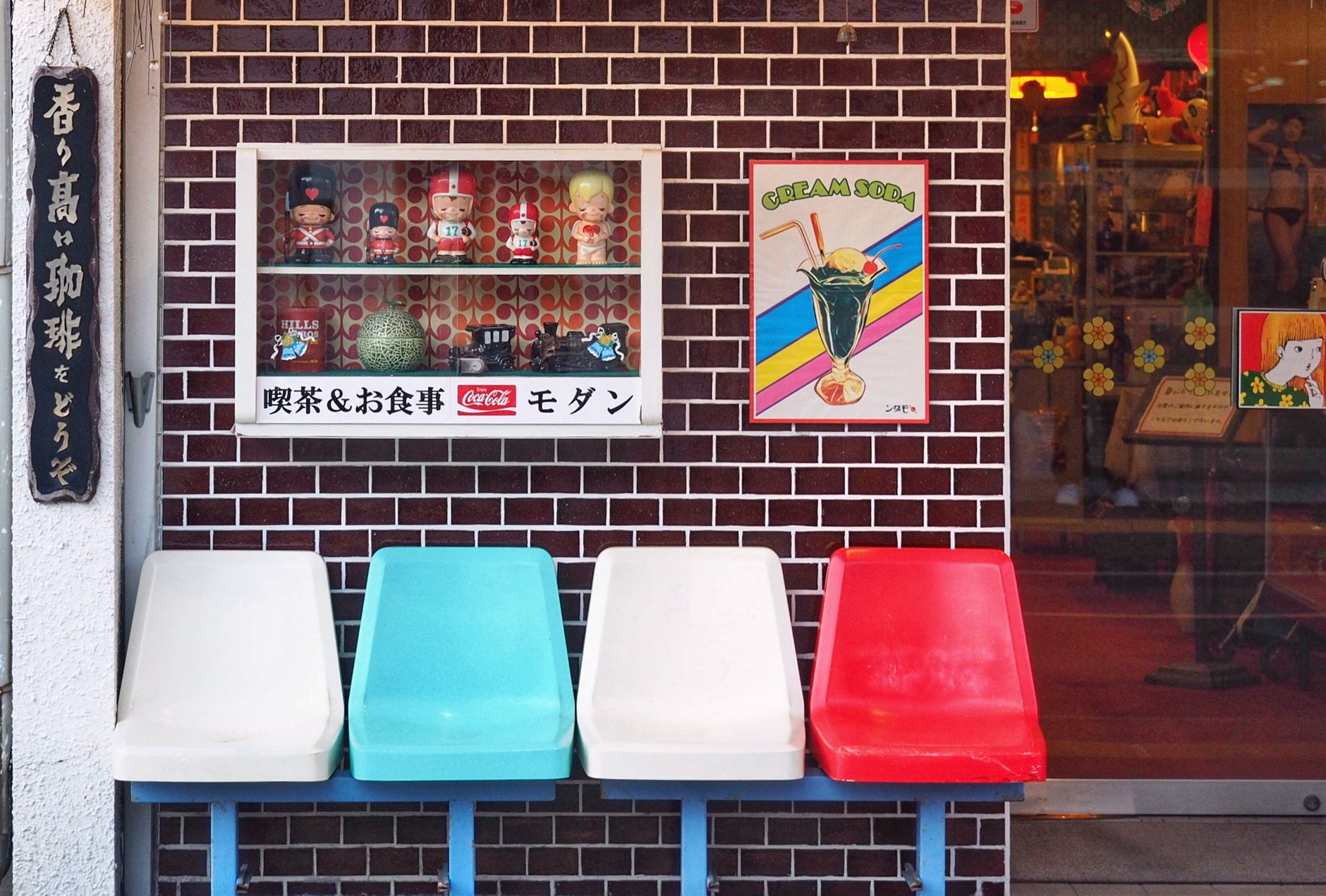
Hiraoka Coffee: the oldest in the city, since 1921
This is the one to make a pilgrimage for. The oldest continuously running kissaten in Osaka, near Honmachi Station, with house-roasted beans, homemade donuts, and the same heavy wooden tables it’s had since the early twentieth century. The morning set, coffee plus buttered toast plus a boiled egg for the price of the coffee, has been served here longer than almost anywhere in Japan. Three generations of the same craft, and it still feels like a working neighborhood shop rather than a museum.
- Where: 3-3-2 Bingomachi, Chuo-ku.
- Hours: 7:00 to 19:00, closed Sundays.
- Cost: ¥500 to ¥800 with the morning set.
- Order: the morning set, served roughly 8:00 to 11:00.
Marufuku Coffee: the prettiest kissaten
The Sennichimae branch of Marufuku is the Showa-era look in its purest form: red leather banquettes, dark wood paneling, vintage chandeliers, and a service rhythm that hasn’t sped up in decades. It turns up on every Instagram list of Osaka cafes, which means it gets busy, but the room earns the attention. Go mid-morning on a weekday if you want a seat without a wait.
Inoda Coffee, Hankyu Sanbangai: the reliable morning set
Inoda is a historic Kyoto chain, and its Osaka branch sits in the Hankyu Sanbangai underground beneath Umeda. The morning set here is the generous version: coffee, toast, scrambled eggs, salad and ham for ¥980. It’s the easy, no-Japanese-required option if you’re staying around Umeda and want a proper sit-down breakfast before a day out.
The specialty chains: % Arabica, Streamer, Bongen
% Arabica is the Kyoto-born brand that went global. Osaka’s branch is pure white-minimalist Instagram bait, with photogenic latte art and the unmistakable “%” logo. ¥600 to ¥800 a drink. It gets crowded, but the consistency and the look make it a fair stop if you happen to be passing.
Streamer Coffee Company comes from a latte-art champion, and every cup arrives with pristine art on top. Modern, lively, popular with a younger crowd. Bongen is the opposite energy: a small roaster making noise with seasonal single-origin imports, usually packed with people who take their coffee very seriously. If you want to talk beans, Bongen is your room.
For a longer sit: Brooklyn Roasting, Madragoa, the Hozenji stalls
Brooklyn Roasting Company’s Osaka outpost is stylish, has several branches, and is comfortable for laptop work or a long visit, which most specialty places quietly discourage. Madragoa is a boutique micro-roastery doing Portuguese-style espresso, niche but genuinely excellent. And in the lantern-lit Hozenji Yokocho alley near Dotonbori, one or two morning standing-counter shops pour hand-drip for ¥400 to a local salaryman crowd. That last one is more atmosphere than precision, but the atmosphere is the whole point.

The morning set, explained
If you take one thing from this guide, take this. Osaka kissaten serve a morning set, “mooningu setto,” usually a coffee plus toast, butter, jam and a boiled or fried egg, between roughly 7:00 and 11:00, for the same price as the coffee on its own. It started in mid-twentieth-century Osaka as a way for kissaten to pull in the breakfast crowd, and it stuck. Most older kissaten and plenty of specialty cafes still do it.
- The standard: coffee plus thick-cut shokupan toast plus a boiled egg plus a jam-and-butter packet. ¥500 to ¥800.
- Variations: some shops throw in salad, ham, or fruit.
- How to order: say “moningu setto,” or just point at the photo on the menu. It works every time.
Kissaten or specialty: how to choose on the day
- Go kissaten if you want atmosphere, a morning set, a slow ambient cup, and an hour or two to read or watch the room.
- Go specialty if you care about origin, roast and method, want a quick high-quality cup, and prefer the brighter modern energy.
- Go hybrid (LiLo Kissa, Brooklyn) if you want the modern design and the traditional comfort in one room.
What it costs in 2026
- Standard kissaten coffee: ¥400 to ¥600.
- Morning set with toast and egg: ¥500 to ¥1,000.
- Specialty pour-over: ¥700 to ¥1,200.
- Specialty espresso drinks: ¥500 to ¥800.
- Cake or pastry add-on: ¥400 to ¥800.
Two cafe routes that actually flow
The specialty walk, Kitahorie and Yotsubashi
Start at Mill Pour around 10:00 for a pour-over flight (about ¥1,500). Walk over to Takamura at 11:30 for an espresso and a browse (¥600). Finish at LiLo Coffee Kissa around 13:00 with a kissaten-style filter (¥700). Four hours, three cups, roughly ¥3,000 to ¥4,000, all within an easy walk.
The heritage kissaten crawl
Open at Hiraoka with the morning set at 8:00 (¥700). Hit Marufuku in Sennichimae at 10:00 (¥600). Wrap up at Inoda in Sanbangai at 11:30 (¥980). A full morning in Showa-era rooms for about ¥2,300, and you’ll have eaten a proper breakfast somewhere in there.

Practical things to know before you go
- Smoking: a lot of kissaten still allow it, often in a dedicated section. Specialty cafes are generally smoke-free.
- Wi-Fi: common at specialty places, rare in kissaten.
- Power outlets: same story. Plan to work at a modern third-wave cafe, not a kissaten.
- English menus: common at specialty and chain cafes, rare at small kissaten, where Google Translate’s camera mode earns its keep.
- Days off: many small kissaten close on Sundays. Check before you trek across town.
- Cash: smaller kissaten are cash-only, so carry some.
- How long you can stay: kissaten welcome a long sit. Specialty cafes would rather you drink up and free the seat.
Osaka cafes: common questions
What is a kissaten?
A traditional postwar Japanese coffee shop. Think dim lighting, dark wood, jazz or classical at low volume, often a siphon brewer, and the morning set. Many have run for fifty to a hundred years or more.
Which Osaka cafe is best for specialty coffee?
Mill Pour, LiLo Coffee Roasters and Takamura Wine & Coffee are the three names that come up most. They cluster in the Kitahorie and Yotsubashi area, so you can do all three on foot in a single morning.
What’s the morning set?
A breakfast deal at most Osaka kissaten: a coffee that comes with toast, butter, jam and a boiled egg for about the price of the coffee alone. Served roughly 7:00 to 11:00.
How much does coffee cost in Osaka?
¥400 to ¥600 at a standard kissaten, ¥700 to ¥1,200 at specialty third-wave cafes. The morning set often makes kissaten the cheaper breakfast despite the lower-tech coffee.
Do Osaka cafes have Wi-Fi?
Most specialty cafes do; most traditional kissaten don’t. The big chains, % Arabica, Brooklyn Roasting, Streamer, all offer free Wi-Fi.
Is Starbucks easy to find here?
Yes, there are branches all over central Osaka. The one in Osaka Castle Park is the most interesting building-wise. Local cafes are far better, but Starbucks is a dependable Wi-Fi-and-laptop fallback.
When to go for the best experience
Timing matters more than you’d think. The morning set window, roughly 7:00 to 11:00, is the single best slot in a kissaten: the room is calm, the deal is on, and the regulars are reading the paper. Hit Hiraoka or Marufuku then and you’ll see the tradition at its truest. Specialty cafes peak differently. They’re sharpest mid-morning to early afternoon, after the opening rush and before the post-lunch crowd, which is when a barista has time to actually talk you through a single-origin. Weekends pack out the photogenic spots like % Arabica and Takamura, so if a quiet seat matters more than the day of the week, come on a Tuesday or Wednesday.
One more bit of sequencing. A slow morning coffee sets up a big lunch beautifully, so plan a kissaten breakfast before a heavier midday meal, whether that’s okonomiyaki on a hot griddle or a counter of conveyor-belt sushi. The contrast, quiet coffee then loud food, is one of the small pleasures of eating your way through this city.
How Osaka coffee differs from Tokyo
Travellers who’ve done both cities notice it. Tokyo’s specialty scene is bigger, more competitive, and a little more performative, with high-design cafes that feel built for a magazine shoot. Osaka’s runs quieter and, frankly, friendlier. Baristas here are more likely to chat, the prices tend to sit a touch lower, and the kissaten tradition is woven deeper into daily life, partly because Osaka was a merchant city where coffee shops doubled as informal offices for deal-making. You feel that history in the older rooms. People are doing business over a slow cup, the same as they have for sixty years. If Tokyo coffee can feel like a destination, Osaka coffee feels like a habit.
Kissaten etiquette, so you don’t fumble it
The unwritten rules trip up first-timers more than the language does. A few things to know before you push open a kissaten door:
- One drink, minimum, per person. A kissaten isn’t a co-working space you visit for the seat. Order something, and order again if you stay past an hour.
- Wait to be seated in the older, smaller places. The owner often runs the whole floor solo and will point you to a table.
- Keep your voice down. The whole appeal is the calm. A loud group changes the room for everyone in it.
- Don’t rush the staff. Siphon-brewed coffee takes a few minutes by design. That wait is part of what you came for.
- Pay at the register on the way out, not at the table, unless they bring you a check.
Where the cafes cluster
You don’t have to crisscross the city. The cafes group up by district, which makes a half-day coffee crawl easy to plan.
- Kitahorie and Yotsubashi: the specialty heartland. Mill Pour, Takamura, LiLo Kissa, all within a walkable grid west of Shinsaibashi.
- Amerikamura: younger, scruffier, home to the original LiLo and a clutch of smaller roasters between the vintage shops.
- Honmachi and the business district: the heritage kissaten zone, where Hiraoka and its peers served the merchant crowd and still do.
- Umeda: chain-heavy and convenient, with Inoda in the Hankyu Sanbangai basement and Starbucks branches you can’t avoid. Good for a quick fix between trains.
Fit it into the rest of your trip
Cafes are the off-switch between Osaka’s bigger meals, the gap between a takoyaki run and a kushikatsu dinner. Slot this alongside the complete Osaka food guide, the street food guide, and the Kuromon Market guide for the grazing that bookends a slow morning coffee. Start with a heritage kissaten and a morning set. It’s the gentlest possible introduction to the city.