Takoyaki is the food Osaka built its name on, and you can eat a great plate of it for under ¥700. The basics: wheat-flour batter, a chunk of octopus dropped into each well, scallion and pickled ginger folded in, then brown sauce, mayo, dried seaweed, and bonito flakes that curl in the heat. Tomekichi Endo cooked the first batch at his Aizuya stall back in 1935. The city has run with it ever since, and the few blocks around Dotonbori and Namba now hold more good counters than you could clear in a weekend.
What follows is the short version of years of eating these things: which shops are worth a line, which are worth a detour, and how to tell a good plate from a soggy one before you’ve handed over your money. Prices and hours below are what the shops were running as of 2026. Takoyaki stalls move and reshuffle, so treat them as a guide, not gospel.
The five-second version
If you only have one afternoon, here’s where I’d send you, and why.
- Wanaka, Sennichimae: the one to beat. Dashi-heavy batter, copper plates, a line that actually moves. Start here.
- Juhachiban: the troublemaker. Sakura shrimp, ginger, and tempura crumbs go into the batter. Different enough to be worth a second plate.
- Aizuya, Tamatsukuri: the original, off the tourist strip. No sauce, no mayo, just octopus and dashi. Go if you care where this all started.
- Hanadako, Umeda: no neon and no crowd of tourists, just a station-basement stall feeding the office workers. The locals’ pick.
- Kukuru, Ebisu Bridge: the giant octopus on the wall. The photo is the point; the takoyaki is fine.
How to spot a good plate
You don’t need a guide to find decent takoyaki in Osaka. You need to know what you’re looking at. Six things separate a shop worth queuing for from a tourist trap two doors down.
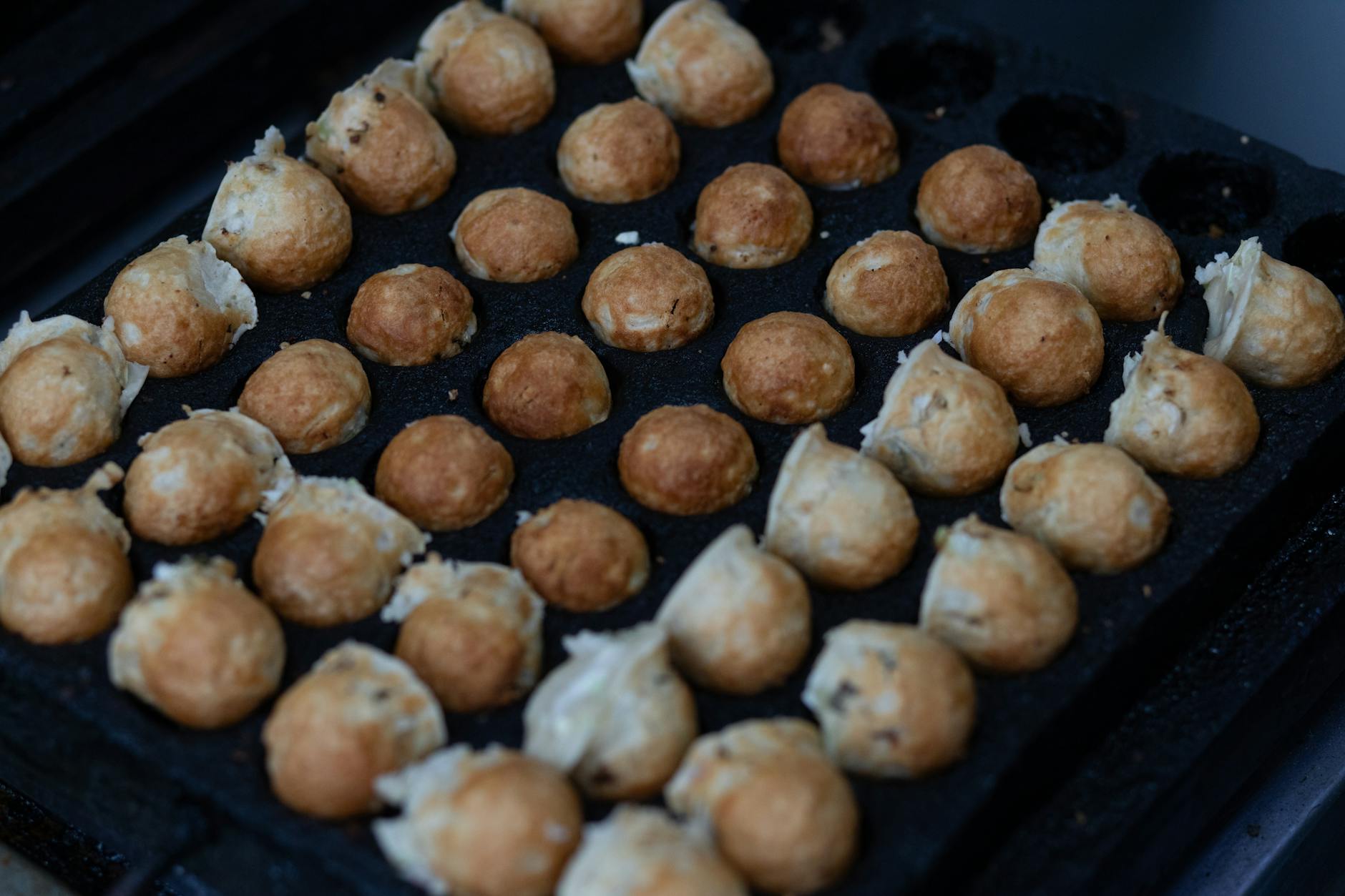
- The shell should crack, the middle should run. That’s the whole trick: a crisp outside giving way to an almost-liquid center. If the inside is dense and chewy, the batter was wrong or it sat too long.
- Look at the octopus. You want a real bite of it in each ball, roughly the size of the end of your thumb. Cheaper places shave it down to nothing and hope the sauce covers for them.
- Copper plates. The good counters cook on copper, not steel. It throws heat faster, which is where the crackle comes from. You can usually see the plate from the queue.
- Dashi in the batter. Top shops build their batter on a kombu-and-bonito stock, not tap water. You taste it even under all the sauce.
- Sauce as a glaze, not a flood. A drowned plate is usually hiding something. The brown sauce should coat, not pool.
- Eat it where you bought it. Takoyaki has a short window, well under two minutes before the good texture goes. Stand at the counter and eat.
Getting to the takoyaki, and when to go
Almost everything on this list clusters around one subway stop. Namba, on the Midosuji line, drops you a few minutes from Dotonbori, Sennichimae, and the canal, which is where Wanaka, Juhachiban, and Kukuru all sit within a short walk of each other. Tap through with an ICOCA card and you won’t think about fares again. The two outliers are Aizuya, fifteen minutes east toward Tamatsukuri, and Hanadako, which is buried in the basement under Umeda Station to the north.
Timing matters more than people expect. Lunch and the early evening rush, say noon to one and six to eight, is when the lines are worst and the queues at Wanaka and Juhachiban can run the better part of an hour. Roll up mid-afternoon, around two or three, and you’ll often walk straight to the counter at the same shops. Late evening on the Dotonbori strip is busy but in a good way: the neon is on, the cooks are flying through batches, and the energy is half the reason to be there.
Takoyaki Doraku Wanaka
If one shop is the benchmark, it’s this one. The Sennichimae main branch sits next to Namba Grand Kagetsu, and the batter is the textbook Osaka style: dashi-rich, cooked hot on copper, a crisp shell over a molten center. There’s a newer Dotonbori branch that’s more central if you’re already on the canal, but the original has the better atmosphere and, somehow, the better plate. Order the plain sauce version first. If you’re hungry, their tonpei-yaki, a takoyaki-omelette hybrid, is the sleeper pick.
- Where: Sennichimae (main) and Dotonbori, plus other branches around the city.
- Hours: roughly 11:00 to 22:00.
- Price: ¥600 to ¥850 for eight.
- Line: 15 to 45 minutes at peak. It moves faster than the length suggests.

Takoyaki Juhachiban
Juhachiban does the one thing Wanaka doesn’t: it messes with the formula. Sakura shrimp, ginger, and crunchy tempura bits go straight into the batter, so every ball comes loaded with extra umami and a different kind of crunch. It isn’t better than the classic. It’s just its own thing, and after a plate of the standard stuff it lands like a palate reset. The main shop is on Dotonbori with a branch over by Sennichimae, and the line tends to be long. Worth it.
- Where: Dotonbori main shop; Sennichimae branch.
- Hours: about 11:00 to 21:00.
- Price: ¥600 to ¥900 for eight.
- Order: the signature sakura-shrimp-and-ginger plate.
Aizuya, the original
This is where the whole thing began. Aizuya, over in Tamatsukuri in Chuo-ku, is the shop Tomekichi Endo opened, and it still serves takoyaki the way he made it: no sauce, no mayo, no bonito, just batter and octopus. The early version went by “radio-yaki,” because the round shape looked like the dials on a radio set. The flavour is quiet and octopus-forward, and after the sauce-drowned plates downtown it can feel almost stark. That’s the point. It’s a fifteen-minute hop off the main strip, and if you have any interest in the history, it’s the most worthwhile detour here.
- Where: Tamatsukuri, Chuo-ku.
- Hours: roughly 11:00 to 18:00; closed Mondays.
- Price: around ¥600 for twelve.
- Best for: anyone who wants the off-Dotonbori, sauce-free original.
Hanadako, the Umeda workhorse
Ask an Osaka office worker where they actually eat takoyaki and a lot of them will point you to Hanadako. It’s tucked into the Hankyu Sanbangai food court under Umeda Station, it photographs like nothing, and it’s busy from the lunch rush straight through to the after-work crowd. The takoyaki is genuinely excellent, and the negimayo version, a thick blanket of green onion and mayo over the top, is the order to get. No neon, no octopus sculpture, no queue full of cameras. Just very good food where people commute.
- Where: Hankyu Sanbangai underground, Umeda Station.
- Hours: roughly 10:00 to 22:00.
- Price: ¥500 to ¥800 for eight.
- Order: the negimayo, green onion and mayo.

Kukuru and the giant octopus
You’ll find Kukuru without trying. It’s the building on Ebisu Bridge with the enormous octopus wrapped around the outside, and it’s the most photographed takoyaki shop in the city by a wide margin. Here’s the honest read: the plate is good, not life-changing. Solid octopus, fine batter, nothing that’ll ruin you for the others. But the photo is genuinely fun and the location is unbeatable, so if you’re already on the canal, grab the “Big Kukuru” with the oversized octopus chunks and take your picture. Just don’t make it your only stop.
- Where: Dotonbori, Ebisu Bridge.
- Hours: about 11:00 to 23:00.
- Price: ¥600 to ¥850.
- Order: the Big Kukuru, extra-large octopus.
A few more worth knowing
Beyond the headliners, a handful of spots round out the picture depending on where you are and what you’re after.
- Konamon Museum (Dotonbori): part shop, part exhibit on Osaka’s flour-food culture. Takoyaki at standard prices, plus a make-your-own session for around ¥1,500. Good with kids, good in the rain.
- Yamachan (Tennoji): a south-Osaka regulars’ spot going since 1965. Small counter, dashi-forward flavour, none of the downtown polish. That’s the appeal.
- Otako (Dotonbori): about as no-frills as it gets. A four-person standing counter facing the grill, cash only, quick turnover, classic flavour.
- Kukuru’s Konamon Museum offshoot: wider, weirder menu, with cheese-stuffed and mochi-cheese balls and even a takoyaki-burger thing. Touristy, but fun once you’ve eaten the classics.
What it costs, and how much to eat
This is famously cheap food. A tray of eight runs ¥500 to ¥900 almost everywhere, with the lower end at the workhorse stalls and the higher end at the Dotonbori headliners or the loaded-up specialty plates. Most people find one tray is a snack and two is a light meal, so budget ¥1,000 to ¥1,500 a person per shop if you’re treating it as lunch. A four-stop crawl across an afternoon comes to roughly ¥2,500 a head, which is a remarkable amount of eating for the money.
One practical note: carry some cash. The bigger chains take cards and IC payment now, but the smaller standing counters, the ones often worth seeking out, are frequently cash only. A few thousand yen in your pocket covers a whole day of this.
Ordering, without looking lost
None of this is complicated, but a few habits will make you look less like a first-timer and, more to the point, get you a better plate.
- Six or eight to a box. Most counters cook fresh batches every couple of minutes, so what you get is hot off the plate.
- Pick your topping. Sauce, mayo, aonori and bonito is the default, and it’s the right call your first time. Salt-only is the purist move. Cheese is the gentle option. Mentaiko mayo, spicy cod roe, is the grown-up one.
- Do not bite straight through. The center is molten and it will get you. Pop it, bite the top off, let the steam out, then finish it. The toothpick is there for a reason.
- Drink cold. A beer, Asahi or Sapporo, or cold oolong tea. Either one cuts through the sauce.
- Eat standing. Most of these places are takeout or a few counter stools. Don’t carry it off to eat later; it won’t survive the walk.
Beyond the standard plate
Once you’ve had the classic a few times, the variations are where it gets interesting. A quick map of what you’ll see on menus:
- Sauce-and-mayo classic: the default. Dark Worcestershire-style sauce, Kewpie mayo, aonori, dancing bonito.
- Salt only: the Aizuya school. Subtle, all about the octopus.
- Negimayo: green onion and mayo, lighter on its feet.
- Cheese: melted mozzarella under the usual sauce. Easy to like.
- Ponzu: citrus soy instead of brown sauce. A palate cleanser.
- Mentaiko mayo: spicy cod roe and mayo. The adult order.
- Curry: Japanese curry sauce over the top. More common than you’d expect, and it works.
Cook your own
A few schools around Namba and Umeda run two-hour takoyaki classes in English for roughly ¥3,500 to ¥5,000. You mix the batter, fight with the flipping pick, and eat the evidence. It’s a strong rainy-day plan, it works with kids, and you walk out finally understanding why your home attempts never crisp up right. Book through the operator sites or Klook. If you want to go deeper into hands-on cooking, the wider scene is covered in our food guide below.
A half-day takoyaki crawl
Here’s a route that hits the range without overdoing it. Four shops, one afternoon, somewhere around ¥2,500 all in.
- Start at Wanaka, Sennichimae. The classic, to set your baseline.
- Five minutes to Juhachiban on Dotonbori for the sakura-shrimp version.
- Five more to Kukuru on Ebisu Bridge for the photo, plus the bigger octopus.
- Fifteen minutes on the train to Tamatsukuri for Aizuya, the no-sauce original.

Best takoyaki in Osaka: FAQ
Which takoyaki shop should I go to first?
Wanaka at Sennichimae, every time. It’s the cleanest example of the Osaka style, the line moves, and it gives you a baseline to judge everywhere else against. From there, most people add Juhachiban for contrast and Aizuya if they want the original.
How much does takoyaki cost?
Roughly ¥500 to ¥850 for an eight-piece tray, depending on the shop and the topping. Most people work through one or two trays per stop, so a full crawl lands around ¥2,500 a head.
Is takoyaki only in Osaka?
No, you’ll find it all over Japan. But Osaka is where it started and where the standard gets set. Tokyo’s tends to come out smaller and crisper; Osaka’s runs bigger and more molten in the middle.
Is takoyaki spicy?
Not at all. The standard plate is savoury and rich, with no heat. The only one with any kick is the mentaiko mayo version, and even that’s mild.
Can vegetarians eat takoyaki?
Not the traditional kind, since octopus is the whole point and the batter usually carries a fish-based dashi. A few specialty shops do mushroom or mochi-cheese versions, but they’re uncommon and you’ll need to ask.
What’s the difference between takoyaki and akashiyaki?
Akashiyaki, from nearby Akashi, came first: an egg-rich batter, no sauce, dipped into a bowl of dashi broth. Takoyaki is the wheat-flour, sauce-topped Osaka descendant. Try akashiyaki if you ever see it; it’s softer and lighter.
Mistakes people make
Most disappointing takoyaki comes down to a handful of avoidable errors, not bad luck.
- Eating it on the move. The single biggest one. A box bought to walk-and-eat is a box eaten lukewarm and gummy. Stand at the counter, take the two minutes, and you’re eating a different food.
- Going only at peak hours. If your one shot at Wanaka is 7pm on a Saturday, you’re spending forty minutes in a line for something you can walk straight into at 3pm on a weekday.
- Judging the whole city by Kukuru. A lot of visitors eat one plate at the photogenic Ebisu Bridge spot, find it merely good, and move on. Compare at least two shops before you decide what you think of Osaka takoyaki.
- Drowning it in extra sauce. The squeeze bottles are tempting. Resist. A good plate is already balanced, and a flood of sauce buries the dashi you paid for.
- Skipping the salt-only version. People assume sauce equals flavour and never try takoyaki the original way. The plain, octopus-forward plate at Aizuya tells you what the dish actually tastes like.
One more, if you have the time
If takoyaki grabs you and you have a spare half-day, ride out to Akashi, about forty minutes west toward Kobe, and try akashiyaki where it comes from. It’s the softer, egg-rich ancestor, served warm and dipped into a bowl of clear dashi rather than slathered in sauce. Eating the two back to back, the molten sauced version in Osaka and the gentle dunked one in Akashi, is the best way to understand how this whole family of food evolved. It’s a niche move, but the kind of thing that turns a good food trip into a memorable one.
Where to go next
Takoyaki is one corner of a much bigger eating city. Once you’ve got it sorted, line up a bowl of the best ramen in Osaka and spend a night working through the Osaka street food strip along the canal. For the full lay of the land, our Osaka food guide ties the clusters together and points you toward okonomiyaki, kushikatsu, and the markets worth your time.