This article contains advertising. Our booking links are routed through a partner that adds commission tracking automatically, so if you book through one we earn a commission from the provider, at no extra cost to you. It never affects what we recommend. Affiliate disclosure
Abeno Harukas is a department store that happens to be three hundred metres tall. That sounds like a joke and is closer to a floor plan. Walk in off the street at Tennoji and you are in a Kintetsu food hall selling wagyu bento, pickles by weight and seasonal sweets in paper boxes. Take the lifts up from the sixteenth floor and you step out at the top of the tallest building in western Japan, looking down on a city so flat that on a clear winter afternoon you can follow it all the way to the sea.
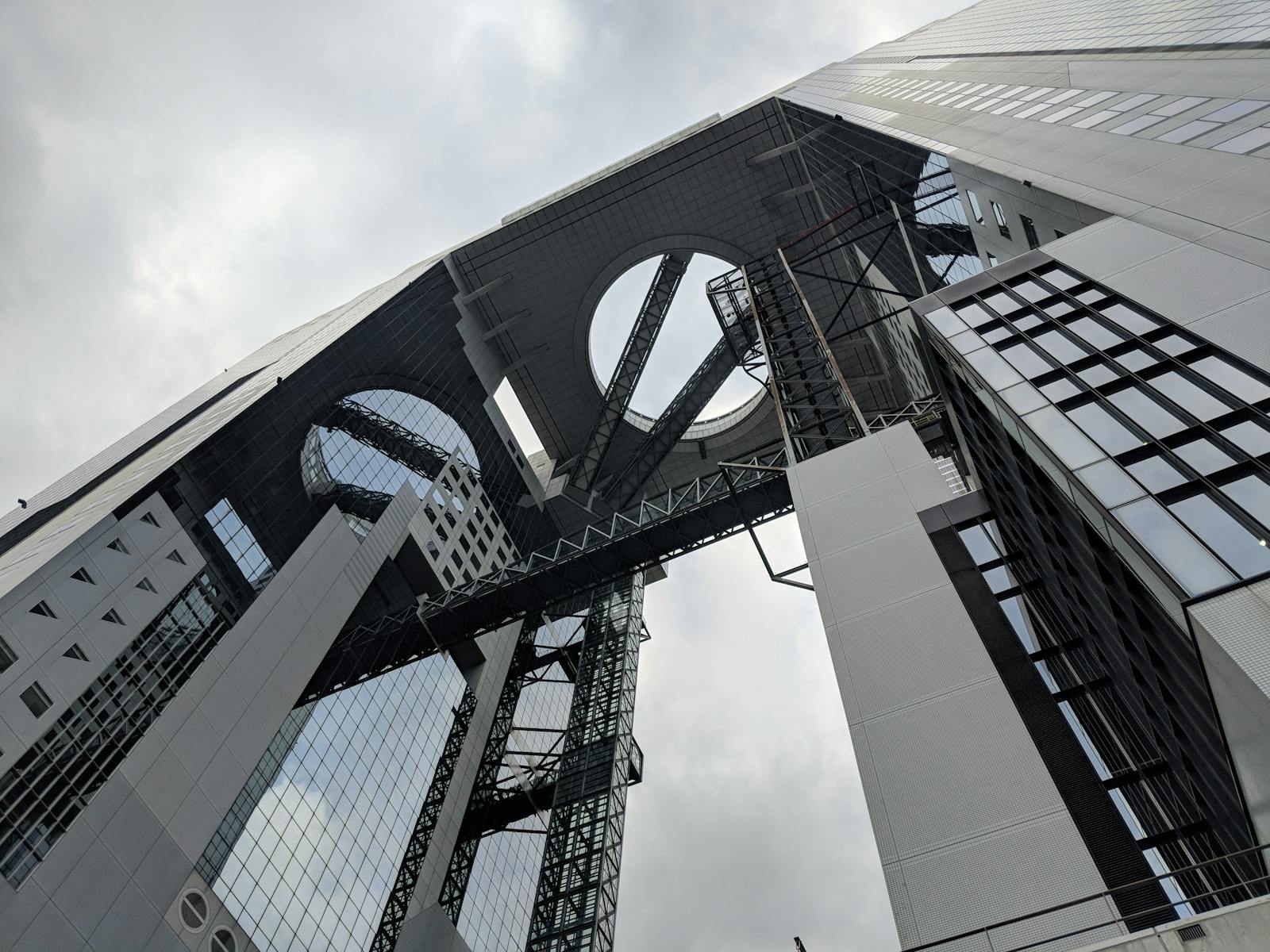
The observatory at the top is called Harukas 300, after the building’s height, and it is the most straightforward of Osaka’s big viewpoints: enclosed, warm, very high, and open from nine in the morning until ten at night, every day of the year. It is not the most atmospheric — that is still the Umeda Sky Building, with its open-air roof — but it is the one that works in any weather, and on a clear day it simply sees further than anything else in the city.
This guide covers what a ticket costs in 2026, when to go, what is on each of the three observatory floors, whether the Edge walk is worth paying extra for, and how to fold the tower into a day in the south of the city rather than making a special trip across town for it.
The essentials
| Admission | Around ¥2,200 adult (15 and over) at the counter; around ¥900 age 6–14; under 6 free. A little less if booked online by the day before |
| Opening hours | 09:00–22:00 every day, last entry 21:30 |
| Tickets sold | 16th-floor counter, or the official web ticket store |
| Observatory floors | 58, 59 and 60 |
| Nearest stations | Tennoji (Midosuji and Tanimachi lines, JR) and Kintetsu Osaka-Abenobashi, directly underneath |
| Time needed | 60–90 minutes; nearer two hours if you stay through sunset |
| Osaka Amazing Pass | Not one of its free entries |
What the building actually is
The name is a good place to start. Harukas comes from an archaic verb, harukasu, meaning roughly to clear up or to brighten — the kind of word that turns up in classical poetry and, it turns out, in corporate naming committees. Kintetsu, the railway company whose Osaka-Abenobashi terminus sits underneath, opened the tower in 2014 as a vertical city: its own department store across the lower floors, the Abeno Harukas Art Museum on the sixteenth, offices through the middle, the Osaka Marriott Miyako Hotel from the thirty-eighth floor upwards, and the observatory on top.
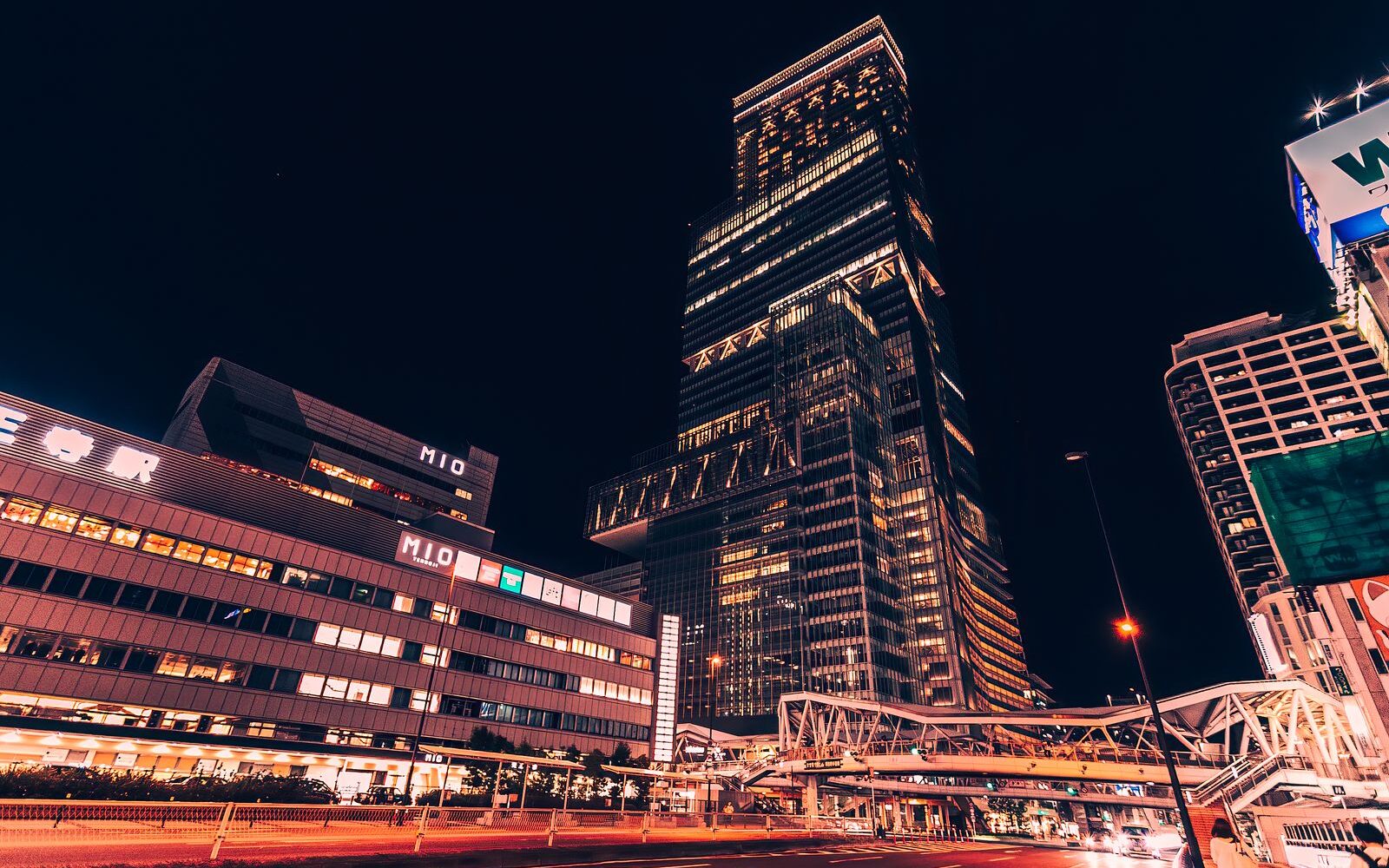
At 300 metres it was Japan’s tallest building from 2014 until 2023, when Tokyo’s Azabudai Hills Mori JP Tower edged past it. Older guidebooks and plenty of tour listings still call it the tallest in the country; it is not, but it remains the tallest in Osaka and in western Japan by a wide margin. More usefully for a visitor, it stands almost on its own. There is nothing remotely that height for kilometres in any direction, so nothing blocks the view out — and, for the same reason, you can see the tower from half the city, which makes it a handy landmark when you are lost in the south.
The building steps back as it rises, in stacked blocks, with open voids cut into the structure. From the street it looks less like one tower than several glass boxes piled up with gaps between them, and those gaps are not decoration: one of them is the open-air courtyard on the fifty-eighth floor, which is the closest this observatory comes to letting you feel the wind.
Tickets, prices and the passes that do not cover it
The ticket counter is on the sixteenth floor. Follow the Harukas 300 signs to the lifts that serve it; once you are inside the building the signage is clear, though it is easy to wander into the department store first and spend twenty minutes among handbags.
- Adults (15 and over): around ¥2,200 at the counter.
- Children (6–14): around ¥900.
- Under 6: free, which makes this one of the kinder viewpoints for families with small children.
- Online: the official web ticket store sells date-specific tickets for a couple of hundred yen less, provided you book by the day before.
That online deadline is more useful than the discount. Because it lets you book as late as the day before, you can wait until you have seen the forecast, which is exactly how you should buy a ticket for a view. Booking a fortnight ahead for a specific date and then waking up to haze is the most common way people waste the money. Buy the evening before, once you know the next day will be clear.
Three more ticket rules worth knowing. There is no re-entry on a standard ticket, so if you want daylight and the night view, arrive before sunset and stay rather than planning to come back. Tickets cannot be refunded or reissued once bought. And on busy days the counter may hand out numbered tickets for same-day sales, which effectively gives you an appointment later in the afternoon — one more reason to book online on a weekend or a public holiday.
Now the passes. Harukas 300 has not been one of the Osaka Amazing Pass’s free entries, so do not plan a pass day around it; our Osaka Amazing Pass guide lists what the pass does cover and the before-15:00 rule that applies to several of them. A few regional attraction bundles sold to tourists do include the observatory, the Have Fun in Kansai Pass among them. They save money only if you will genuinely use most of what they include, which is rarer than the marketing implies — do the arithmetic before you buy, the way our day pass comparison does.
Getting there
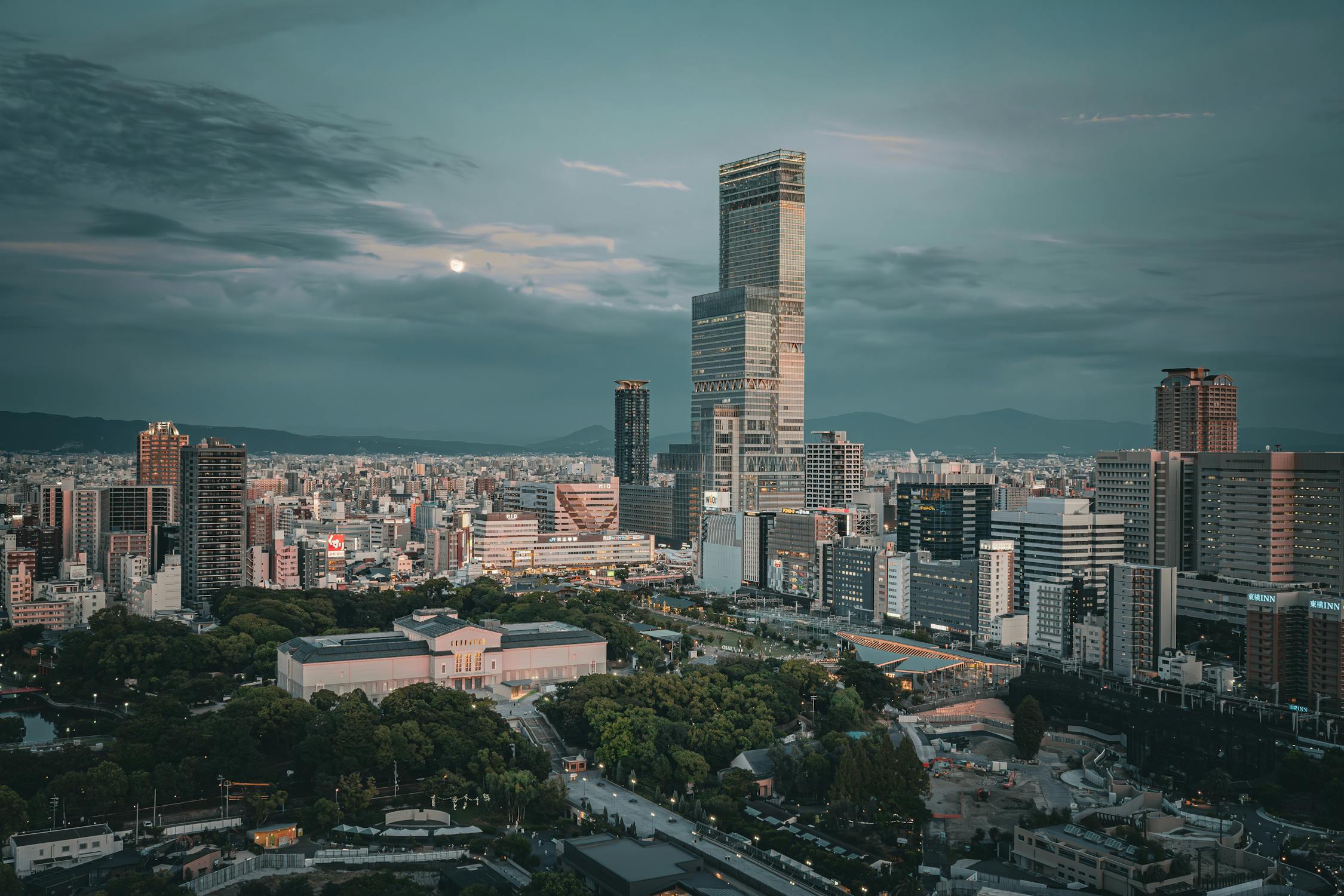
Abeno Harukas sits on top of one of the biggest transport interchanges in the city, so getting there is the easy part.
- From Umeda or Namba — the Midosuji subway line runs straight down to Tennoji: about 15 minutes from Umeda, under 10 from Namba. Follow the signs for Abeno Harukas through the underground concourse. Our subway guide explains the lines.
- By JR — Tennoji is on the Osaka Loop Line, around 20 minutes from Osaka Station, and on the lines heading south towards Wakayama and the airport.
- By Kintetsu — Osaka-Abenobashi station is literally underneath the tower. This is the terminus for Kintetsu trains to Yoshino and the southern Nara countryside, not the line to Nara city, which runs from Namba.
- From Kansai Airport — the Haruka limited express stops at Tennoji, which makes the observatory an easy first-evening or last-afternoon stop with bags in a locker. See Kansai Airport to Osaka and luggage storage.
Tap through everything with an ICOCA card. The Tennoji station complex is large but far less confusing than Umeda, and the tower itself is visible from nearly every exit, which helps.
The three observatory floors
A high-speed lift takes you from the sixteenth floor to the sixtieth, and the observatory then works its way back down through three floors. Do them in the order the building intends, which is top first.
The 60th floor: the glass corridor
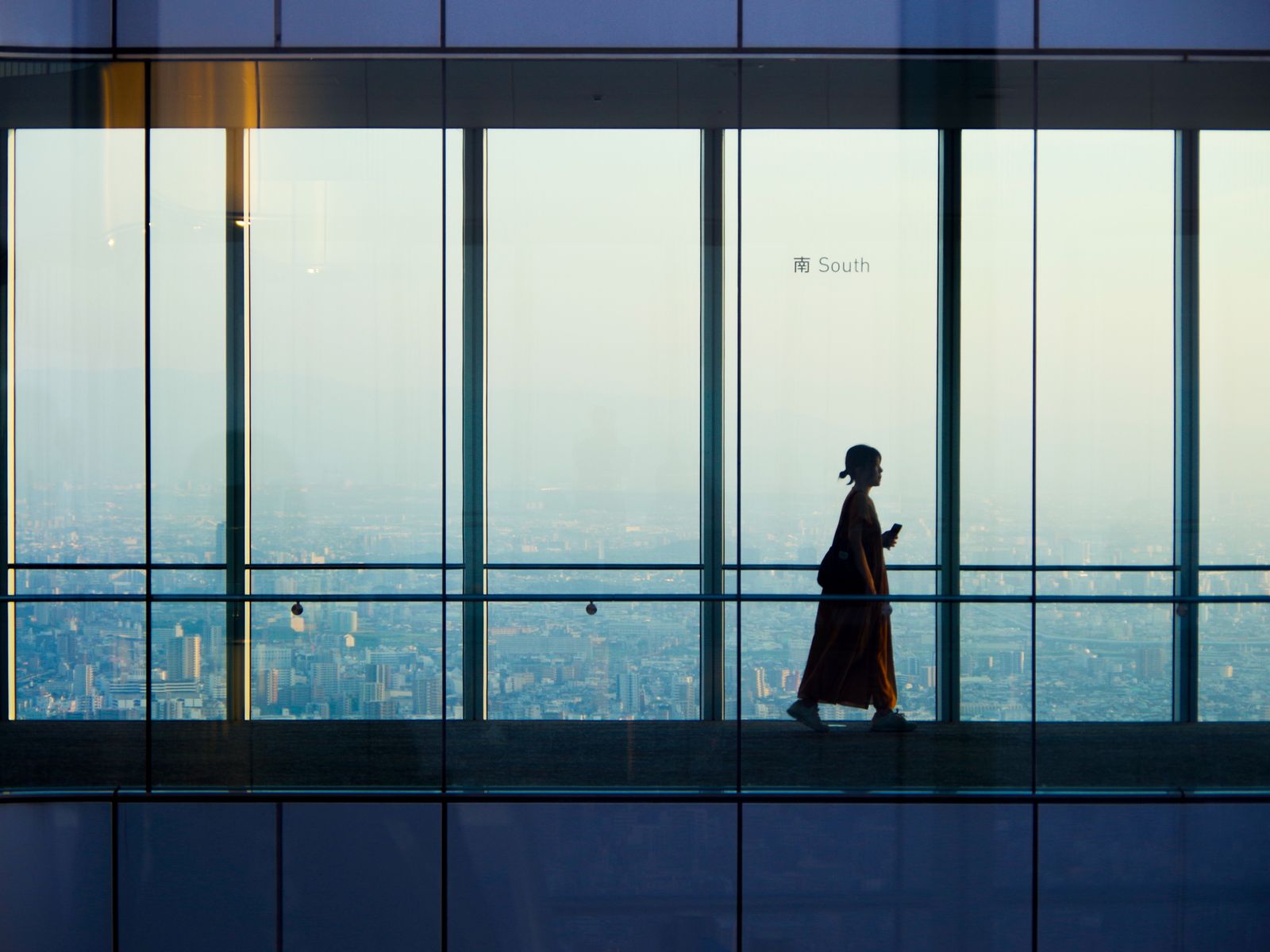
This is the main event: a continuous corridor running all the way round the top of the tower, glass from floor to ceiling, with the windows labelled by compass direction. It is the least complicated great view in Osaka. You walk the loop, the city turns beneath you, and at no point is there anything in the way. A slow circuit takes ten minutes; a proper one, with stops to work out what you are looking at, takes half an hour.
The height changes the character of the view in a way that is hard to explain until you are up there. From the Umeda Sky Building you look across at a city of towers. From here you look down on it, and the towers mostly disappear into a single grey grid that runs until the mountains stop it. It is less dramatic and more humbling. The scale of the Osaka plain, and how much of it is built on, is the thing most visitors mention afterwards.
The 58th and 59th floors: courtyard, café and shop
Below the corridor, the observatory opens out into the building’s hollow top. The fifty-eighth floor has Tenjo Hiroba, the “sky courtyard”, a roofless wooden deck set inside the tower’s upper void. You do not get the view from here — the walls of the building rise around you — but you do get the sky directly overhead and moving air, which after half an hour behind glass is surprisingly welcome. It is lit in the evening and at its best then.
There is a café on the same floor and a gift shop on the way out. The café is priced for its location: you are paying for the seat, not the coffee. On a quiet weekday afternoon, with a window seat, that is a fair trade. On a busy Saturday it is not, and you are better off heading down and finding somewhere cheaper at street level.
Edge the Harukas: worth the extra?
Above the observatory, on the roof of the tower itself, is Edge the Harukas, which the operator bills as Japan’s first “cliff experience”. Clipped into a harness and led by staff, you walk the edge of the roof at around 300 metres, with no glass between you and the drop. It is a separate ticket on top of observatory admission, runs in small timed groups, has age and height restrictions, and stops when the wind picks up or it rains — which, at that height, is often.
Our verdict is simple. Edge the Harukas is a thrill product, not a view product. The view from the roof is the same one you already paid for on the sixtieth floor, with fewer chances to stop and look. If the idea of standing on the lip of a skyscraper excites you, it is well run and memorable, and far better value than most things in Osaka that sell adrenaline. If it does not excite you, do not let a tick-box instinct talk you into it. Check the current price, slot times and restrictions on the official site before you go, since all three change.
When to go
The advice we give for every observation deck in the city applies here: arrive about forty-five minutes before sunset. You get the daylight view, the sunset, and the city switching itself on, all on one ticket. Sunset in Osaka runs from around 16:50 in December to around 19:15 in June, so the target time moves by more than two hours across the year.
- Clearest air: winter, roughly December to February, and the day after a typhoon or a big weather front has passed through, when the haze gets scrubbed out of the sky. Our Osaka in winter guide has the rest of the season.
- Haziest: a humid summer afternoon. You will still see Osaka, but the mountains and the bay turn into a pale blur. Osaka weather by month explains the pattern.
- Quietest: opening time at 09:00 on a weekday. Harukas opens an hour earlier than the Umeda Sky Building, and a morning visit, with the sun behind you lighting the view west towards the bay, is underrated.
- Busiest: weekend and holiday evenings around sunset, Golden Week, the New Year period, and clear December evenings when the winter illuminations are on.
One test before you pay, which costs nothing and saves a lot: look up at the top of the tower from the street. On a day of low cloud the upper floors can be inside it. If you cannot see the top of the building, you will not see anything from the top of the building either.
Rain on its own is not a reason to skip it. This is a fully enclosed deck, which makes it one of the best options in the city on a wet evening, provided the cloud is above the tower rather than wrapped round it. More ideas for grey days are in rainy day Osaka.
What you are actually looking at
The direction labels on the glass help, but the observatory is thin on explaining what lies in each direction. A rough orientation from the sixtieth floor:
- North — the towers of Umeda, about eight kilometres away, form the only other real cluster of height in the city; the twin towers of the Umeda Sky Building are among them. Osaka Castle sits in the parkland between here and there, a little to the right, and is surprisingly hard to pick out unless it is floodlit.
- West — the port, the bay and the artificial islands, with the ferris wheel of the bay area visible at dusk. Further round to the north-west, Kobe and the ridge of Mount Rokko, and on the clearest days the Akashi Kaikyo Bridge and the shape of Awaji Island.
- South — the flattest, least interrupted view, running down through the suburbs towards Sakai. The forested mounds of the ancient Mozu kofun tombs are down there; the famous keyhole shape, however, needs an aeroplane rather than a tower to make out. Kansai Airport’s island is visible on exceptional days.
- East — the long ridge of the Ikoma mountains, which marks the border with Nara prefecture, and closer in, the pagoda of Shitennoji.
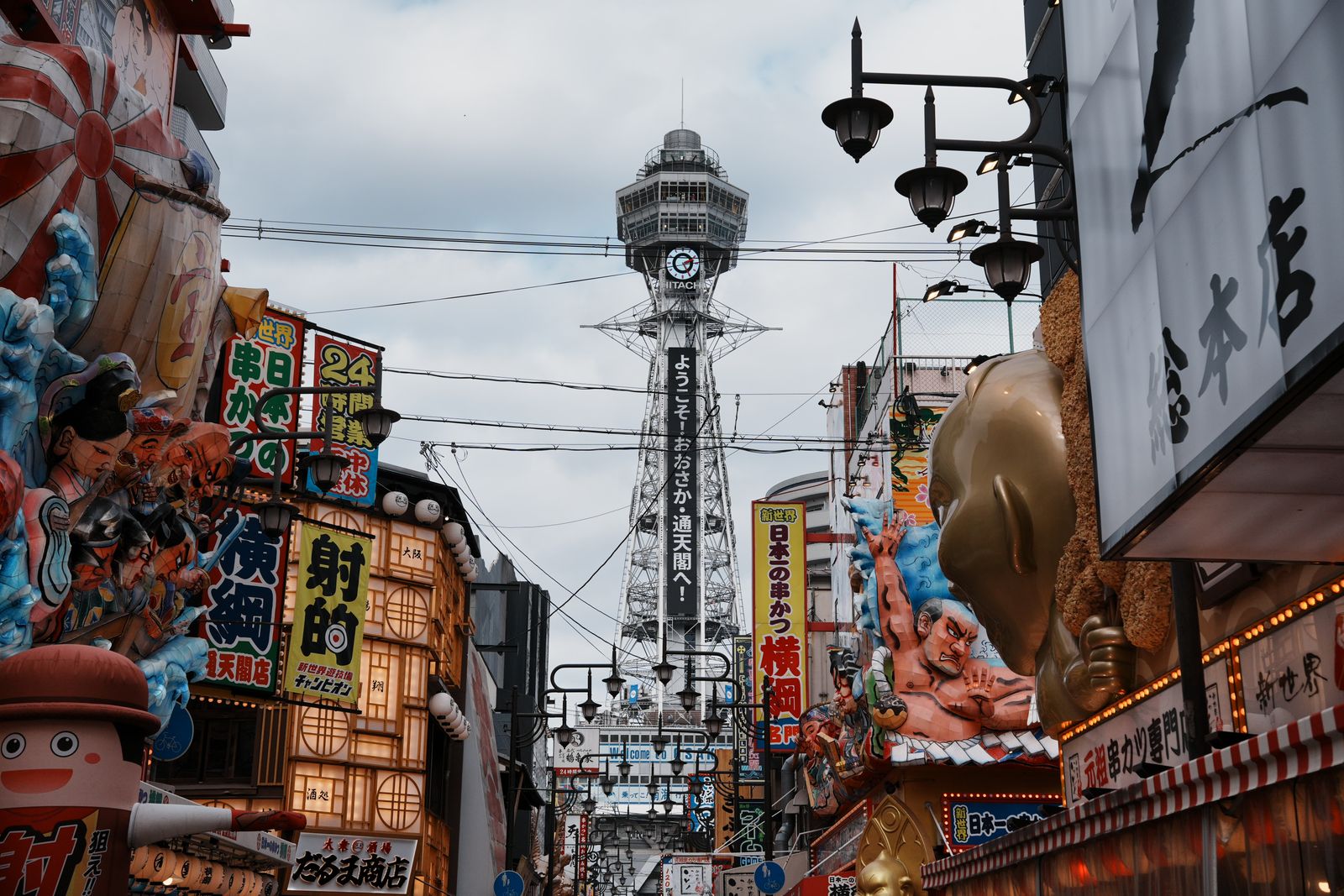
- Straight down — Tennoji Park and the zoo, and just to the west, the grid of Shinsekai with Tsutenkaku in the middle of it like a model on a railway layout.
That last view is the one to seek out. Looking down on Shinsekai from three hundred metres, then walking there afterwards and looking back up at the tower, is the best way to understand how this corner of the city fits together.
Eating and drinking in the building
You can spend a whole evening in Abeno Harukas without going outside, and it is worth knowing which parts of that are good value.
- The basement food hall. The Kintetsu department store’s depachika (basement food floors) is enormous and excellent, and in the last hour before closing, prepared food gets discounted. Picnic supplies for Tennoji Park, or dinner to take back to the hotel. Our department stores guide explains how depachika work.
- The restaurant floors. Near the top of the department store section are floors of mid-range restaurants, several with window tables. They are pleasant and fairly priced for a department store; nothing here is a destination, but everything is reliable.
- The observatory café. Worth it for one drink on a quiet afternoon, as above.
- The Marriott. The Osaka Marriott Miyako Hotel’s bars and restaurants sit high in the tower and are the splurge option. They are lovely; they are also lower than the observatory, so if the view is the point, the observatory gives you more of it for less. Our rooftop bars guide makes the same point about several of the city’s high-floor bars, and luxury hotels in Osaka covers staying there.
Our honest recommendation is to eat elsewhere. Shinsekai is a fifteen-minute walk away and it is where you should be having kushikatsu — remember the one rule, no double-dipping in the communal sauce pot. Or ride the loop line to Tsuruhashi for dinner.
Tsuruhashi, Osaka’s Koreatown, is three stops round the JR Loop Line from Tennoji and the best place in the city for grilled meat — see our guide to yakiniku in Tsuruhashi.
The Abeno Harukas Art Museum
On the sixteenth floor, next to the observatory ticket counter, is the Abeno Harukas Art Museum, which runs a rotating programme of temporary exhibitions: Japanese painting, Buddhist art, ukiyo-e, design, occasionally a big international loan show. It has no permanent collection, so whether it is worth your time depends entirely on what is on. Check before you go; if the current show appeals, it pairs naturally with the observatory, since you are on the right floor anyway. Separate ticket. Our Osaka art galleries and museums guides cover the city’s permanent collections.
Around the tower: a southern half-day
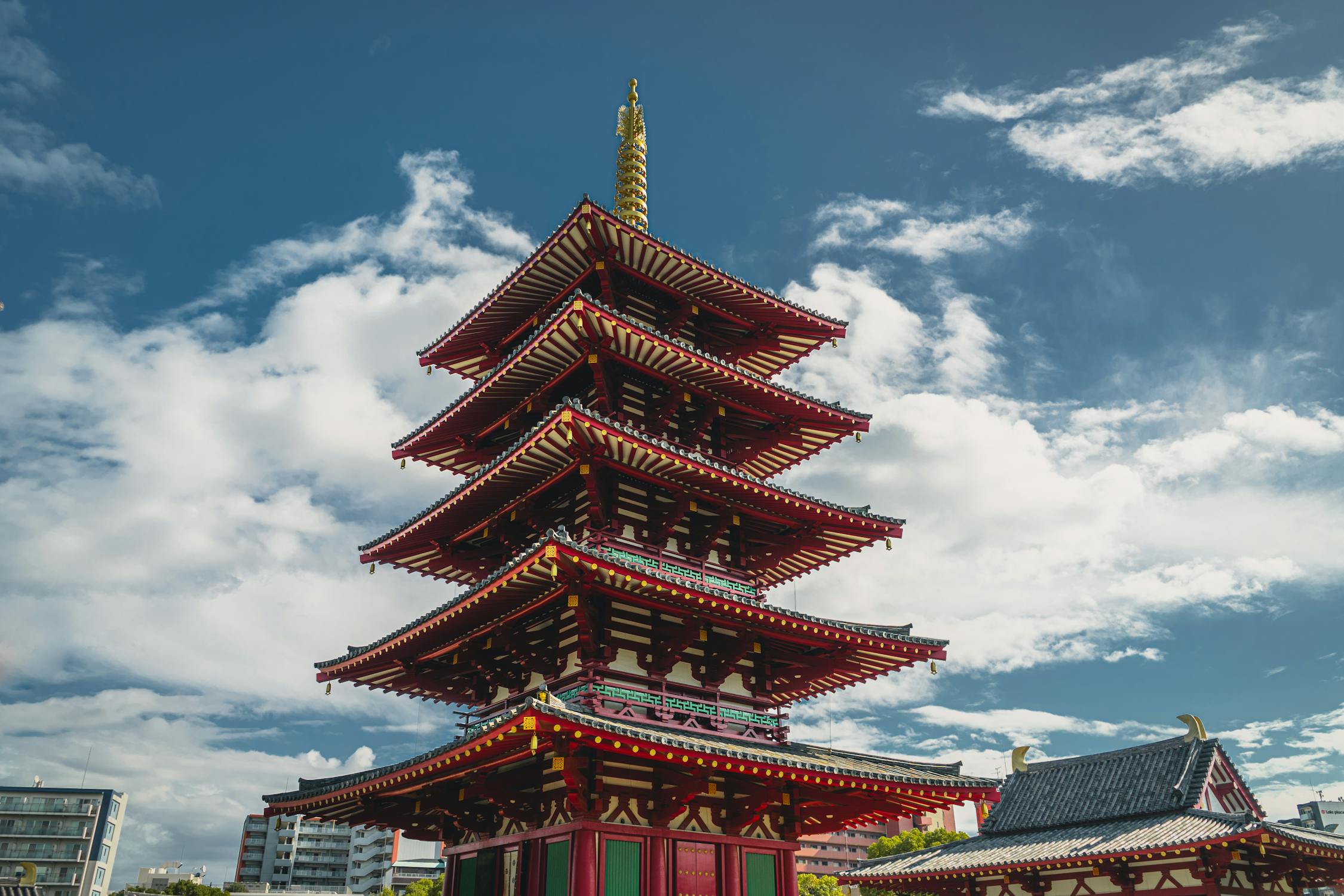
The mistake is to treat Abeno Harukas as a stand-alone trip from Namba or Umeda. It is much better as the end of a day spent in the south of the city, which has more to see within walking distance than most visitors realise. Our Tennoji and Abeno guide covers the district properly; the short version:
- Shitennoji — about fifteen minutes’ walk north. Founded in 593 by Prince Shotoku, rebuilt many times, and still laid out on its original Asuka-period plan. Go on the 21st or 22nd of the month if you can, when a flea market fills the grounds.
- Isshinji — a short walk from Shitennoji, and one of the strangest temples in Japan: its Buddha statues, the okotsubutsu, are made from the cremated bones of people whose families entrusted them to the temple.
- Tennoji Park — directly across the road, with the free Tenshiba lawn and its cafés at the station end, the Keitakuen garden, the city’s museum of fine art and Tennoji Zoo. More in Osaka parks and gardens.
- Shinsekai — a ten- to fifteen-minute walk west through the park. Retro neon, kushikatsu counters and Tsutenkaku.
- The Hankai tram — Osaka’s last streetcar line runs south from Tennoji-ekimae, in front of the tower, to Sumiyoshi Taisha. Slow, cheap and charming.
A sequence that works well: Shitennoji and Isshinji in the morning, lunch in Shinsekai, an hour in Tennoji Park, the observatory from about forty-five minutes before sunset, then dinner in Tsuruhashi or back in Shinsekai. That is a full, unhurried day with very little time on trains, and it shows you a side of Osaka that visitors who never leave Namba and Umeda miss entirely. It slots into the longer plans in our Osaka itinerary hub and the 3 days in Osaka itinerary.
How it compares
| Harukas 300 | Umeda Sky Building | Tsutenkaku | |
|---|---|---|---|
| Adult ticket | Around ¥2,200 | Around ¥1,500 | Cheaper |
| Height | Top of a 300 m tower | About 170 m | A tower of about 100 m |
| Open air? | No, apart from the courtyard and the paid Edge walk | Yes — rooftop deck | Partly |
| Hours | 09:00–22:00 | 10:00–22:30 | Shorter |
| Amazing Pass | No | Free before 15:00 | Check the current list |
| Best for | Sheer height, bad weather, mornings | Sunset, open air, photographs | Retro Shinsekai atmosphere |
Which one? If you want a single view and you want it to be the biggest one, this is it, and it is the clear choice on a wet or bitterly cold night and for anyone staying in the south. The Umeda Sky Building wins on atmosphere, sunset and photography, because its roof is open and the glass is not in the way; its open-air deck is simply a more memorable experience. Tsutenkaku is not really about the view at all. Our Osaka observation decks guide compares every option in the city, including the free ones, and free things to do in Osaka lists the no-cost viewpoints.
Is Abeno Harukas worth it? The honest answer
Yes, for most first-time visitors, with two conditions: go on a clear day, and go at the right time.
It is at its best when you want height and certainty. It opens early, stays open late, does not care about rain, and on a clear winter afternoon shows you most of the Kansai plain in a single loop of a corridor. For families it is good value, since under-sixes go free. If you are staying in the south, around Tennoji or Namba, it is the obvious choice of the big viewpoints.
Where it is less convincing is as a second observatory. At around ¥2,200 an adult, it is not cheap, and if you have already done the Umeda Sky Building on the same trip, a second view of the same flat city from a different angle adds much less than the first. On a three-day trip, pick one. We would choose Umeda for a sunset and this one for a morning, a wet day, or sheer altitude.
And there are days to skip it outright: when the top of the tower is in cloud, and on a hazy midsummer afternoon, when you will pay full price for a pale grey smudge. On those days, spend the money on dinner instead — our Osaka food guide will not have any trouble finding a use for it.
Practical notes
- Allow 60–90 minutes from ticket counter to street, longer through sunset. There is no re-entry, so have eaten first.
- Photography: after dark the glass reflects the interior lighting. Press your lens or phone flat against the window and cup a hand or a dark jacket around it. Tripods are not a good idea in a busy corridor.
- Accessibility: the whole route is lift-served, which makes this the easiest of Osaka’s big viewpoints for wheelchair users and pushchairs. The Umeda Sky Building’s famous open-air escalator has no equivalent here.
- With children: under sixes are free, and pairing the tower with Tennoji Zoo across the road makes an easy family day — see Osaka with kids.
- Luggage: leave suitcases in the coin lockers at Tennoji station rather than taking them through the department store.
- Heights: unlike the Umeda Sky Building’s glass escalator, nothing here is designed to frighten you. Anyone nervous about heights will be fine on the observatory floors.
- Special closures: the observatory occasionally changes its hours for events. The official site posts notices, so it is worth a quick look on the day.
Abeno Harukas FAQ
How much does Abeno Harukas cost?
Around ¥2,200 for adults (15 and over) and around ¥900 for children aged 6–14 at the counter; under 6 is free. Booking online by the day before is slightly cheaper. These are 2026 figures and Japanese admission prices have been rising every year, so check the official site before you go.
What are the Harukas 300 opening hours?
09:00 to 22:00, every day of the year, with last entry at 21:30. The observatory occasionally changes its hours for special events, which are posted on the official site.
Is Abeno Harukas the tallest building in Japan?
Not any more. At 300 metres it held the title from 2014 until 2023, when the Azabudai Hills Mori JP Tower in Tokyo overtook it. It is still the tallest building in Osaka and in western Japan.
Is Abeno Harukas included in the Osaka Amazing Pass?
No — it has not been one of the pass’s free entries. Some regional attraction bundles, such as the Have Fun in Kansai Pass, do include it. Check the current list of any pass before you buy it for this.
Abeno Harukas or the Umeda Sky Building?
Abeno Harukas for sheer height, a morning visit, bad weather or if you are staying in the south. The Umeda Sky Building for sunset, open air and photographs. On a short trip, one is enough.
Is Edge the Harukas worth it?
Only if the thrill appeals. It is a harnessed walk around the edge of the roof at around 300 metres, separately ticketed, and it closes in wind and rain. The view is essentially the one you already have from the sixtieth floor.
How long do you need at Harukas 300?
An hour to ninety minutes, or closer to two if you arrive before sunset and stay for the lights, which is what we recommend.
How do I get to Abeno Harukas?
Take the Midosuji subway line to Tennoji — about 15 minutes from Umeda and under 10 from Namba — or JR to Tennoji, or Kintetsu to Osaka-Abenobashi, which is directly underneath the tower. The Haruka airport express from Kansai Airport also stops at Tennoji.
Where to go next
Compare the options in our Osaka observation decks guide, and read the Tennoji and Abeno guide for the district the tower stands in. If you are building a whole day around the south, start with Shinsekai and Shitennoji.
For everything else, start with things to do in Osaka, plan with our Osaka itinerary hub, and pick up the practical details in Osaka travel tips before you fly.