This article contains advertising. Our booking links are routed through a partner that adds commission tracking automatically, so if you book through one we earn a commission from the provider, at no extra cost to you. It never affects what we recommend. Affiliate disclosure
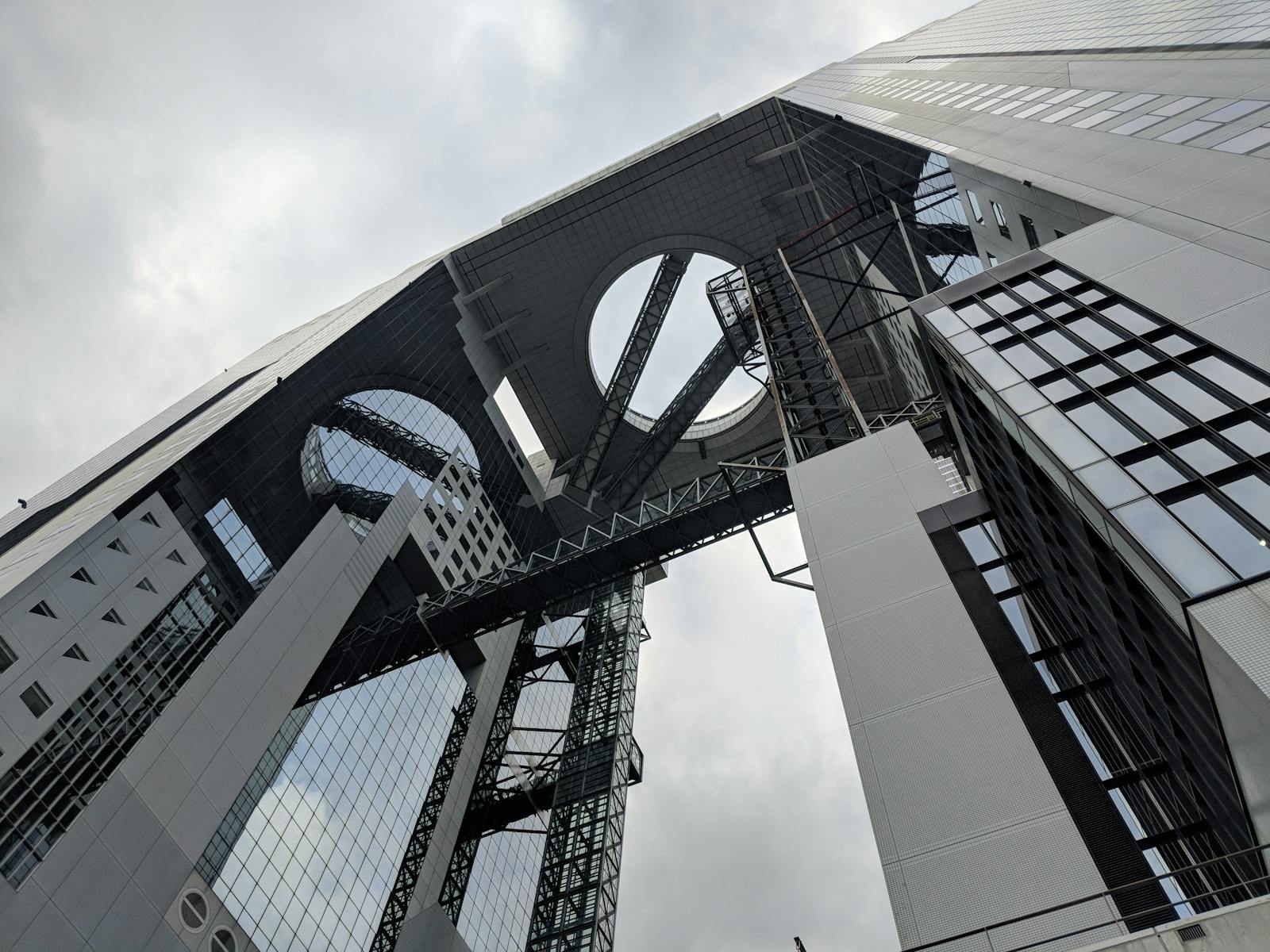
There is a moment on the way up the Umeda Sky Building that decides whether you love the place. You have taken a lift to the thirty-fifth floor, and then you step onto an escalator that is not inside anything — a glass tube slung diagonally through open air between two towers, forty floors up, with the city visible beneath your feet through the gaps. People go quiet on it. Some people go back down.
That escalator is the reason to come here rather than to one of Osaka’s taller, newer, more comfortable observation decks. Abeno Harukas is higher. The Umeda Sky Building is better, because it is an experience rather than a window, and because the top of it is open to the sky.
The essentials
| Admission | Around ¥1,500 adult; ¥800 junior and senior high; ¥500 age 4 to elementary |
| Opening hours | 10:00–22:30, last admission 22:00 |
| Height | Observatory across floors 39 and 40 plus the open-air rooftop |
| Nearest station | Osaka / Umeda — about a 9-minute walk |
| Time needed | 60–90 minutes, longer at sunset |
| Best time | Arrive 45 minutes before sunset |
What it actually is
The Umeda Sky Building opened in 1993, designed by Hiroshi Hara, and it was an extraordinarily strange thing to build at the time: two forty-storey towers connected at the top by a suspended ring called the Kuchu Teien, the Floating Garden Observatory. The original plan was for four towers. Two got built, which is arguably why it works — the gap between them is the whole design.
The observatory occupies floors 39 and 40 and then opens onto the roof, which is the part that matters. Most observation decks in Japan put you behind glass. This one lets you stand outside at 170-odd metres with the wind on you and the whole of northern Osaka laid out below. On a clear evening you can see out to Osaka Bay in one direction and to the mountains beyond the city in the other.
Getting there, and the walk that catches people out
The building is about nine minutes on foot from Osaka Station and the Umeda cluster, and the walk is the single most complained-about part of the visit. You have to pass under the railway lines through a pedestrian underpass, which is well signposted but feels wrong — you go down, along, and up again, and more than one visitor has turned back convinced they have gone the wrong way. You have not. Keep going.
- From JR Osaka Station — leave by the Central North Gate and follow signs for the Sky Building. Roughly nine minutes.
- From Umeda (Midosuji subway) — about twelve minutes, through the station complex first.
- From Namba — Midosuji line to Umeda, around eight minutes on the train, then the walk.
Use an ICOCA card and tap through. Umeda’s underground network is genuinely disorienting — our Umeda guide explains the layout, and the subway guide covers the lines.
Tickets, and the Amazing Pass trap
Buy at the counter on the third floor, or online in advance. Advance booking is worth it on a weekend evening and unnecessary on a weekday afternoon.
The Osaka Amazing Pass includes the observatory — but only before 15:00. After that it drops to roughly a ten per cent discount. This single rule is the most common way visitors waste money on the pass: they save the “free” observatory for the evening view, arrive at six, and discover they are paying almost full price. If you are using the pass, either come in the early afternoon and accept a daylight view, or accept that this is the attraction you will pay for. Our Osaka Amazing Pass guide has the full list of which attractions carry the restriction.
The honest verdict on that trade-off: come at sunset and pay. The daytime view from here is fine and unremarkable. The sunset and night view is why the building has a reputation.
The escalator
Worth its own section, because it is the attraction. From the thirty-fifth floor you transfer to a pair of escalators that run through a transparent tube bridging the gap between the two towers. There is nothing beneath you but the city.
If you have a serious problem with heights, this is a genuine consideration — there is no alternative route up, and turning around halfway is awkward. Most people who are mildly nervous find it fine, because the sides are enclosed and it is over in under a minute. Look forward rather than down if you would rather not test it.
The rooftop
The rooftop deck is a circular walkway open to the sky, ringed by a high glass barrier you can shoot over the top of. In practice this means the photographs are better here than at any enclosed deck in the city, because there is no glass in the way and no reflections to fight.
- The floor is embedded with luminous stones that glow after dark, which sounds naff and is actually rather lovely.
- Lumi Sky Walk is the name given to the illuminated evening version of the deck. It is the same deck, lit.
- Padlocks line one section — the standard couples’ ritual. Skip it or join in as you prefer.
- It is genuinely windy. At forty floors, in December, with nothing between you and the sky, it is cold in a way the enclosed decks are not. Bring a layer — see what to pack for Osaka.
- In rain the roof may close, leaving only the enclosed indoor floors, which halves the point of coming. Check the forecast; rainy day Osaka has alternatives.
Timing it
The single best piece of advice about this building: arrive about forty-five minutes before sunset. You get the daylight view, the sunset itself, and the city lighting up, all on one ticket. Turn up after dark and you have paid the same for a third of the experience.
Sunset in Osaka runs from around 16:50 in December to around 19:15 in June, so the target time moves considerably across the year. Check the day’s sunset and work back.
- Quietest: weekday mornings, and the last hour before closing at 22:30.
- Busiest: Friday and Saturday evenings around sunset, and any clear evening in autumn.
- Best visibility: winter, when the air is clearest — see Osaka in winter.
- Worst: a humid August evening, when haze flattens the view. Osaka in summer explains the trade.
What you are actually looking at
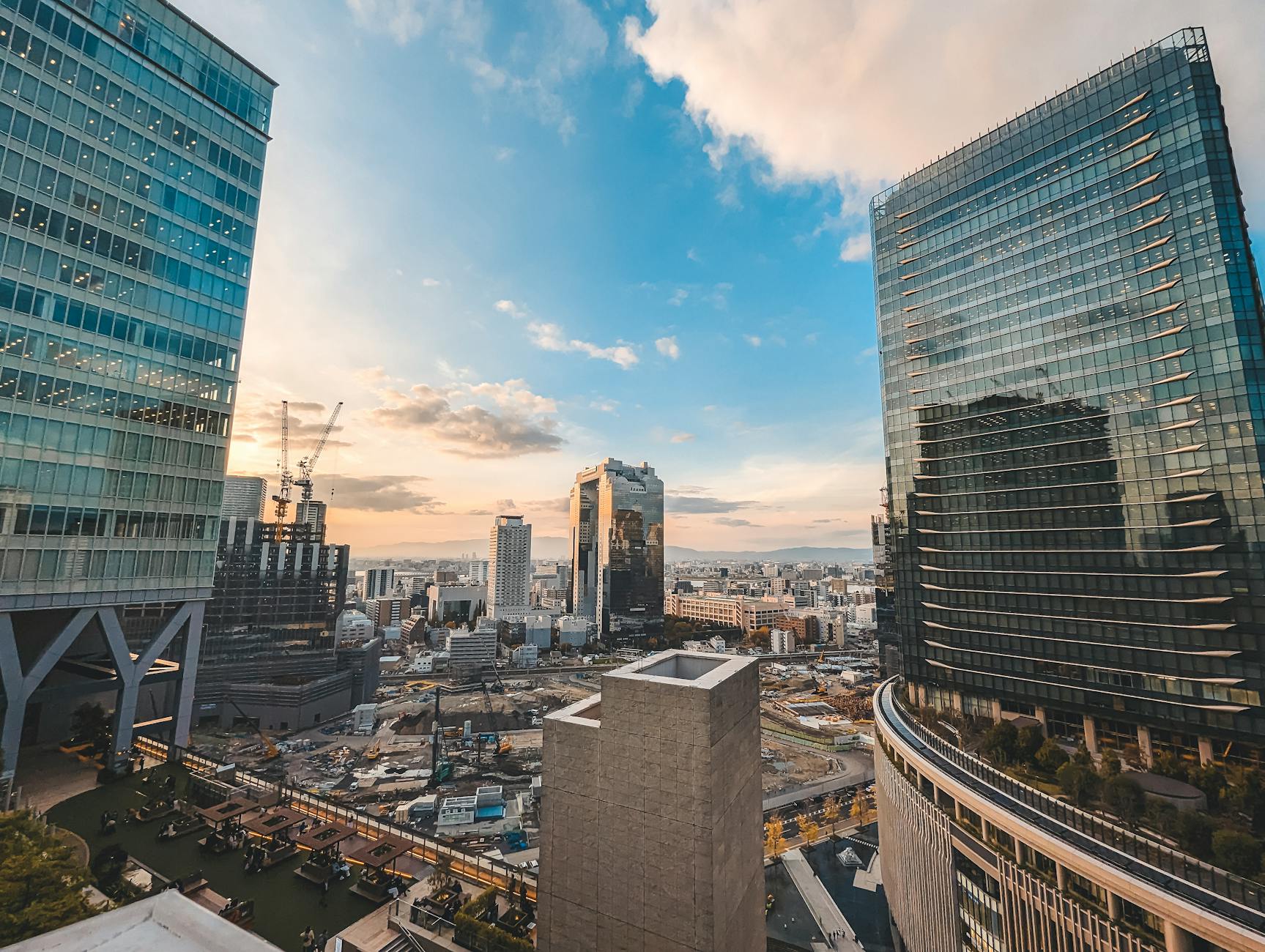
Half the value of an observation deck is knowing what you are pointing at, and the Sky Building’s own signage is thin on this. A rough orientation from the rooftop:
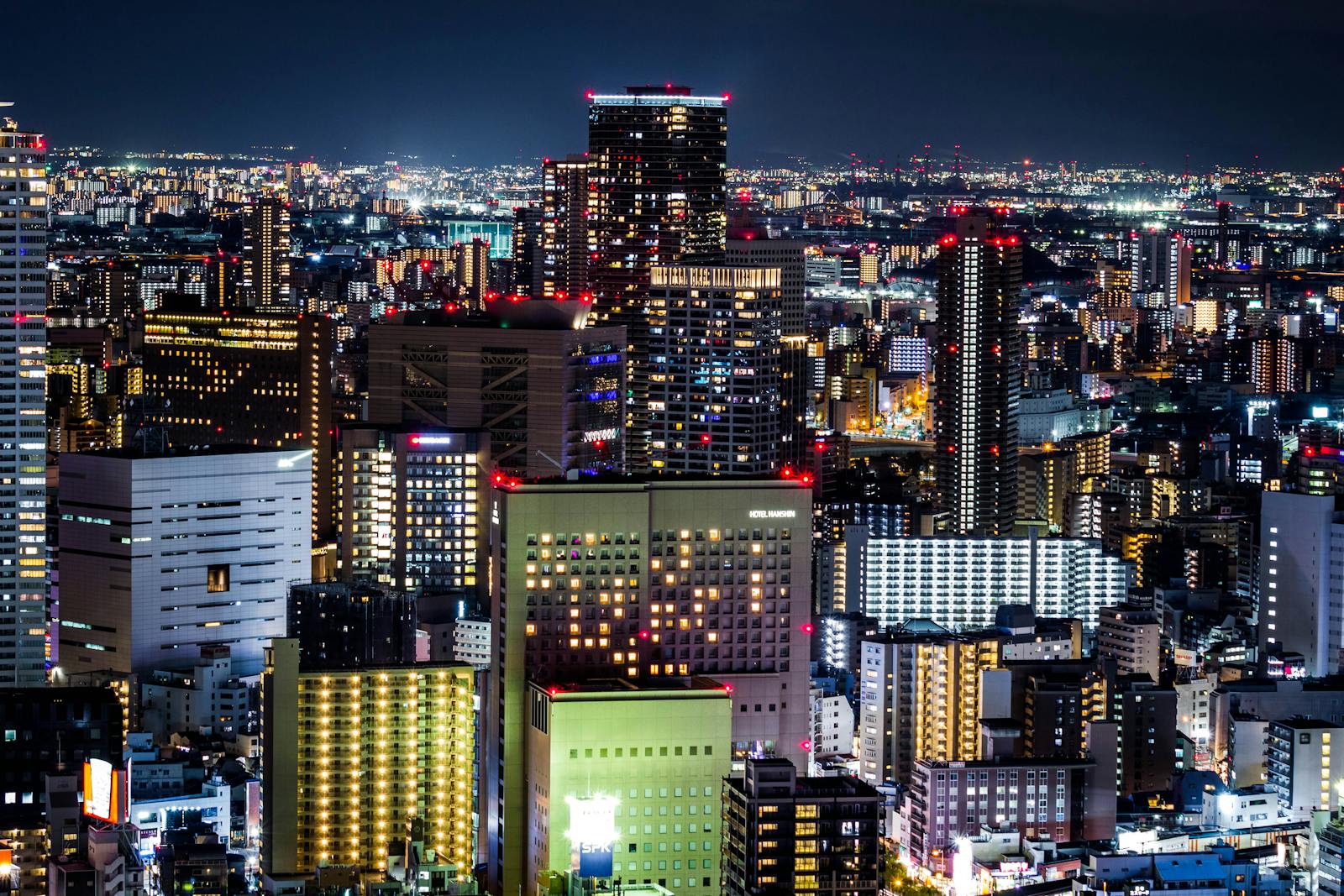
- South — the dense grid of central Osaka, with the Midosuji line running away from you through Shinsaibashi and Namba. On a clear evening you can pick out Abeno Harukas, the tallest building in the country, standing alone at the far end. That is Tennoji, about eight kilometres away.
- West — the Yodogawa river mouth and Osaka Bay beyond it, with the ferris wheel and the bay area silhouetted at dusk. On the clearest winter days you can see across to Kobe and the Akashi Kaikyo bridge.
- East — the Ikoma mountains, which mark the boundary with Nara prefecture. Osaka Castle is somewhere in the middle distance and is genuinely hard to pick out among the towers unless it is floodlit.
- North — the suburbs running towards Minoo and the Senri hills, greener and lower than anything else on the horizon.
The thing that surprises most first-time visitors is how flat and how vast Osaka is. There is no natural high ground inside the city, so the built-up area simply keeps going until the mountains stop it. That is why the view from a moderate height here reads as more impressive than the same height would in a hillier city.
The building itself
It is worth ten minutes of attention as architecture, not just as a viewing platform. Hiroshi Hara’s design was a deliberate provocation in early-1990s Osaka: rather than build one tall tower, he built two and connected them at the top, creating a hole in the middle of the structure that serves no commercial purpose whatsoever.
The original scheme called for four towers linked by a ring — a “city in the air”. Japan’s asset bubble burst during construction and two towers were built instead. The result is more interesting than the plan would have been, because the gap between the towers frames the sky and gives the building its silhouette.
The ground-level plaza between the towers is free to walk into, and it is worth doing before you go up. Looking straight up through the void at the ring overhead is the best photograph of the building, and it costs nothing. There are steps and a small waterfall feature, and it is a pleasant enough place to sit for twenty minutes while you wait for the light to turn.
Seasonal and evening events
The building runs a rotating programme of seasonal decoration and lighting, and it is one of Osaka’s better winter illumination spots — the plaza between the towers is used for a German-style Christmas market in December, which is genuinely popular with locals rather than being a tourist confection. Our Osaka in winter and festival calendar pages cover the season’s illuminations more broadly.
In cherry blossom season the surrounding Shin-Umeda City grounds get busy in the early evening, and in summer the rooftop stays comfortable long after street level has stopped being pleasant, which is a genuine argument for a late visit in July and August.
Check the official site for current events before you plan around them; the programme changes annually and is announced late.
Is it worth it? The honest answer
Yes, on one condition: go at sunset, or do not go.
The building is not tall enough for the view alone to justify ¥1,500 — Osaka is a flat city and from a fixed indoor window at this height it is a grey grid. What you are paying for is the rooftop, the open air, the escalator and the twenty minutes when the light changes and eight million people turn their lights on beneath you. Arrive at two in the afternoon on an overcast Tuesday and you will wonder what the fuss was about.
Two situations where we would say skip it outright: if it is raining hard, because the roof may be closed and the indoor floors are ordinary; and if you have already done Abeno Harukas on the same trip, because a second view of the same flat city from a similar height adds very little. In both cases, spend the money and the evening on food instead — see the food guide.
Takimi Koji, in the basement
The part of the building most visitors walk past. In the basement is Takimi Koji, a food street built as a reconstruction of a Showa-era Osaka lane — wooden shopfronts, hand-painted signage, deliberately grubby-looking alleys, all of it fake and all of it convincingly done.
Around twenty restaurants operate here: okonomiyaki, kushikatsu, ramen, izakaya. Is the food good? It is decent, priced for a captive audience, and about twenty per cent more than the equivalent elsewhere in Umeda. Is it worth going? Yes, for twenty minutes, because the set-dressing is genuinely charming and it costs nothing to walk through.
Our honest recommendation: walk through it, take the photographs, then eat properly somewhere else. The depachika food halls under the Umeda department stores are five minutes away and are dramatically better, particularly in the last hour before closing when they discount. Or go south and eat in Dotonbori. Full options in the Osaka food guide and cheap eats.
How it compares
| Umeda Sky Building | Abeno Harukas 300 | Tsutenkaku | |
|---|---|---|---|
| Admission | about ¥1,500 | higher | lower |
| Open air? | Yes — rooftop deck | No — enclosed | Partly |
| Height | Lower | Highest in Osaka | Lowest |
| Hours | 10:00–22:30 | 09:00–22:00 | Shorter |
| Best for | Sunset, photography, the building itself | Sheer height, bad weather | Retro Shinsekai atmosphere |
Which one? If you are doing exactly one observation deck in Osaka, do this one, at sunset. Abeno Harukas wins on altitude and on a wet or freezing night, and it is the better choice if you are already down in Tennoji. Tsutenkaku is not really about the view at all — it is about Shinsekai underneath it. Our observation decks guide compares all of them, including the free ones.
And there are free alternatives worth knowing: several municipal and hotel buildings around Umeda have public upper floors with genuine views and no admission at all. They are in our free things to do in Osaka guide.
Practical notes
- Allow 60–90 minutes from ticket counter to street, longer if you stay through sunset.
- Photography: shoot from the rooftop, not the indoor floors. Bring a lens hood or use your hand to cut reflections if you do shoot through glass indoors. Tripods are generally not permitted.
- Accessibility: there are lifts as an alternative to the tube escalator, and staff will direct you — ask at the ticket desk rather than at the escalator.
- With children: fine and popular, though the escalator frightens some. The luminous rooftop stones are a reliable hit — see Osaka with kids.
- Luggage: do not arrive with suitcases. Osaka Station’s lockers are nine minutes away — see luggage storage.
- Cash: the ticket desk takes cards; some Takimi Koji restaurants do not.
What to pair it with
The building sits at the north-west edge of Umeda, which makes it a natural end to a northern day rather than a standalone trip. A sequence that works: Nakanoshima in the early afternoon, the Umeda department stores and their food halls from four, the Sky Building for sunset, then dinner in Kitashinchi or back south to Namba.
That is essentially day two of our 3 days in Osaka itinerary, and it slots into the wider plans in the Osaka itinerary hub.
Umeda Sky Building FAQ
How much does the Umeda Sky Building cost?
Around ¥1,500 for adults, ¥800 for junior and senior high school students and ¥500 for children from age four to elementary school. These are 2026 estimates; Japanese admission prices have risen every year recently, so check before you go.
What are the opening hours?
The Floating Garden Observatory opens 10:00–22:30, with last admission at 22:00. The late closing makes it one of the better options for an evening with nothing else scheduled.
Is the Umeda Sky Building worth it?
Yes, at sunset. The open-air rooftop and the escalator between the towers make it a genuinely different experience from a standard observation deck. In flat daylight, or in rain when the roof may close, it is much less compelling.
Is it free with the Osaka Amazing Pass?
Only before 15:00. After that the pass gives roughly a ten per cent discount. This catches a lot of visitors out, because the building is at its best in the evening.
Umeda Sky Building or Abeno Harukas?
Umeda Sky Building for the experience, the sunset and the photographs. Abeno Harukas for sheer height and for a wet or bitterly cold night, since it is fully enclosed. One is plenty on a short trip.
Is the escalator scary?
It is a glass tube crossing open air between two towers about forty floors up. Most people find it exciting rather than frightening, but anyone with a real fear of heights should know about it in advance. Lifts are available as an alternative — ask at the ticket desk.
How long does a visit take?
Sixty to ninety minutes, or closer to two hours if you arrive before sunset and stay for the lights, which is the recommended approach.
Can I get in with a suitcase?
Better not to. Use the coin lockers at Osaka Station, nine minutes away, and travel up unencumbered.
Where to go next
Compare it against the alternatives in our Osaka observation decks guide, and read the Umeda guide for the district it sits in. If you are working out whether a pass makes sense, the Amazing Pass guide and day pass comparison do the arithmetic.
For everything else in the city, start with things to do in Osaka and Osaka neighbourhoods, plan with our 3 days in Osaka itinerary, and read Osaka travel tips before you fly. If you are staying nearby, see Umeda hotels.