This article contains advertising. Our booking links are routed through a partner that adds commission tracking automatically, so if you book through one we earn a commission from the provider, at no extra cost to you. It never affects what we recommend. Affiliate disclosure
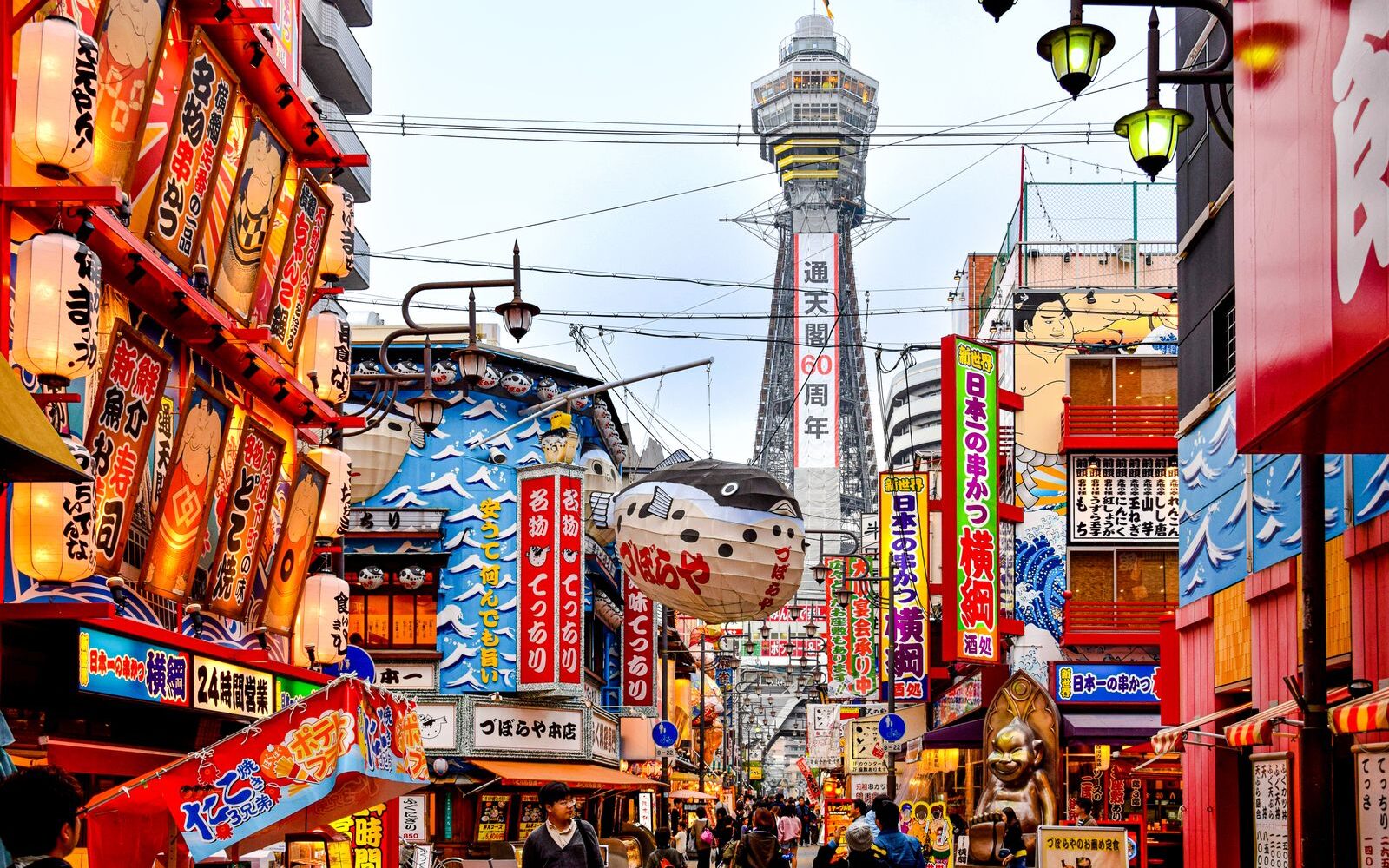
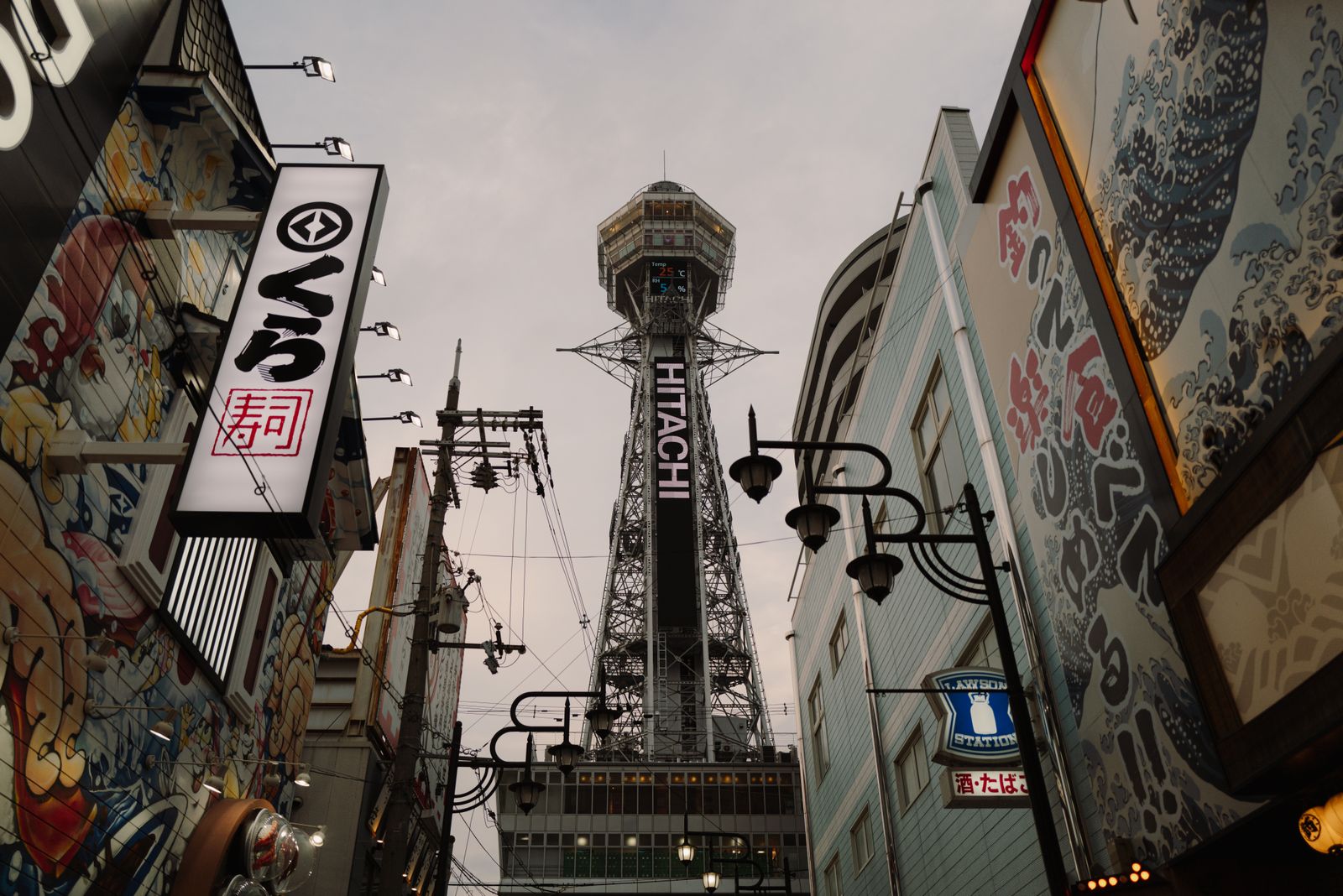
From the deck of Abeno Harukas, fifteen minutes’ walk away, Tsutenkaku looks like something off a model railway: a squat steel lattice with a hat on, wedged into a grid of low roofs. From the street below it, it is something else entirely. It fills the end of every road in Shinsekai, wrapped in neon and an enormous HITACHI sign, with giant pufferfish lanterns and plaster sumo wrestlers crowding up to its feet. It is not tall, it is not elegant, and Osaka would not swap it for anything.
Tsutenkaku — the name translates roughly as “tower reaching heaven” — is the landmark of Shinsekai, the old amusement quarter on the southern side of the city centre, and the one Osaka sight that is loved more for its personality than for what you can see from it. This guide covers what is inside and what it costs, which of the extras are worth paying for, how it compares with the city’s taller towers, and how to spend the rest of an afternoon in the streets around it.
Tsutenkaku at a glance
- What: a steel observation tower of a little over 100 metres, opened in 1956, the second tower on the site and a registered Tangible Cultural Property of Japan.
- Where: the middle of Shinsekai, Naniwa ward, just west of Tennoji Park.
- Hours: roughly 10:00 to 20:00, last entry around 19:30. Check the official site before a late visit; special events change the hours.
- Price: around ¥1,000 for adults for the main observation floors, plus around ¥300 for the open-air deck at the top. The Tower Slider is a separate ticket, ¥1,100 for adults and ¥600 for children aged 7 to 14. All 2026 estimates.
- Time needed: forty-five minutes to an hour for the tower, longer with a queue or the slider.
- Nearest stations: Ebisucho on the Sakaisuji line is a few minutes’ walk from the tower; Dobutsuen-mae on the Midosuji and Sakaisuji lines is slightly further; JR Shin-Imamiya and Tennoji are within ten to fifteen minutes on foot.
- Best time: straight after opening for no queue, or late afternoon so you come down into Shinsekai as the neon comes on.
A tower that has already been built twice
The first Tsutenkaku went up in 1912 as the centrepiece of Shinsekai, a brand-new pleasure district laid out on the site of a recent industrial exhibition. The planners borrowed shamelessly from abroad. The northern half of the district was modelled on Paris, with streets radiating from the tower, and the southern half on Coney Island, with an amusement park called Luna Park. The original tower stood on an arched base inspired by the Arc de Triomphe, with an Eiffel-style lattice on top, and an aerial ropeway once carried visitors from it across to a white tower in the park.
Luna Park closed in the 1920s, but the tower stayed until 1943, when a fire in a nearby cinema damaged its legs. It was dismantled, and its steel went to the war effort. Shinsekai spent the next decade without its landmark, and the local residents and businesses who campaigned to rebuild it set up a company to do the job. The second Tsutenkaku opened in 1956, designed by Tachu Naito, the structural engineer who went on to design Tokyo Tower, and it is that tower you climb today.
It was meant as a statement of Osaka’s recovery, and it still reads as one. In 2007 it was registered as a Tangible Cultural Property, which is a curious honour for a structure with a giant electronics advertisement down its side, but entirely in keeping with the place. The illuminated HITACHI sign has been there for most of the tower’s life, and the lights at the very top double as a coloured weather forecast for the following day.
What is inside, from the bottom up
The base and the lift
Tickets are sold at the base of the tower, where there is usually a short queue for the lift at busy times; on weekend afternoons and holidays it can stretch to half an hour or more. The basement level is given over to souvenir shops, which are a fine place to pick up the Billiken-themed snacks that half of Shinsekai sells. The lift ride up is short.
The main observation floors
The lift delivers you to the main observation floors, roughly 90 metres up. The fifth floor is decorated in gold and given over to the Billiken, who sits in a small shrine and has his feet rubbed by a steady stream of visitors. The views run all the way round: Tennoji Park and the zoo directly below, Abeno Harukas towering over you to the east, the low sprawl of the south of the city running off towards the sea, and, on clear days, Osaka Castle and the towers of Umeda to the north. Expect to spend twenty minutes here unless there is a crowd round the windows.
The open-air deck at the top
For around ¥300 more, a stairway takes you to the special outdoor observation deck at the very top, about 94 metres up and open to the sky. The extra height makes no real difference to the view, but standing in the wind at the top of the lattice, with the antenna above you and the streets of Shinsekai almost directly underneath, is a better experience than looking through glass. It is worth the extra on a clear, calm day and not on a wet or blowy one. Note that there are stairs, so it is not suitable for anyone who cannot manage them.
The Tower Slider
The newest addition, opened in 2022, is a 60-metre enclosed spiral slide that starts around 22 metres up and corkscrews down into the basement in about ten seconds. Tickets are ¥1,100 for adults and ¥600 for children aged 7 to 14. Riders must be 7 to 65 and at least 120 cm tall, and under-13s need an adult with them, so check before you queue with children. It is daft, brief and fun. It is also ten seconds for ¥1,100, so if the wait for it is longer than half an hour, spend the time on kushikatsu instead.
Dive & Walk
For people who want to be on the outside of the tower rather than inside it, Dive & Walk combines a harnessed walk around the roof of the middle observation level with a controlled vertical drop from about 40 metres. It is sold as a separate experience with its own booking, prices and restrictions, so check the official site before you plan around it. Most visitors will be perfectly happy watching other people do it from the street.
The Billiken, and why everyone is touching his feet
The Billiken is a grinning, pointy-headed little figure with his legs stuck straight out in front of him, and he is not Japanese at all. He was created in 1908 by an American illustrator, Florence Pretz, became a craze in the United States as the “god of things as they ought to be”, and arrived in Osaka with Luna Park in 1912. When the park closed, the original statue disappeared. The figure in the tower today is a modern replacement, but the habit of rubbing the soles of his feet for luck has survived intact, and they are polished bright by it.
You will see Billikens all over Shinsekai, outside restaurants and in shop windows, on biscuits, keyrings and kushikatsu menus. Rubbing his feet is free and quick, and it is the most Shinsekai thing you can do in thirty seconds. The district has adopted him so thoroughly that many visitors leave assuming he is a local deity.
Is the view from Tsutenkaku worth it?
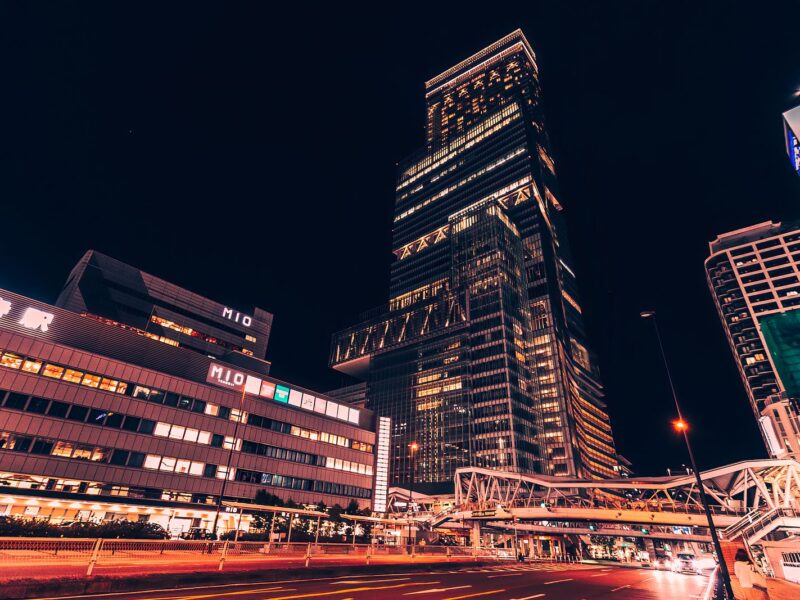
Honestly, not on its own. Tsutenkaku’s main deck sits at about 90 metres, and Abeno Harukas, a fifteen-minute walk away, puts you 300 metres up. On a clear day the view from Tsutenkaku is pleasant and interesting, because you are low enough to see individual streets and rooftops rather than a carpet of city; it is not a panorama that will stop you in your tracks.
That is the wrong way to judge it, though. You go up Tsutenkaku for the tower: the history, the gold rooms, the Billiken, the wind on the top deck, the slightly absurd fun of a 1950s attraction that has never tried to look modern. If you want the big view and only have time or budget for one tower, go to Harukas or the Umeda Sky Building and admire Tsutenkaku from the street. If you have an afternoon in Shinsekai anyway, around ¥1,000 for the tower is good value for the experience.
Tsutenkaku, Abeno Harukas or the Umeda Sky Building?
| Tsutenkaku | Harukas 300 | Umeda Sky Building | |
|---|---|---|---|
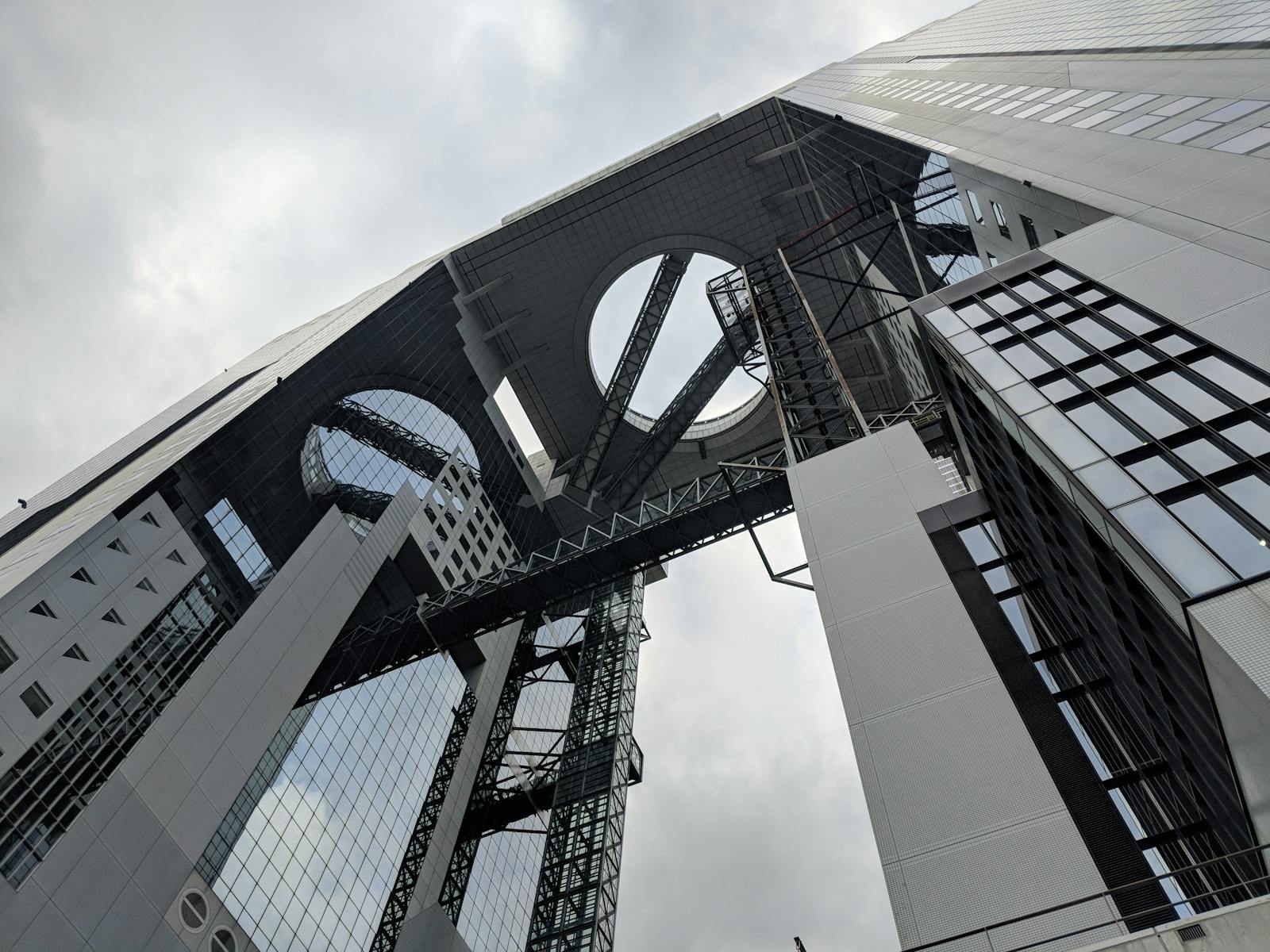
| Height of the view | About 90 m, open-air deck about 94 m | About 300 m, floors 58–60 | About 170 m, floors 39–40 plus rooftop |
| Adult price, around | ¥1,000 (+¥300 outdoor deck) | ¥2,200 at the counter | ¥1,500 |
| Hours, roughly | 10:00–20:00 | 09:00–22:00 | 10:00–22:30 |
| Open-air section | Yes, paid extra | Roofless courtyard on 58F | Yes, the rooftop ring |
| Best for | Retro character, the Billiken, Shinsekai | The highest view in western Japan | Architecture and the night view |
The full comparison, including the free decks most visitors never find, is in our guide to Osaka observation decks. If you are choosing between the two southern towers, read Abeno Harukas as well; for the northern one, the Umeda Sky Building guide.
When to go
Straight after opening on a weekday is the quietest Tsutenkaku gets. The tower opens at 10:00, Shinsekai is still waking up, and you can be at the windows with almost nobody else. The light is also clearer in the morning, before the haze builds.
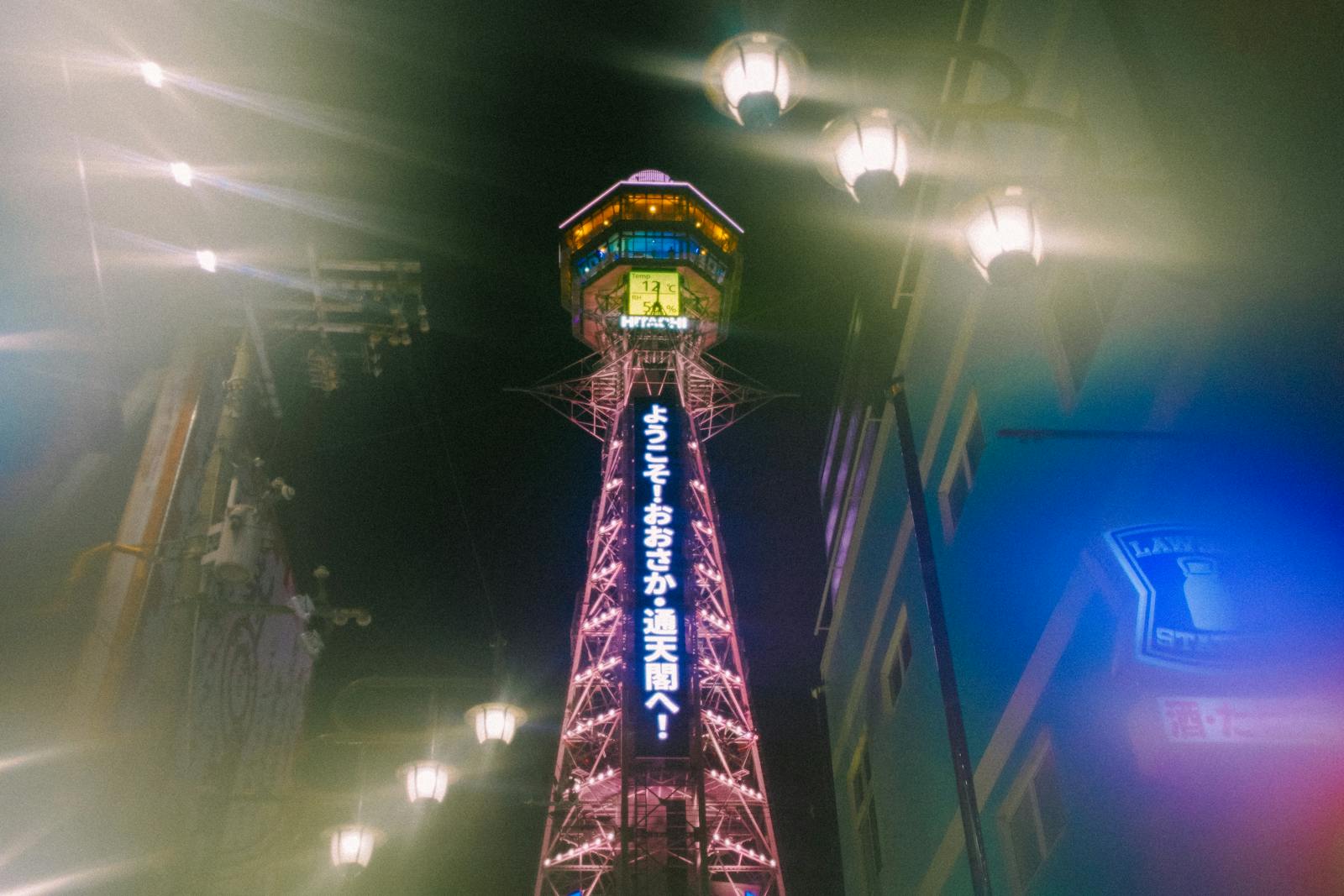
Late afternoon into dusk is the best combination. Go up at about four, come back down as the lanterns and neon switch on, and walk straight into Shinsekai for dinner. That is when the district looks most like itself, and the tower is lit above you as you eat.
Weekend and holiday afternoons are the worst time. The lift queue lengthens, the main deck is crowded and the kushikatsu restaurants all have lines. If a weekend is all you have, go at opening; our 2 days in Osaka itinerary puts Tsutenkaku at half past ten on Saturday for exactly that reason.
Where to photograph the tower from
Tsutenkaku is one of those towers that photographs better from the ground than it looks from the top. A few angles do most of the work:
- Down the main street from the north. The classic shot. Stand near the Ebisucho end of the shopping street that runs up to the tower, and the lanterns, signs and crowds frame it on both sides. Go at dusk, when the signs are lit and there is still colour in the sky.
- Under the legs. The tower stands on four legs, and you can walk right underneath it. Looking straight up through the lattice is the most dramatic angle in the district, and almost nobody bothers.
- From the side streets. The narrow lanes west of the main street give you the tower over a jumble of kushikatsu signs, plaster statues and overhead wires, which says more about Shinsekai than the postcard view.
- From Tennoji Park. The park’s western edge has the tower rising behind trees and open lawn, a calmer picture than anything in the streets.
- From above. The Harukas 300 deck looks straight down on it from 300 metres, which is the best way to understand how small it is and how much the neighbourhood is built around it.
The usual courtesy applies: photograph the street, not the faces of the people eating in it, and ask before you point a camera into a restaurant or a game hall.
How to get there
- From Namba: Midosuji line two stops south to Dobutsuen-mae, then walk north through Shinsekai, or Sakaisuji line from Nippombashi to Ebisucho. Either takes about ten minutes door to door. On foot it is about thirty minutes through Den Den Town, which is a good walk in itself.
- From Umeda: Midosuji line to Dobutsuen-mae, six stops and about 14 minutes.
- From Tennoji or Abeno Harukas: walk west through or alongside Tennoji Park, about fifteen minutes.
- By JR: Shin-Imamiya on the Loop Line, about ten minutes’ walk south of the tower, past Spa World.
An ICOCA card covers every option. The full network is explained in our Osaka subway guide.
Around the tower: Shinsekai in an afternoon
Tsutenkaku is best treated as the centre of an afternoon rather than the whole of it. Within a few minutes’ walk:
- Kushikatsu. Shinsekai is where Osaka’s skewers of breadcrumbed, deep-fried meat, vegetables and seafood come from, and the streets around the tower are lined with counters frying them. The one rule, posted everywhere, is no double-dipping in the shared sauce. Our kushikatsu guide has the ritual and the best counters.
- Jan Jan Yokocho. A narrow covered alley running south from the district towards the station, full of cheap eateries, standing bars and the shogi and go parlours where older men play through the afternoon. Look in; do not photograph the players without asking.
- Retro games. Shinsekai has some of the oldest game centres in the city, including a hall of smart ball, a bagatelle-style game that had its heyday in the early post-war years. Our Osaka arcades guide covers the best of them.
- Spa World. A huge bathhouse complex between Shinsekai and the JR station, with whole floors of European- and Asian-themed baths. It is a good end to a long day if you have the time; our Osaka onsen and sento guide covers it and the alternatives, including the tattoo question.
- Tennoji Park and beyond. The park, the zoo, the Keitakuen garden and, beyond them, Shitennoji and Abeno Harukas make a natural second half to the afternoon. Our Tennoji and Abeno guide joins it all up.

Shinsekai has a rough reputation, and it is mostly out of date. The district is gritty, cheap and a bit faded, and the Airin district of Nishinari, a working-class area with a long history of day labourers and homelessness, sits just across the tracks to the south-west. In practice Shinsekai itself is busy with families and visitors all day and well into the evening, and the usual city sense is all you need. Our Shinsekai guide covers the neighbourhood in full.
A Tsutenkaku afternoon, by the clock
If you want the tower and the neighbourhood in one go, this is the order that works best, timed for a visit outside high summer, when sunset falls somewhere between five and six:
- 15:00 — Walk south from Nippombashi through Den Den Town and arrive at the north end of Shinsekai at Ebisucho. Allow twenty minutes, more if the figure shops pull you in.
- 15:30 — Up the tower. Main floors, the Billiken, and the open-air deck if the day is clear.
- 16:30 — The Tower Slider, if the queue is short, then a slow loop of the streets around the tower, Jan Jan Yokocho included.
- 17:15 — Kushikatsu, early, before the counters fill. Ten skewers and a beer comes to roughly ¥2,000–2,500.
- 18:30 — Back to the main street for the tower lit up at dusk, and the photograph from the north end.
- 19:00 — Either a long soak at Spa World, or the Midosuji line from Dobutsuen-mae back to Namba for Dotonbori at night.
In summer, push everything an hour later. In winter, when it is dark by five, swap the order: kushikatsu first, then the tower after dark, when the view from the deck is mostly lights and the gold rooms look their most theatrical.
Tsutenkaku with children
Children tend to like Tsutenkaku more than adults expect to. The lift is short, the gold rooms and the Billiken are fun, and the Tower Slider is the highlight for anyone who meets its limits. The open-air deck is fine for older children; with toddlers, the stairs and the wind make it less appealing. Tennoji Zoo is a few minutes’ walk away for the rest of the day, and if the kushikatsu restaurants look too smoky for small children, the department store food floors at Tennoji are the easy alternative. More ideas in Osaka with kids.
Practical tips
- Passes. Tsutenkaku has featured on the free list of the Osaka Amazing Pass in past editions, but the list changes with each edition and several attractions only give free entry before 15:00. Check the current list before you count on it.
- Payment. Carry cash in Shinsekai. Many of the restaurants, stalls and game halls around the tower do not take cards.
- Bags. There is little room in the lift or on the decks for large luggage. Use a coin locker at the station first.
- Weather. On a hazy or rainy day, skip the deck entirely and do Shinsekai at street level. The tower is better looked at than looked from in bad weather.
Before you go, our guide to Japanese etiquette in Osaka covers the handful of rules that genuinely matter in a place like Shinsekai, from the sauce to the shogi parlours.
Tsutenkaku FAQ
How much does Tsutenkaku cost?
Around ¥1,000 for adults for the main observation floors, plus around ¥300 for the open-air deck at the top. The Tower Slider is a separate ticket, ¥1,100 for adults and ¥600 for children aged 7 to 14. These are 2026 estimates; prices across Japan are rising, so check the official site.
How tall is Tsutenkaku?
A little over 100 metres, including the antenna. The main observation floors are at roughly 90 metres and the open-air deck at about 94 metres. It is the second tower on the site; the first, built in 1912, was dismantled in 1943.
Is Tsutenkaku worth visiting?
For the experience, yes; for the view alone, no. The tower’s charm is its retro interior, the Billiken and its place at the heart of Shinsekai. If you only want a high view, Abeno Harukas or the Umeda Sky Building do that better.
What are the opening hours?
Roughly 10:00 to 20:00, with last entry around 19:30. Hours change for special events, so check before a late visit.
What is the Billiken?
A good-luck figure created in America in 1908, brought to Shinsekai in 1912 and adopted by Osaka as its own. A statue sits on Tsutenkaku’s fifth floor, and visitors rub the soles of his feet for luck.
How long do I need at Tsutenkaku?
Forty-five minutes to an hour for the tower itself, more with a queue or the slider. Allow half a day if you want to combine it with kushikatsu and a walk around Shinsekai.
Where to go next
Tsutenkaku is one stop on a bigger list: the rest of the city’s sights are ranked in things to do in Osaka, and the Osaka itinerary hub shows how to fit them into one day or several. For the neighbourhood around the tower, start with our Shinsekai guide; for the south of the city as a whole, the Tennoji and Abeno guide.
If you are on a tight budget, Shinsekai is one of the cheapest places to eat in the city, and our cheap eats and free things to do guides make the most of it. For other places with the same faded charm, see unusual things to do in Osaka.