This article contains advertising. Our booking links are routed through a partner that adds commission tracking automatically, so if you book through one we earn a commission from the provider, at no extra cost to you. It never affects what we recommend. Affiliate disclosure
You do not need Japanese to visit Osaka. That is worth saying first, because the anxiety about it stops people booking. Signage on transport is bilingual, translation apps read menus well enough, and staff will find a way. What a dozen phrases actually buys you is not comprehension — it is a completely different reception. Osakans are the most talkative people in Japan, and a visitor who says ookini instead of arigatou gets a reaction out of all proportion to the effort involved.
Most lists of Japanese phrases for travelers are written by people who have never had to use them in a queue. This one is ordered by how often you will actually need each thing, includes the Osaka dialect nobody teaches you, and tells you which of the classic phrases to leave at home.
The ten that do ninety per cent of the work
| Japanese | Romaji | Meaning | When |
|---|---|---|---|
| すみません | sumimasen | Excuse me / sorry / thank you | Constantly. The single most useful word. |
| ありがとうございます | arigatou gozaimasu | Thank you (polite) | Everywhere |
| お願いします | onegaishimasu | Please / I’d like this | Ordering, asking, handing something over |
| これ | kore | This | Pointing at a menu. Add onegaishimasu. |
| はい / いいえ | hai / iie | Yes / no | Everywhere |
| 大丈夫です | daijoubu desu | It’s fine / no thanks / I’m OK | Declining anything politely |
| いくらですか | ikura desu ka | How much is it? | Markets, small shops |
| 英語のメニューはありますか | eigo no menyuu wa arimasu ka | Is there an English menu? | Restaurants |
| ごちそうさまでした | gochisousama deshita | Thank you for the meal | Leaving any restaurant |
| わかりません | wakarimasen | I don’t understand | The honest exit from any conversation |
If you learn only two, make them sumimasen and gochisousama deshita. The first opens every interaction. The second closes every meal, and it is the correct alternative to a tip — which you must not leave, ever, anywhere in Japan. Staff will chase you into the street to return it. More on that in our Osaka travel tips.
Pronunciation: four rules and you are done
Japanese pronunciation is far easier than the writing system suggests, and getting these four right makes you comprehensible immediately.
- Five vowels, always the same. A as in father, i as in machine, u as in put, e as in bed, o as in for. They never change. Sake is sah-keh, not sah-key.
- Every syllable gets equal weight. There is no stressed syllable the way English has one. Ka-ra-o-ke, four beats, evenly. Not ka-ree-OH-kee.
- Long vowels are genuinely twice as long and change meanings. Obasan is aunt; obaasan is grandmother.
- U and i often go nearly silent between certain consonants and at the end of words. Desu is closer to “dess”. Sukiyaki starts closer to “skee”.
Nobody will mind if you get these wrong. Getting them right is the difference between being understood on the first attempt and the second.
In a restaurant, in order
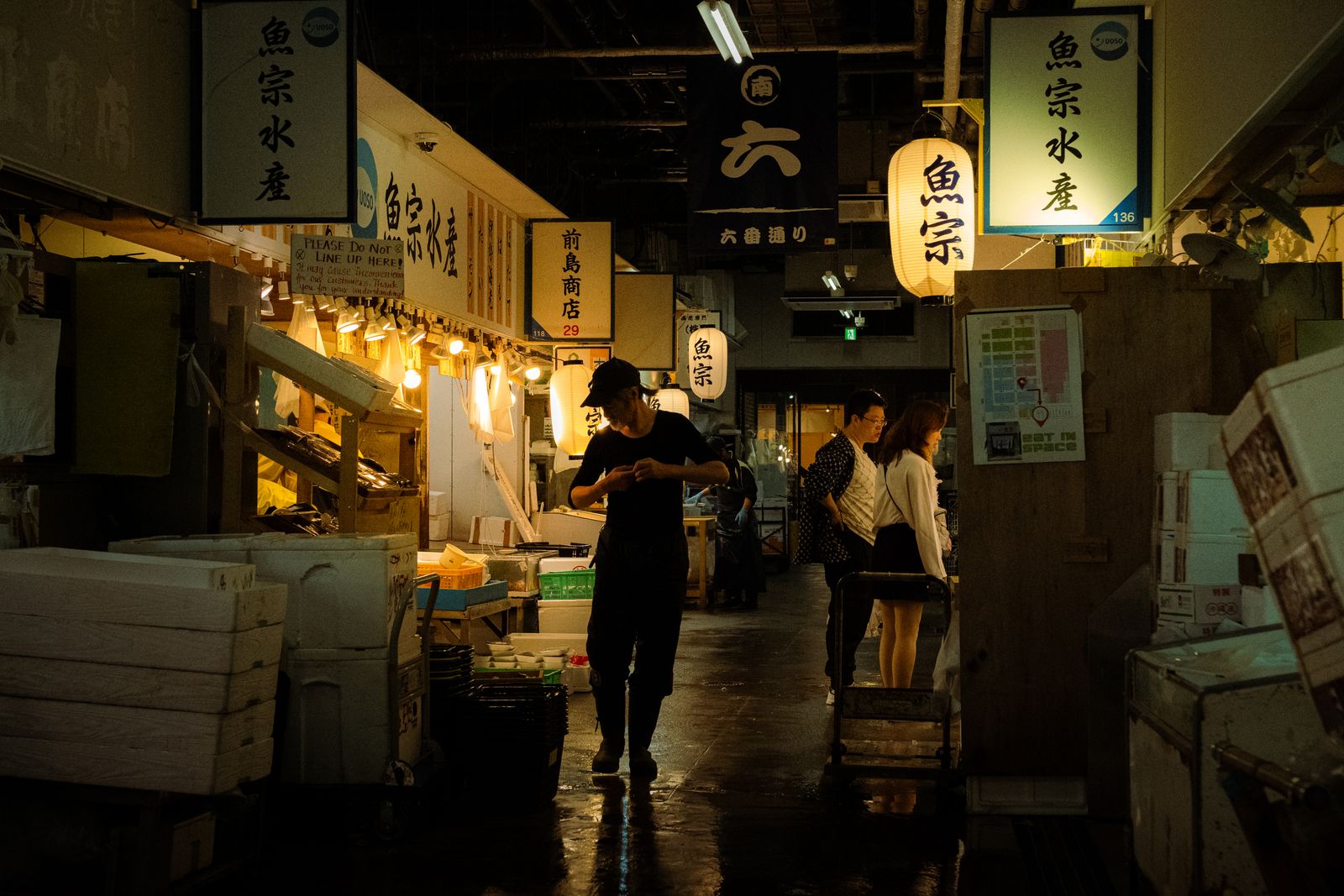
Restaurants are where most of your Japanese will happen, and the sequence is predictable enough to learn as a script.
- Walking in — staff will call irasshaimase (welcome). You do not reply. Just hold up fingers for how many people, or say futari (two), sannin (three).
- Ordering — point and say kore onegaishimasu. That is the whole thing. For a second round, sumimasen to get attention first.
- Recommendations — osusume wa nan desu ka (what do you recommend?). In Osaka this often produces something genuinely good and a short conversation.
- Dietary needs — … wa taberaremasen (I can’t eat …). Niku is meat, sakana fish, ebi prawn, tamago egg, nyuuseihin dairy. Have it written down in Japanese as well; dashi, which is made from fish, is in almost everything, and that catches vegetarians out constantly.
- During — oishii (delicious) said out loud is entirely normal and lands well.
- The bill — okaikei onegaishimasu. In many places you carry the slip to the till rather than paying at the table.
- Leaving — gochisousama deshita, on the way out, to the room in general.
The vending-machine ticket system at ramen and gyudon shops removes the need for any of this: buy a ticket at the machine by the door, hand it to the counter, sit down. Many machines have a hidden English button on the side panel. See our ramen guide and the Osaka food guide.
Shopping and money
- Ikura desu ka — how much is it? In Osaka you will also hear nanbo, which is the local version.
- Kaado wa tsukaemasu ka — can I use a card? Ask before you order in a small place; a great many are cash-only.
- Menzei dekimasu ka — can I get tax-free? Bring your passport; the threshold is a ¥5,000 spend at one shop on one day. Note that the system changes on 1 November 2026 to a refund claimed at the airport rather than a discount at the till — see tax-free shopping.
- Fukuro wa irimasen — I don’t need a bag.
- Miteiru dake desu — I’m just looking.
- Kore kudasai — I’ll take this.
Numbers are worth ten minutes of your time, because prices are frequently spoken rather than shown in the markets: ichi, ni, san, yon, go, roku, nana, hachi, kyuu, juu for one to ten, then hyaku for hundred, sen for thousand, man for ten thousand. ¥3,500 is sanzen gohyaku. Osaka’s markets are also one of the few places in Japan where a small amount of good-natured haggling happens — not on a price tag, but on a bundle. See Kuromon Market and the markets guide.
Transport and getting lost
- … wa doko desu ka — where is …? Fill the gap with toire (toilet), eki (station), deguchi (exit), koban (police box).
- … ni ikitai desu — I want to go to …. Say the place name and show it written down; Japanese place names said with an English accent are frequently unrecognisable.
- Kono densha wa … ni ikimasu ka — does this train go to …?
- Saishuu densha wa nanji desu ka — what time is the last train? Genuinely useful, because the subway stops around midnight and not at one.
- Michi ni mayoimashita — I’m lost. This will produce help, often quite a lot of it.
The most effective transport strategy is not verbal: show the station name on your phone in Japanese characters. Station staff will point, draw, or physically walk you to the right platform. Ask at the manned gate rather than in the concourse. See our subway guide and the transportation guide.
At the hotel
- Chekku-in onegaishimasu — check-in please. Chekku-auto for the other end.
- Nimotsu o azukatte moraemasu ka — could you hold my luggage? Almost always yes, before check-in and after checkout. If not, the station lockers will — see luggage storage in Osaka.
- Wai-fai no pasuwaado wa nan desu ka — what’s the wifi password?
- Kin’en no heya wa arimasu ka — do you have a non-smoking room? Still worth asking at older business hotels.
- Taoru o mou ichimai onegaishimasu — one more towel, please.
- Asagohan wa nanji kara desu ka — what time is breakfast from?
Hotel front desks are the most reliably English-capable places you will deal with, and staff at a ryokan will patiently explain the yukata, the bath and the dinner timing whether or not you share a language. Say yes to the explanation; it is genuinely useful.
Onsen, temples and taking your shoes off
These are the settings where a wrong move actually registers, so a few words help.
- Irezumi wa daijoubu desu ka — are tattoos OK? Ask before you undress. Many baths still refuse them; see onsen and sento in Osaka.
- Kashikiri buro wa arimasu ka — do you have a private bath? The usual solution to the tattoo problem, and to travelling as a couple.
- Kutsu o nugimasu ka — should I take my shoes off? The answer is yes if there is a step up, a change of flooring, or slippers waiting.
- Shashin o totte mo ii desu ka — may I take a photo? Ask inside temples, in shops and of people, always. Many interiors prohibit it.
- Goshuin o onegaishimasu — a temple or shrine seal, please. Hand over your goshuincho book open at a blank page; there is usually a small fee. See temples and shrines.
Small talk, which Osaka actually wants
This is the part that distinguishes Osaka from the rest of Japan. Strangers here will start conversations — in a standing bar, at a market stall, waiting for a light. Having three sentences ready turns that into one of the better memories of the trip.
- Nihon wa hajimete desu — it’s my first time in Japan.
- … kara kimashita — I’m from ….
- Oosaka no tabemono wa saikou desu — Osaka’s food is the best. This is a correct opinion and it will be received as such.
- Osusume no mise wa arimasu ka — do you know a good place? Ask this of a bartender and you will frequently be walked to the door and pointed.
- Nihongo wa sukoshi dake desu — I only speak a little Japanese. Deploy early to set expectations.
The reliable icebreaker is food. Say you are looking for takoyaki or okonomiyaki and you will get an opinion, usually a strong one, sometimes an argument with the person next to them. This is the city working correctly. The standing bars of Ura Namba and the counters in our izakaya guide are where it happens most.
Is it worth learning more before you go?
For a trip of a week or two, no — the return on the twentieth phrase is far lower than on the first five. Time is better spent on two other things.
Learn katakana. It takes a couple of hours and it unlocks a surprising amount, because katakana is used for foreign loanwords. Once you can read it, a great many menus become legible: コーヒー is koohii, coffee. ビール is biiru, beer. チーズ is cheese. This is the single highest-value hour of study for a visitor.
Learn the numbers. Prices spoken aloud in a market, platform numbers, table numbers and the time all become clear, and it removes the most common moment of confusion in a shop.
Beyond that, a translation app and a willingness to look slightly foolish will cover you. Nobody in Osaka expects a visitor to speak Japanese, and the bar for being appreciated is set very low on purpose.
When something goes wrong
- Tasukete kudasai — please help me.
- Byouin wa doko desu ka — where is the hospital?
- Kibun ga warui desu — I feel unwell.
- Keisatsu o yonde kudasai — please call the police. 110 for police, 119 for ambulance and fire.
- Nakushimashita — I lost it. Say this at a koban, the small neighbourhood police box, which is where lost property genuinely does turn up in Japan.
- Arerugii ga arimasu — I have an allergy. Carry the specific allergen written in Japanese; this is not something to improvise.
Kansai-ben: the Osaka dialect
This is the part other phrasebooks skip, and it is the part that will actually get you a reaction. Kansai-ben is the regional dialect, and Osakans are prouder of it than of almost anything except their food. It is warmer, faster and blunter than standard Japanese, and a visitor attempting one word of it will be received far better than a visitor with textbook-perfect Tokyo Japanese.
| Kansai-ben | Standard Japanese | Meaning |
|---|---|---|
| ookini | arigatou | Thanks — the classic Osaka thank you |
| maido | konnichiwa / irasshaimase | All-purpose greeting, shopkeeper’s hello |
| nanbo | ikura | How much? |
| meccha | totemo | Very, really — used by everyone, constantly |
| honma | hontou | Really? / seriously |
| akan | dame | No good, can’t do that |
| ee | ii | Good, fine |
| chau | chigau | That’s not right / no |
| nandeyanen | — | “What are you on about?” — comic protest |
| bochi bochi | — | “So-so, getting by” — the answer to “how’s business?” |
Two notes on using it. Ookini is the safest and most rewarding to try — say it to a market vendor and watch. Nandeyanen is comic, comes with a hand gesture, and is best deployed only if you are confident the moment is right; used wrongly it is simply confusing. And the rising, sing-song intonation of Osaka speech is a real feature, not an accident: the same words in flat Tokyo intonation do not sound like Kansai-ben at all.
The dialect is also the foundation of Osaka’s comedy tradition, manzai, which is why the city sounds like two people arguing affectionately at all times. Our Osaka like a local and cultural experiences pages go further into that.
Phrases to leave at home
- Konnichiwa as a greeting to staff. It is not wrong, but nobody says it walking into a shop. Sumimasen is what you actually want.
- Sayonara. It carries a weight of finality that makes it odd for leaving a restaurant. Use gochisousama deshita, or just arigatou gozaimasu.
- Watashi wa … desu. Textbook self-introduction that you will essentially never need.
- Anything you cannot follow up. Ask a fluent-sounding question and you will get a fluent answer. Wakarimasen is a perfectly respectable place to stop.
- Domo arigatou gozaimasu with a bow, delivered as a performance. A small nod and a normal thank you is what people actually do.
Reading just enough
You do not need to read Japanese. A handful of characters is still worth recognising, mostly on doors and menus.
- 入口 entrance · 出口 exit
- 男 men · 女 women — on toilet doors, often with no other marking
- 営業中 open · 準備中 closed / preparing
- 円 yen — the symbol after every price
- 禁煙 no smoking · 喫煙 smoking permitted
- 肉 meat · 魚 fish · 鶏 chicken · 豚 pork · 牛 beef
Two useful conventions: prices are often written in kanji numerals on handwritten market signs, and a menu with photographs is almost always the tourist-priced option. The plastic food models in the window are accurate to what arrives.
Apps and what they cannot do
A translation app with a live camera mode handles menus and signs well and is worth downloading before you fly. Download the offline Japanese pack too — underground stations and older restaurants have no signal. Set up connectivity before you land rather than at the airport; see our SIM card and pocket wifi guide.
What the apps do badly: conversation, handwritten menus, and anything spoken quickly in dialect. They are a reading tool, not a speaking one. The other limit is social — holding a phone up to someone’s face to conduct a conversation is a colder interaction than three badly pronounced words and a smile, and in Osaka the smile gets you further.
Japanese phrases FAQ
Do I need Japanese to visit Osaka?
No. Transport signage is bilingual, translation apps read menus, and staff are patient. A dozen phrases changes the quality of the trip rather than its feasibility.
Is English widely spoken in Osaka?
Less than in Tokyo, and considerably less outside the tourist districts. Hotel staff and larger restaurants manage; small izakaya, markets and taxi drivers often do not. Written Japanese on your phone solves most of it.
What is the most useful Japanese word?
Sumimasen. It covers excuse me, sorry, and thank you, and it opens essentially every interaction you will have.
What is Kansai-ben?
The regional dialect of Osaka and the wider Kansai area — warmer, faster and blunter than standard Japanese. Ookini for thanks, nanbo for how much, meccha for very. Locals are delighted when visitors try it.
Should I bow?
A small nod is plenty and is what people actually do in shops and restaurants. A deep formal bow from a visitor reads as a performance. Do not worry about it.
How do I say thank you in Osaka?
Arigatou gozaimasu anywhere in Japan, or ookini for the local version, which is worth using at least once with a market vendor or shopkeeper.
Is it rude to speak English first?
Not at all, though opening with sumimasen and then switching to English lands better than launching straight in. Speaking slowly and simply helps far more than speaking loudly.
Where to go next
The practical companion to this page is Osaka travel tips, which covers money, etiquette and the 2026 rule changes, and first-time Osaka tips if this is your first trip to Japan.
Most of these phrases get used over food, so read the Osaka food guide, street food and izakaya guide next, and consider an Osaka cooking class or food tour, which are the easiest settings in the city to practise in. For planning the trip itself, see the Osaka itinerary hub and our 3 days in Osaka plan.