This article contains advertising. Our booking links are routed through a partner that adds commission tracking automatically, so if you book through one we earn a commission from the provider, at no extra cost to you. It never affects what we recommend. Affiliate disclosure
The most useful restaurant in Osaka has no tables, no menu and no name over the door that you will remember. It is the convenience store on your hotel’s corner, and on almost any street in the city there is another one a few minutes’ walk away. In much of Europe and America a “convenience store” means crisps, cigarettes and a fridge of fizzy drinks. Here it means a hand-rolled salmon onigiri for around two hundred yen, a fried chicken cutlet that people queue for, a cold coffee, a clean ATM that takes your foreign card, and a counter where someone will heat your dinner for you.
This konbini Japan guide explains how to use them well in Osaka: which chain is which, what is worth eating and what is not, how the till works, what the ATMs and other services do, and where a konbini meal is a smart move rather than a sad one. Konbini, short for “convenience store”, is the word everyone uses, and you will hear it constantly.
The chains you will see in Osaka
Three national chains account for most of the konbini you will walk past, and every Osakan has an opinion about which is best. All three sell the same broad range; the differences are in the fresh food, the hot counter and the own-brand lines, and they are worth knowing.
7-Eleven
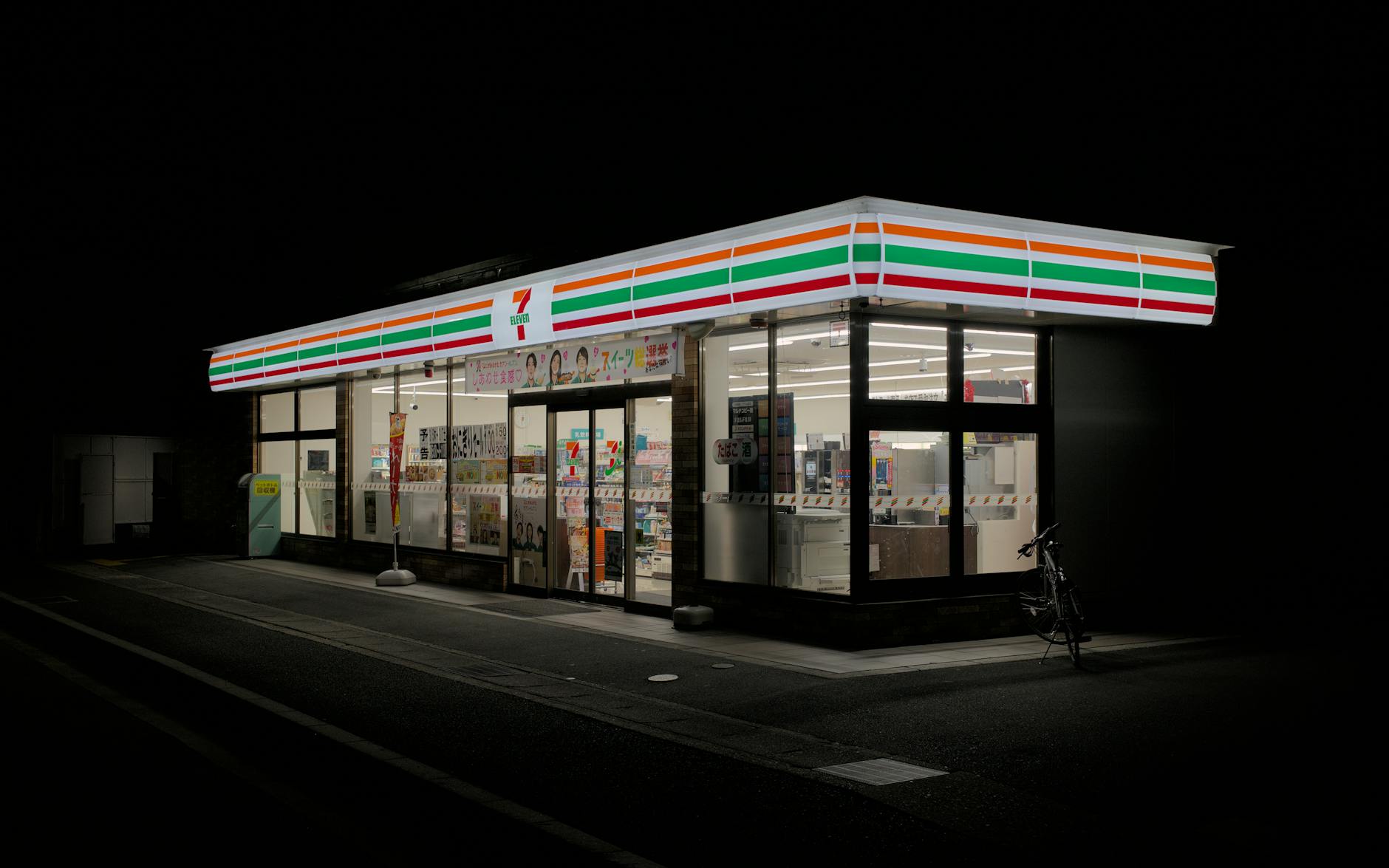
Japan’s 7-Eleven, founded in 1973, is the best-known name and, by its own count, serves about 20 million customers a day. Its strength is everyday fresh food: onigiri, sandwiches, bento and salads. It is also the one to know for cash, because Seven Bank ATMs are in 7-Eleven stores, the most reliable option for foreign cards (more on that below).
FamilyMart
FamilyMart is the one with the green and blue stripes, and its fame rests on one product: Famichiki, a boneless fried chicken cutlet from the hot counter, which turned 20 in 2026. FamilyMart lists the regular Famichiki at ¥230 before tax, ¥248 including it, with prices varying by region. It is crisp, juicy and absurdly satisfying at eleven at night. FamilyMart also does good sweets, and its fresh food is a close second to 7-Eleven’s.
Lawson
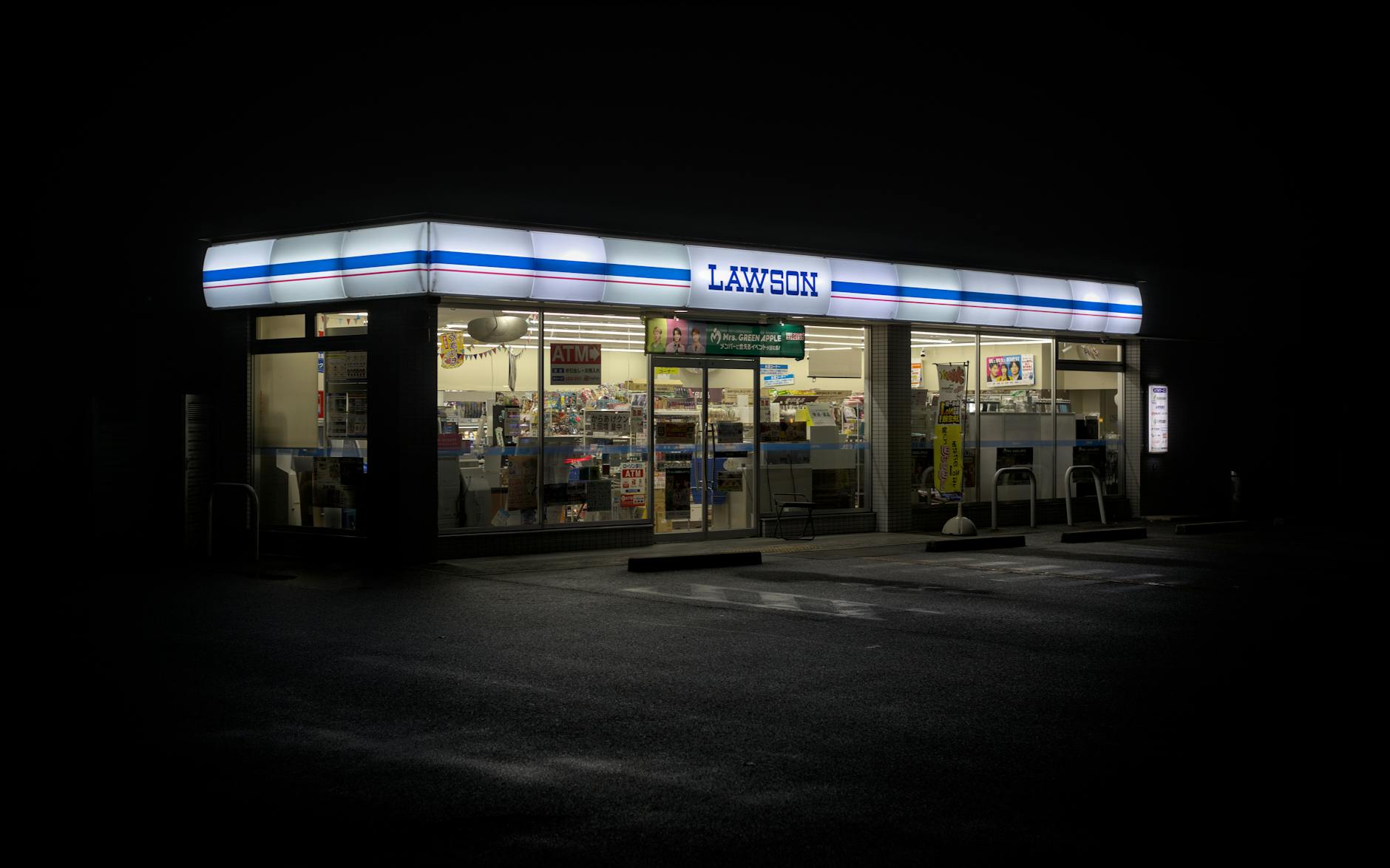
Lawson, with the blue sign and the milk-can logo, has its own fried-chicken rival, Karaage-kun: small nuggets of Japanese fried chicken sold in a little box. The five-piece regular box is around ¥288 including tax on Lawson’s menu, but check the price in store. Lawson is strong on desserts and bakery. It also runs two spin-off formats you will see in Osaka: Natural Lawson, with a lighter, more health-minded range, and Lawson Store 100, a budget format with groceries and a lot of fixed-price items.
The others
- Ministop is smaller, and known for its soft-serve ice cream and fried snacks made in-store. Many branches have eat-in seating.
- Daily Yamazaki belongs to the Yamazaki bakery group, and bread and pastries are its speciality.
Which is best? It depends what you want. For a full meal, 7-Eleven. For fried chicken, FamilyMart, though Lawson fans will fight you on that. For sweets, Lawson. In practice, you will use whichever is nearest, and none of them is bad.
What to eat: a day of konbini meals
Onigiri
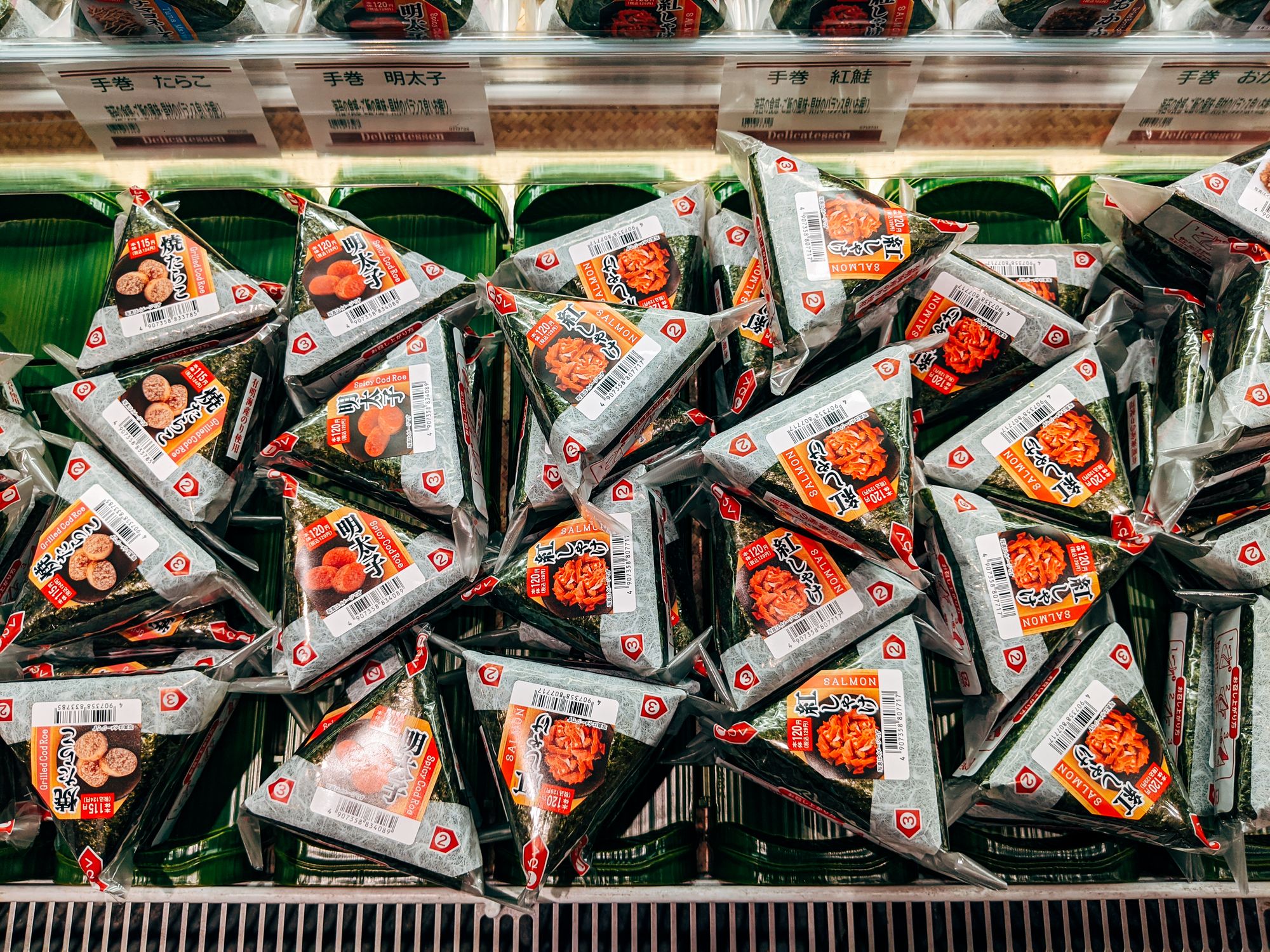
The onigiri, a triangle of rice wrapped in seaweed around a filling, is the konbini’s signature, and the best value on the shelf. At 7-Eleven in the Kinki region, which includes Osaka, a hand-rolled tuna mayonnaise onigiri is ¥182 before tax (¥196.56 with the 8% rate) and charcoal-grilled salmon is ¥198 (¥213.84). Two of them and a drink make a perfectly good, cheap lunch.
Fillings to look for:
- Shake (salmon): the safe classic, flaked and lightly salted.
- Tsuna mayo (tuna mayonnaise): the bestseller, especially with children.
- Mentaiko or tarako: spicy or plain pollock roe, salty and rich.
- Umeboshi: pickled plum, sharp and sour. An acquired taste, and very Japanese.
- Konbu: sweet-salty simmered kelp.
The wrapper is a small engineering marvel designed to keep the seaweed crisp until you eat it. Pull the tab marked 1 straight down through the middle, then pull the two sides (2 and 3) off sideways. Done right, the seaweed ends up wrapped round the rice. Done wrong, it stays stuck inside the plastic, and you will do it wrong at least once.
Sandwiches and bread
Konbini sandwiches are soft white bread with the crusts off, and they are better than they sound. The egg sandwich, tamago sando, is the one people photograph, but the ham and cheese, katsu and fruit-and-cream versions all have their fans. The bread shelves also hold sweet buns: melon pan, curry bread, and whatever new flavour has just arrived.
The hot counter
By the till you will find a heated cabinet of fried chicken, croquettes, sausages on sticks and, at many stores, steamed buns such as nikuman, a pork bun. Point at what you want; the staff bag it for you. Famichiki and Karaage-kun are the stars, and both are worth trying at least once. In the colder months, many stores also keep a tray of oden, ingredients simmered in broth, by the counter.
Bento, noodles and pasta
The chilled shelves hold full meals: bento boxes of rice with grilled fish, fried chicken or hamburger steak, bowls of cold soba, pasta, curry, and noodle dishes for the microwave. Take one to the till and the staff will ask whether you want it heated. These are the meals that tired travellers rely on after a long day, and the better ones are genuinely good. The cheaper end of the bento range is filling rather than inspiring.
Salads, eggs and something green
Travellers often say they struggle to eat vegetables in Japan. The konbini helps: salads in tubs, packs of steamed vegetables, sliced fruit, yoghurt, soft-boiled eggs seasoned in their shells, salad chicken (plain steamed chicken breast in a pouch) and miso soups to add hot water to. A salad, an egg and an onigiri is a better breakfast than many hotel buffets.
Sweets and drinks
The dessert fridges are where the chains compete hardest, with new seasonal flavours appearing all the time: cream puffs, roll cakes, puddings and parfaits. The drinks wall runs from green tea and barley tea to coffee, sports drinks and a generous range of beer, chu-hi and sake. Alcohol is sold only to customers aged 20 or over, and staff may ask you to confirm your age on the till screen. Most stores also have a self-service coffee machine: you buy a cup at the till and pour it yourself.

Your first konbini run: a shopping list
If the shelves are overwhelming on your first visit, start with this list. It covers the classics and gives you a feel for what each chain does well.
- Two onigiri with different fillings, say salmon and tuna mayonnaise, so you learn the wrapper and find your favourite.
- A tamago sando, the egg sandwich, for the soft-bread experience.
- Famichiki at FamilyMart or Karaage-kun at Lawson, from the hot counter, ideally both on different days so you can take sides.
- A seasoned soft-boiled egg, the best-value protein on the shelf.
- A bottle of cold green tea or barley tea, unsweetened, which is what most Japanese people drink with food.
- One dessert from the fridge, whatever looks newest. The cream-filled ones rarely disappoint.
- A can of chu-hi or beer for the hotel room, if you drink, aged 20 or over.
That lot, eaten over a day, will tell you more about everyday Japanese food than an expensive tasting menu.
The konbini as a travel kit
Half the value of a konbini to a traveller has nothing to do with food. When something goes wrong on the road, it is usually the quickest fix. The shelves carry clear plastic umbrellas for the sudden shower, phone chargers and cables, socks, shirts and underwear for an unplanned extra night, toothbrushes, razors and travel-size toiletries, plasters, hand warmers in winter and cooling sheets in summer. Prices are higher than a supermarket or drugstore, but you are paying for the convenience, and at 2am it is worth it. For a fuller selection at lower prices, the drugstores of Shinsaibashi and Namba are better, and our packing list helps you avoid needing any of it.
Eating well, not just cheaply
A konbini can feed you well, but it can also feed you badly, and the difference is mostly about what you put in the basket.
- Mix it. An onigiri, a salad and a protein, such as an egg, salad chicken or yoghurt, makes a balanced meal. A bento plus fried chicken plus a sweet bun is a lot of salt, fat and carbohydrate.
- Check the label. Fresh shelves are usually fullest in the morning and around meal times, and thinnest late at night.
- Look for what is new. Seasonal and limited editions change constantly and are often the most interesting things on the shelf.
- Allergies and diets are hard. Labels are in Japanese, and fish stock turns up in surprising places. If you are vegetarian or vegan, our vegan and vegetarian Osaka guide is more use than any konbini shelf.
And the honest verdict: don’t let the konbini replace Osaka’s food. This is a city whose whole identity is eating out, and an Osaka cheap eat at a standing counter costs little more than a konbini bento and is a world better. Use the konbini for breakfast, for snacks, for picnics on day trips and for the 1am craving, and spend your dinners in the city. Our Osaka food guide starts there.
How to buy: the till, the bag and the tax
The checkout follows the same pattern everywhere, and knowing it makes the whole thing painless. Put your basket on the counter. The staff scan everything, and may ask some of these:
- Atatamemasu ka? “Shall I heat it?” for bento, pasta or anything microwavable. Hai, onegaishimasu (yes, please) or daijōbu desu (no, thank you).
- Fukuro wa irimasu ka? “Do you need a bag?” Plastic bags have been charged for across Japan since 1 July 2020. Each store sets its own price, so carry a folding bag if you want to avoid it.
- Chopsticks, spoon or fork: staff usually ask, or point at the cutlery. Say ohashi for chopsticks.
- Eating in or taking away: some stores ask, because of the tax.
The tax point catches visitors out. Food and drink you take away is taxed at the reduced rate of 8%, while food eaten in the store’s eat-in area is taxed at 10%. Shelf prices are shown including tax, so the difference only shows at the till. If you say you are taking it away, then sit down in the eat-in corner, you are not playing by the rules. The government has also scheduled a temporary cut in consumption tax on food and drink from 1 April 2027 to 31 March 2029; check the National Tax Agency’s site for how it will apply.
Paying is easy. Cash is accepted, and the major chains take credit cards and IC cards. An ICOCA card works wherever the IC mark is shown, so you can tap the same card you use on the trains; our ICOCA guide explains how to get one, and money and payments in Osaka covers cards and cash in general.
More useful phrases are in our Japanese phrases for Osaka guide.
More than food: ATMs and other services
ATMs
For most foreign visitors, the 7-Eleven ATM is the easiest way to get yen. Seven Bank’s ATMs, found in 7-Eleven stores, accept overseas-issued Visa and Mastercard around the clock, 365 days a year; other card brands, including UnionPay, Amex, JCB, Discover and Diners, have slightly shorter hours. The limit for overseas cards is ¥100,000 per withdrawal, or ¥30,000 with a magnetic-stripe card. Some cards may not be accepted, and fees depend on your card brand, so check the screen before you confirm. Japan Post Bank’s ATMs, in post offices, also take overseas Visa and Mastercard. When the machine offers to charge you in your home currency, decline: the rate is worse than your bank’s.
Lawson and FamilyMart have ATMs too, but if you hold a foreign card, the 7-Eleven is the one to head for.
Everything else
Most konbini also have a multifunction copier for printing and copying, and some have toilets you can use as a customer; ask first, and buy something. Many branches have a small eat-in counter, a rubbish point inside or just outside the door, and, at some branches, free Wi-Fi. It is also where Japanese people pay utility bills, buy concert tickets and send parcels, though most of those services need Japanese, a Japanese address or both. For staying connected, see our SIM card and Wi-Fi guide.
Konbini etiquette
- Eating on the go. Walking while eating is generally frowned upon in Japan, though Osaka’s street-food districts are more relaxed. The polite thing is to eat in the store’s eat-in area, outside by the door, or at a bench.
- Rubbish. Public bins are rare. Konbini have bins, sorted by type, for rubbish from what you bought there. Don’t bring a day’s worth of rubbish from elsewhere.
- Queue properly. There is usually one queue for all the tills; wait at the marked spot and go to whichever till calls you.
- Put the money in the tray. Coins and notes go in the small tray on the counter, not into the cashier’s hand.
Our Osaka etiquette guide covers the wider picture.
Is konbini food tax-free?
Almost never, and from November 2026 it is even less of a question. Japan’s tax-free shopping system changes on 1 November 2026: visitors pay consumption tax at the till and claim it back after customs confirms that the goods have left Japan, and food and drink consumed in Japan does not qualify for a refund. Your onigiri is taxed like everyone else’s. For tax-free shopping that does work, see our Osaka tax-free shopping guide, and for the drugstore haul, drugstore shopping in Osaka.
When the konbini is the right call
- Breakfast. If your hotel’s breakfast is expensive, skip it. An onigiri, a yoghurt and a coffee from the corner store costs a fraction of the price and takes five minutes.
- After a night out. When the bars of Dotonbori close and you need something salty, the konbini is the answer. Our late-night food guide has the sit-down alternatives.
- Day trips. Stock up before an early train to Kyoto, Nara or Himeji, and you can eat at a park bench in the sun rather than queue for lunch with the tour groups. See day trips from Osaka.
- Travelling with children. Familiar food, quick, at any hour, with a toilet nearby. See Osaka with kids.
- On a budget. Konbini meals are a big part of how budget travellers make Japan work. Our Osaka budget travel and money-saving tips guides have the rest of the plan.
Konbini FAQ
Which konbini is best in Japan?
It depends what you want. 7-Eleven is the most consistent for fresh food and has the ATM most foreign cards use, FamilyMart is famous for its Famichiki fried chicken, and Lawson is strong on desserts. All three are good.
Can I use a foreign card at konbini ATMs?
Yes, especially at 7-Eleven. Seven Bank ATMs accept overseas-issued Visa and Mastercard 24 hours a day, 365 days a year, with a limit of ¥100,000 per withdrawal for overseas cards. Some cards may not work, and fees vary by card brand.
Are konbini open 24 hours?
Many are, but not all: hours vary by branch, and stores inside stations, offices or shopping centres keep shorter hours. Check the hours on the door or on the chain’s store finder.
Do konbini charge for plastic bags?
Yes. Plastic shopping bags have been charged for in Japan since 1 July 2020, and each store sets its own price. Staff will ask whether you want one.
Can you eat inside a konbini?
At branches with an eat-in area, yes. Tell the staff you are eating in, because food eaten in the store is taxed at 10% rather than the 8% for takeaway.
How much does an onigiri cost?
At 7-Eleven in the Kinki region, a hand-rolled tuna mayonnaise onigiri is ¥182 before tax, about ¥197 with tax, and grilled salmon is ¥198 before tax. Prices vary by chain, product and region, and the shelf label shows the price including tax.
More practical Osaka advice
Our Osaka travel tips hub gathers all our practical guides. Before you fly, read first-time Osaka tips and what to pack for Osaka, and when you are ready for something better than a konbini dinner, head to Dotonbori after dark.