This article contains advertising. Our booking links are routed through a partner that adds commission tracking automatically, so if you book through one we earn a commission from the provider, at no extra cost to you. It never affects what we recommend. Affiliate disclosure
Kyoto gets the postcards, but Osaka’s sacred sites are older than most people realise, and a good deal less crowded. Some of them predate Kyoto’s headliners by centuries. You can stand at the oldest state Buddhist temple in Japan in the morning and a shrine that’s been here 1,800 years by afternoon, all reachable on a day pass. The Osaka temples and shrines covered below range from genuine national treasures to a courtyard dominated by a 12-metre lion’s head, and none of them ask you to fight the tour-bus crush.
This guide runs through the major sites with the practical detail you need, history, hours, access, what to actually look for, plus a few oddities that most visitors walk straight past. Maybe you’re after the scale of Shitennoji, the ancient lines of Sumiyoshi Taisha, or the moss-covered Buddha hiding a minute off Dotonbori, here’s how to do it like someone who lives here.
Temples vs shrines: the difference in 30 seconds
One distinction shapes every visit. Temples (寺 / tera or ji) are Buddhist. You’ll know them by ornate gates (sanmon), incense burners, pagodas, and Buddha statues, often under sweeping curved roofs with intricate woodwork. People burn incense and press their palms together to pray. Look for a main hall (hondō), a bell tower (shōrō), and often a cemetery on the grounds.
Shrines (神社 / jinja) are Shinto, dedicated to kami, the spirits and gods of Japan’s native religion. The markers are torii gates (those red or wooden arches), shimenawa (sacred ropes), and komainu (guardian lion-dogs). Here you purify your hands at a water basin, then clap twice and bow to pray. Japan’s spiritual life is famously mix-and-match, so you’ll regularly find a Buddhist temple and a Shinto shrine sitting side by side.
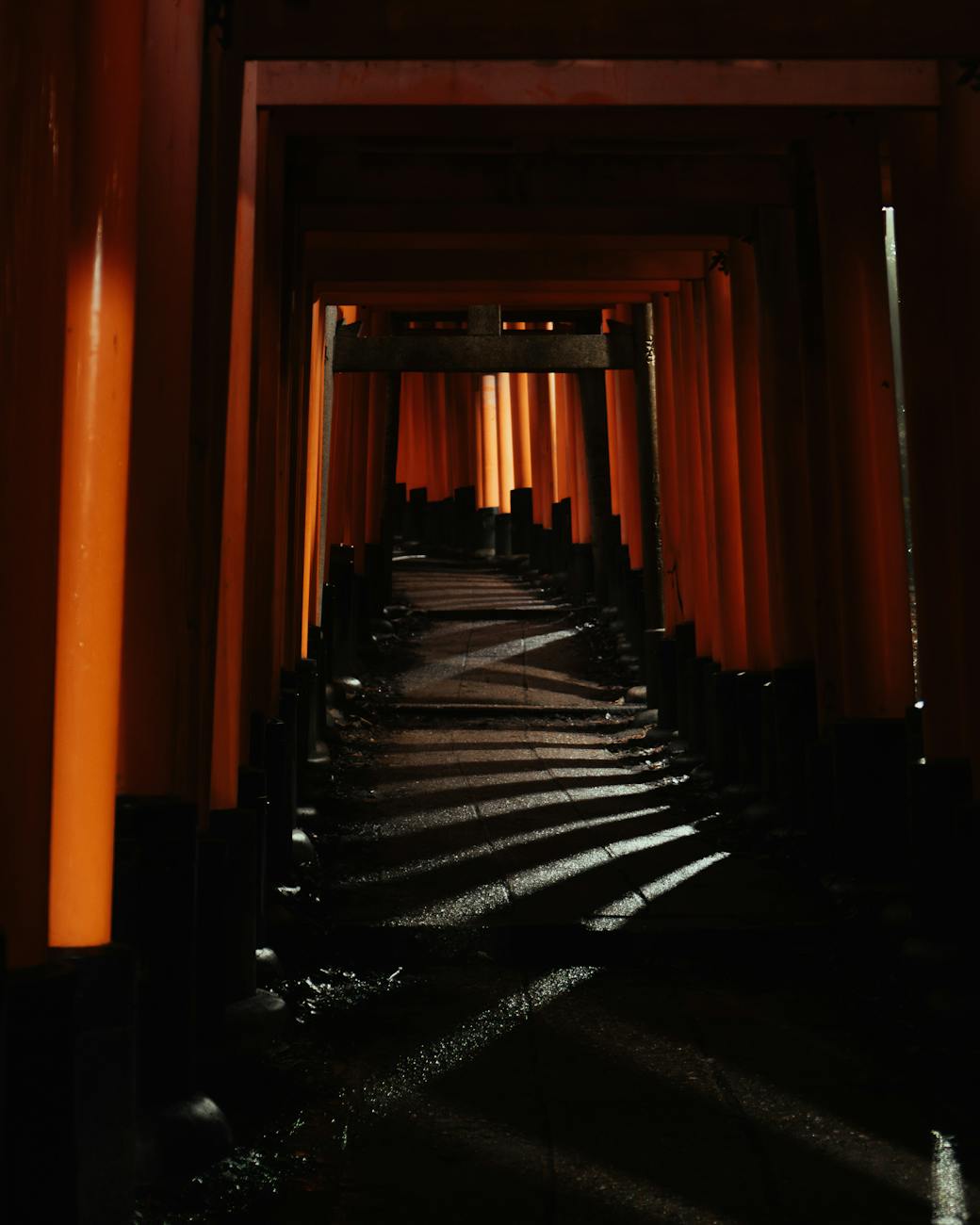
Shitennoji: Japan’s first state Buddhist temple
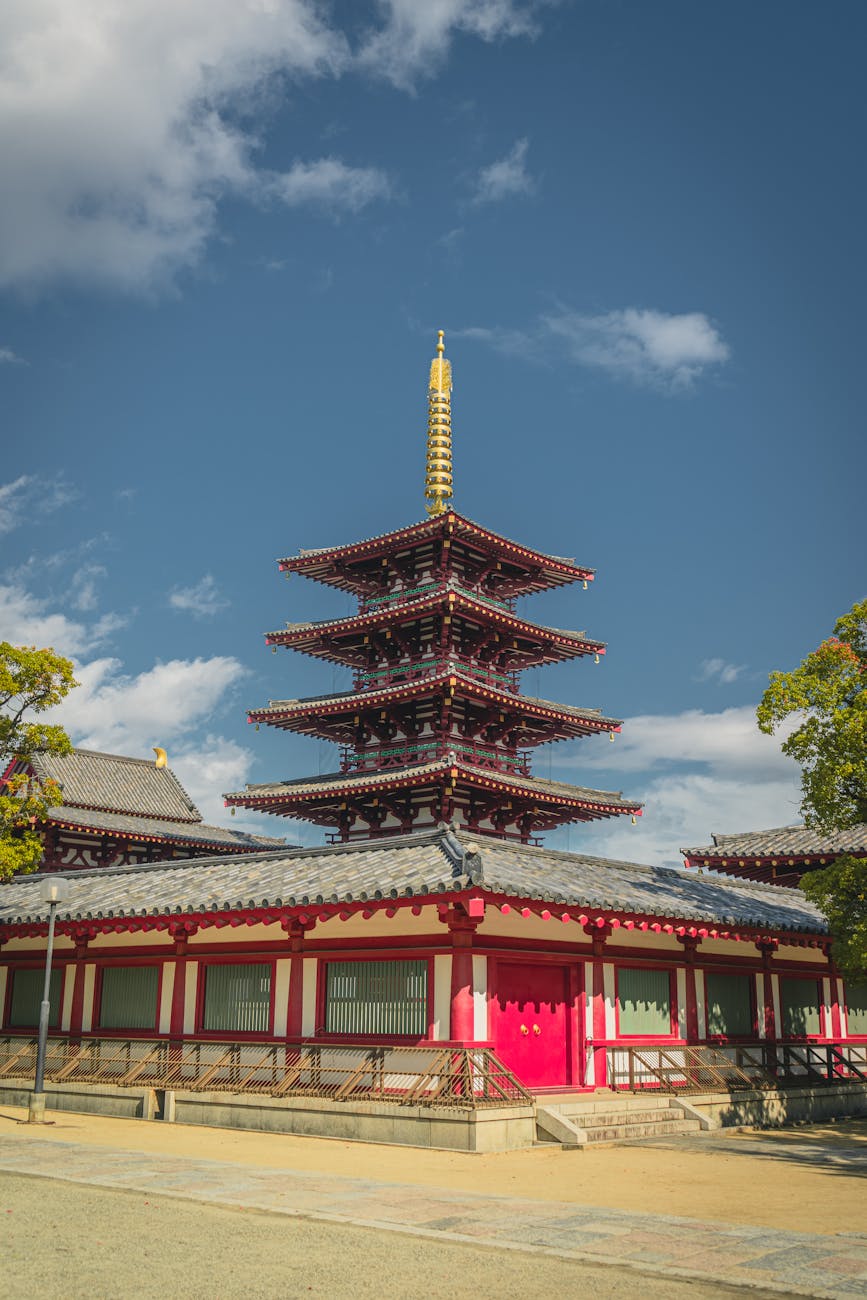
Start at Shitennoji, the first Buddhist temple the Japanese state ever built. Prince Shotoku, the regent credited with planting Buddhism in Japan, founded it in 593 AD, and its place in the country’s religious story is hard to overstate.
History
Shotoku built it after beating the anti-Buddhist Mononobe clan in battle. He’d prayed to the Four Heavenly Kings (Shitennō) for the win and promised them a temple if it came. The result, laid out in the formal Shitennoji-shiki-garan style, became the template for Buddhist temple design across Japan: main gate, pagoda, main hall, and lecture hall in a dead-straight line south to north, wrapped in a covered corridor. Fire, war, and disaster have flattened the wooden buildings many times over the centuries, and each time they’ve been rebuilt to the original plan. What stands now dates mostly from a 1963 concrete reconstruction, but it holds the true dimensions of the 6th-century original. For more on the warlords and battles behind sites like this, our Osaka samurai history guide fills in the wider story.
What to see
The five-story pagoda is the shot everyone takes, visible from the surrounding streets, and unusually you can climb inside it for views over Osaka, a rarity, since most Japanese pagodas stay closed. The Gokuraku-jodo Garden (Paradise Garden) is a Heian-style design meant to evoke the Buddhist paradise, built around a central pond with an arched bridge linking two small islands. And on the 21st and 22nd of each month, the grounds fill with Shitennoji-san, a sprawling flea market of vintage kimono, ceramics, old coins, and crafts that’s drawn bargain hunters for decades, a properly local scene, well off the tourist track.
Visitor information
Hours: grounds open daily 8:30am-4:30pm (April-September), 8:30am-4:00pm (October-March); the outer grounds stay open around the clock. Admission: free for the outer grounds; the inner precinct and the garden are ¥300 each. Access: a 5-minute walk from Shitennoji-mae Yuhigaoka Station on the Tanimachi Subway Line, and within walking distance of Tennoji Station, so it pairs easily with the Tennoji neighbourhood. The full breakdown is in our Shitennoji temple guide.
Sumiyoshi Taisha: the city’s most important shrine
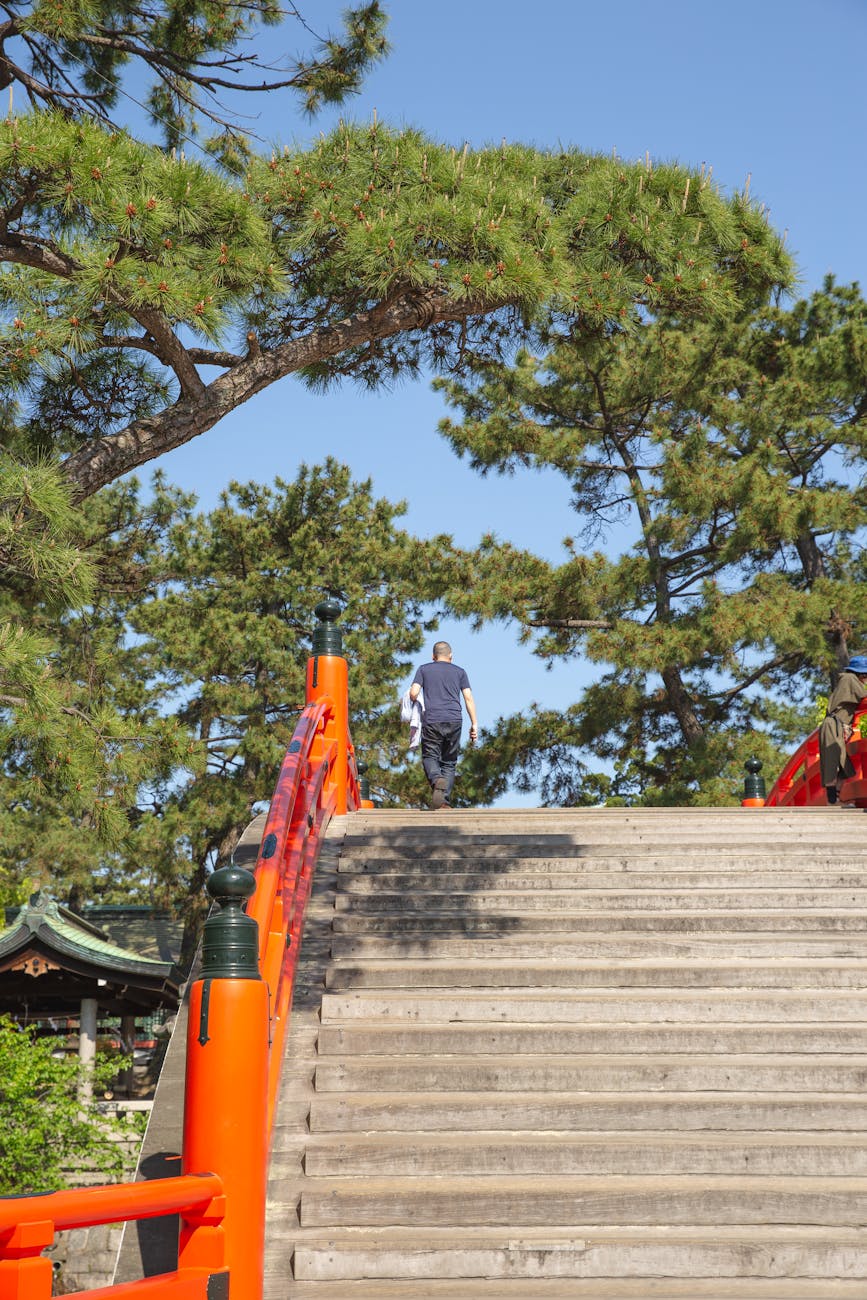
Sumiyoshi Taisha is the head shrine of roughly 2,300 Sumiyoshi shrines nationwide and the most historically important Shinto site in Osaka. Its history runs back more than 1,800 years, to before Buddhist architecture reached Japan, which makes its buildings some of the purest examples of native design anywhere.
The Sumiyoshi-zukuri style
What sets it apart is its Sumiyoshi-zukuri architecture, one of the oldest shrine styles in the country. Unlike almost everything else you’ll see, the four main halls have straight-ridged roofs in cypress bark rather than the curved, Chinese-influenced shape, sitting on raised floors with a rectangular plan and not a curved line anywhere, a purely Japanese aesthetic from before continental influence arrived. All four halls are designated National Treasures.
The Sorihashi bridge
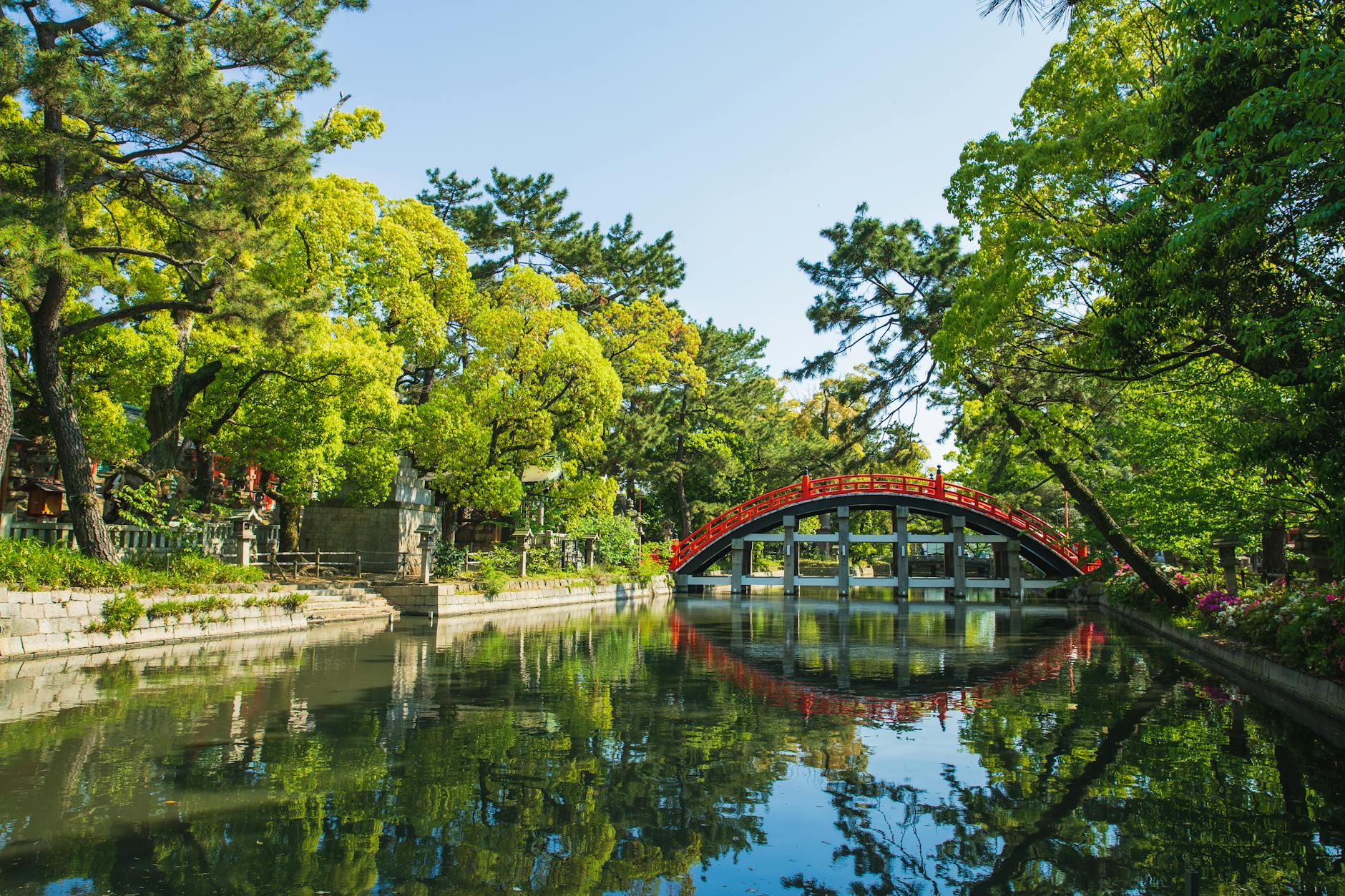
The signature sight is the Sorihashi (Taiko-bashi), a vermillion bridge arching at a dramatic 48 degrees. Crossing it is said to purify you, the steep climb standing for the trials of life, the gentle descent for the ease that follows. It vaults over a calm pond and is one of the most photographed spots of any of the city’s shrines, especially in autumn with the foliage doubled in the water below.
Festivals
Sumiyoshi Taisha hosts the Sumiyoshi Matsuri (July 30-August 1), one of Osaka’s three great summer festivals, with a procession of mikoshi (portable shrines), traditional performances, and hundreds of food stalls. At New Year it draws over 2 million visitors in the first three days, the highest of any shrine in Osaka and among the highest in all of western Japan.
Visitor information
Hours: grounds open daily 6:00am-5:00pm (April-September), 6:30am-5:00pm (October-March). Admission: free. Access: a 3-minute walk from Sumiyoshi Taisha Station on the Nankai Main Line, or take the Hankai Tramway to Sumiyoshi-Torii-mae, riding Osaka’s last surviving streetcar is half the fun. Our transportation guide covers the Hankai Tramway, and our full Sumiyoshi Taisha guide goes deeper on the grounds.
Osaka Castle: samurai history and the best view in town
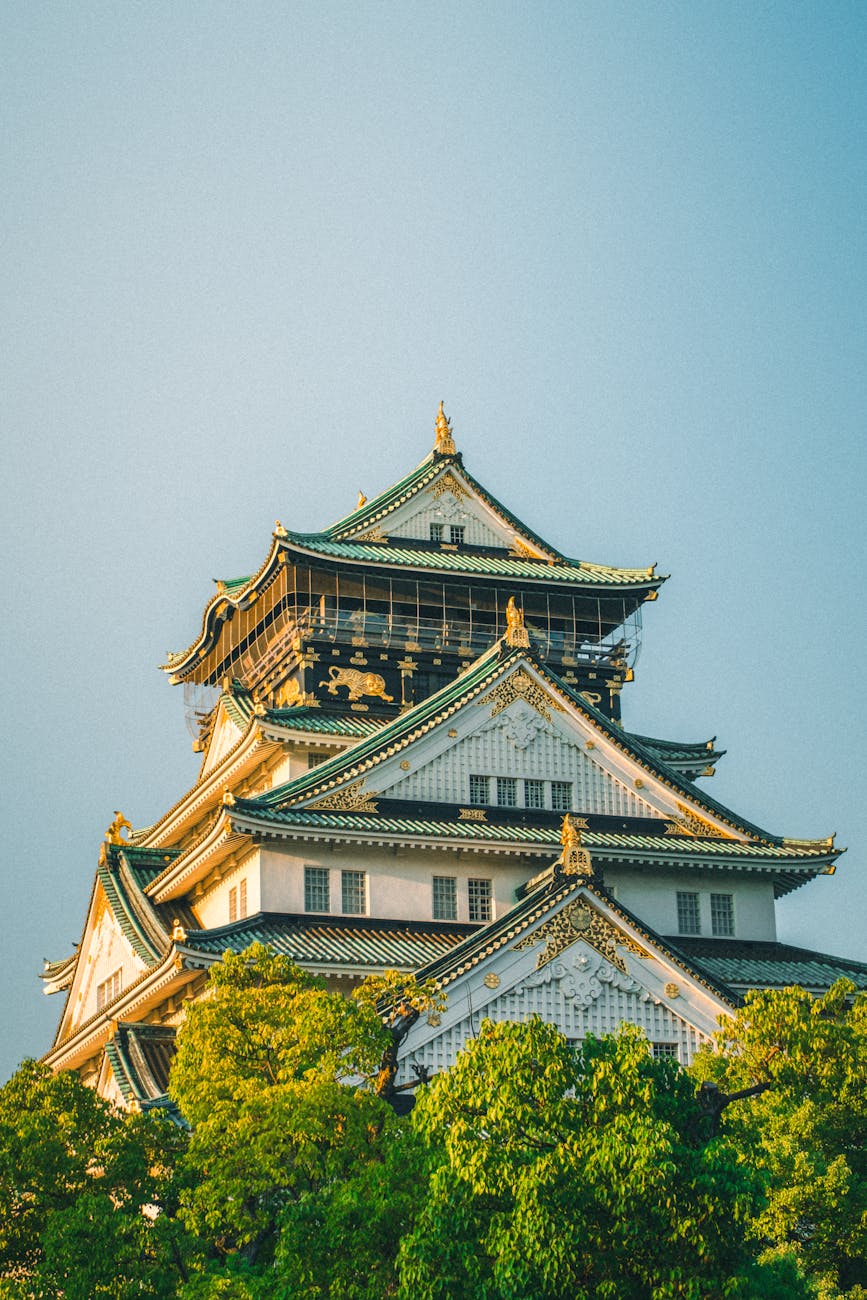
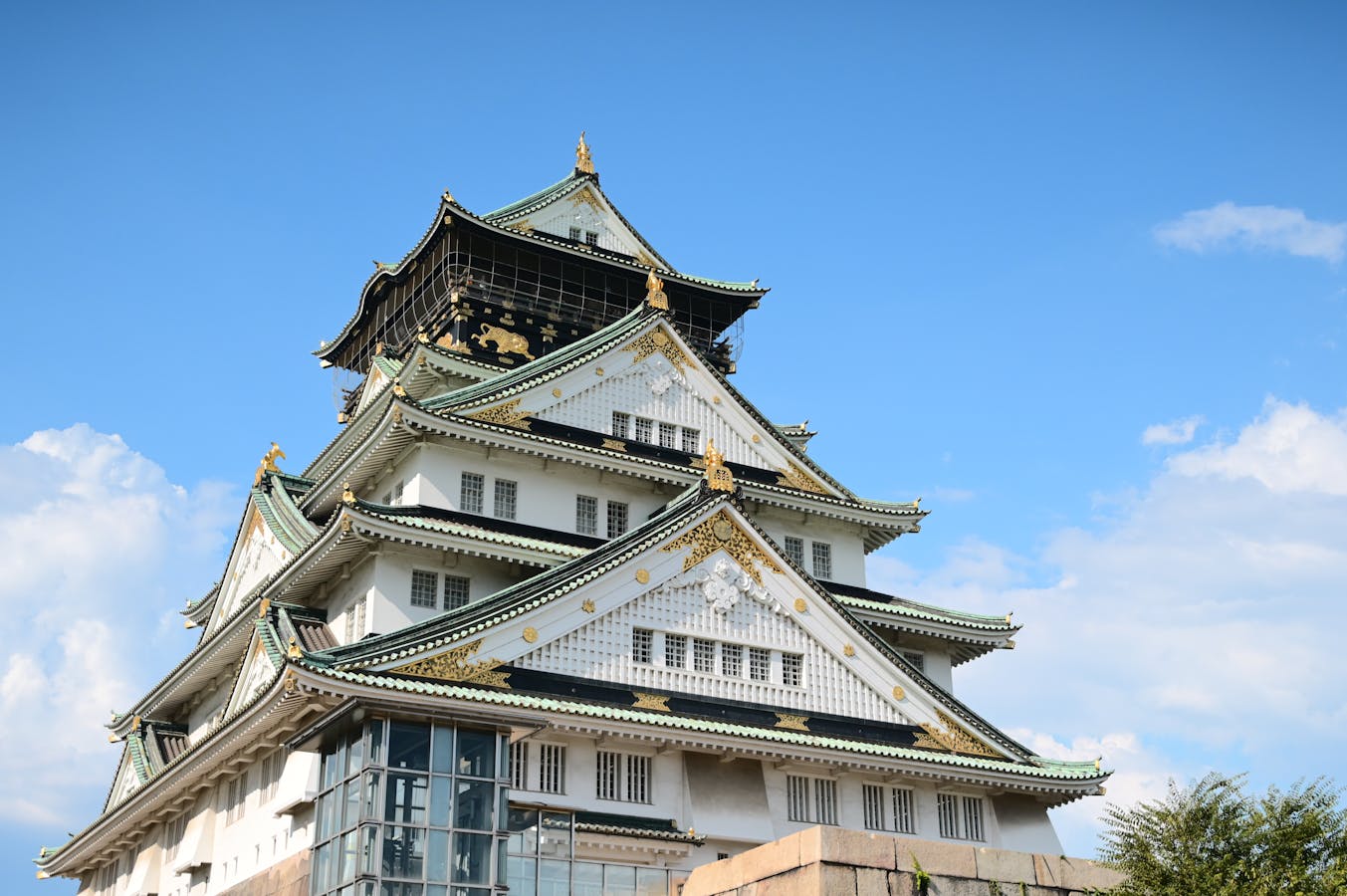
It’s a castle, not a temple or shrine, but it’s so bound up in Osaka’s history that no tour of the city’s sacred and historical sites really skips it. Toyotomi Hideyoshi, the warlord who unified Japan, built it in 1583, and for a time it was the largest, most intimidating fortress in the country.
History
Hideyoshi raised his castle on the former site of the Ishiyama Honganji, a Buddhist temple-fortress that had held off even Oda Nobunaga for over a decade. His version had five storeys outside and eight within, gold-leaf detailing, and massive stone walls that remain among the largest in Japan. It fell in the Summer Siege of Osaka in 1615, when the Tokugawa shogunate crushed the Toyotomi and opened the Edo period. The Tokugawa rebuilt it; lightning burned it down in 1665. It stayed gone until 1931, when the current concrete tower went up on public donations. Not an original wooden keep, then, but a beloved emblem of the city’s stubbornness, and now a museum on Hideyoshi and the castle’s own turbulent past. The deeper version sits in our Osaka Castle history guide.
What to see
The eight-floor museum holds armour, screens, and dioramas walking you through the Siege of Osaka and the Toyotomi legacy. The top-floor observation deck gives a 360-degree sweep of the city, arguably the best viewpoint in Osaka. The surrounding park runs to 106 hectares and is one of the city’s prime cherry blossom spots, over 3,000 trees, with a plum grove that blooms earlier in February and the Nishinomaru Garden framing the tower through the blossom. Don’t miss the Octopus Stone (Takobishi) in the outer wall, the complex’s largest at 5.5 metres tall and an estimated 100-plus tons, a flex of 16th-century engineering. More to do nearby in our things to do in Osaka guide.
Visitor information
Hours: 9:00am-5:00pm daily (later in cherry blossom and summer seasons). Closed December 28-January 1. Admission: ¥600 for the tower museum; the park is free. Access: a 15-minute walk from Osaka-jo Koen Station (JR Loop Line) or Tanimachi 4-chome Station (Tanimachi/Chuo Subway Lines). From most central Osaka hotels it’s about 20 minutes.
Osaka Tenmangu: the scholar’s shrine
Locals call it “Tenjin-san.” Osaka Tenmangu honours Sugawara no Michizane, the scholar-turned-deity revered as the god of learning and the arts, and it’s been a hub of intellectual life for more than a thousand years. Emperor Murakami ordered it founded in 903 AD.
History and architecture
Michizane was a brilliant 9th-century scholar and politician exiled from Kyoto by court intrigue. After he died, a run of disasters and plagues got blamed on his furious spirit, so the court deified him as Tenjin to calm him down. Thousands of Tenmangu shrines across Japan now honour him, and Osaka’s is among the most significant. The main hall carries elaborate carvings and gilded detail, and the Touryuumon gate (“Gate of the Rising Dragon”) earns its name from the dragon carvings worked into it. Heads up: as of 2026 the main hall is being re-roofed, work expected to run through August 2026. The shrine stays open, but expect some scaffolding.
Tenjin Matsuri
The shrine’s claim to fame is the Tenjin Matsuri, held every July 24-25, one of Japan’s three greatest festivals and the biggest event on Osaka’s calendar. It peaks with a boat procession on the Okawa River, over 100 lit boats carrying mikoshi and participants, capped by a huge fireworks display. More than a million people turn out each year.
Visitor information
Hours: 9:00am-5:00pm daily. Admission: free. Access: right by Osaka Tenmangu Station on the JR Tozai Line, or a short walk from Minami-Morimachi Station (Tanimachi/Sakaisuji Subway Lines). It sits beside the Tenjinbashi-suji arcade, Japan’s longest covered shopping street, so it folds neatly into a day of shopping in Osaka. Our Osaka Tenmangu guide has the rest.
The quirky ones most tourists miss
Past the big names, Osaka hides some genuinely strange and atmospheric sites that the crowds never reach, crowd-free, intimate, and in a couple of cases properly odd.
Namba Yasaka Shrine: the giant lion head
If you’ve seen a photo of a colossal lion’s head glaring over a courtyard, it was almost certainly this. The draw at Namba Yasaka is the Ema-den, a building shaped like an enormous lion’s head, 12 metres tall and 11 wide. The open mouth is said to swallow evil spirits and pull in good luck, which makes it one of the most photogenic spots in the city. For all the drama, the shrine dates to the Heian period (794-1185) and has deep roots, dedicated to Susanoo-no-Mikoto, the storm deity, and especially popular with students and athletes praying to win. It’s a quick walk from Namba Station, easy to tack onto a wander through the Namba nightlife district.
Hours: grounds open 24 hours. Admission: free. Access: 7-minute walk from Namba Station (any line). Full detail in our Namba Yasaka Shrine guide.
Hozenji: the moss Buddha off Dotonbori
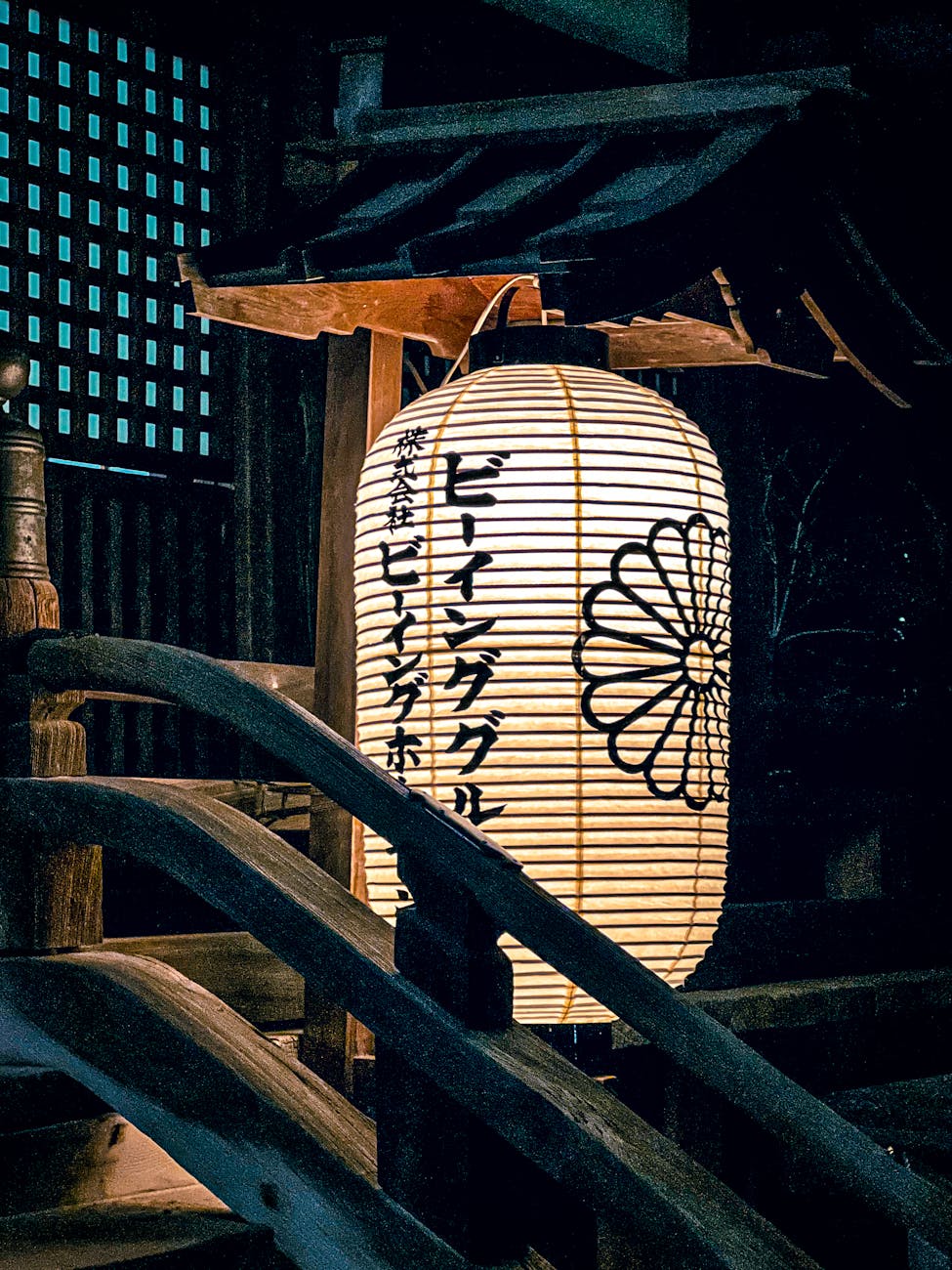
A minute off the neon chaos of Dotonbori, down a narrow alley, sits one of the most atmospheric temples in the city. Hozenji’s draw is the Mizukake Fudo, a statue of the fierce deity Fudo Myoo so thickly coated in green moss, from centuries of visitors splashing water on it while making wishes, that it looks more grown than carved. Lit by warm lanterns, it feels a world away from the entertainment district a few metres off. Tradition says wet the statue, make your wish, especially for love or business, and it may come true. The narrow Hozenji Yokocho alley around it is lined with old-school restaurants and bars, perfect mid-evening. The grounds are open 24 hours, so it slots into a late-night crawl through Osaka’s food scene.
Hours: 24-hour access. Admission: free. Access: 2-minute walk from Namba Station, right off Dotonbori. See our Hozenji temple guide for more.
Isshinji: the bone Buddha temple
This is the strangest site in the city, and it earns it. Founded by the monk Honen in the 12th century, Isshinji is known for its Okotsu Butsu, Buddha statues made from the cremated remains of the dead. Since 1887 the temple has combined the ashes of tens of thousands of people with cement into seated Buddha figures, building a new one roughly every decade. Fourteen exist so far, representing the remains of more than 2 million people. The modern Sanmon gate by sculptor Yoshihiro Takahashi is just as arresting, a contemporary work crowded with imagery of heaven and hell, set against the traditional halls behind. It sounds macabre; in practice the bone Buddhas are treated with deep reverence, a moving expression of how Japanese Buddhism thinks about death and continuity.
Hours: 9:00am-4:30pm. Admission: free. Access: 5-minute walk from Tennoji Station, near Shitennoji, combine the two in one morning. Our Isshinji temple guide has the full story.
Horikoshi: the power spot
Near Shitennoji, Horikoshi Shrine has a local reputation as a “power spot”, a place thought to radiate spiritual energy. It’s dedicated to Prince Shotoku (the founder of Shitennoji) and known for its lucky charms and amulets. Japanese visitors come especially for its empowerment blessings, and the shrine’s power stone is said to top up your drive and determination when you touch it with both hands.
Hours: 9:00am-5:00pm. Admission: free. Access: 10-minute walk from Tennoji Station.
How to visit: a quick etiquette guide
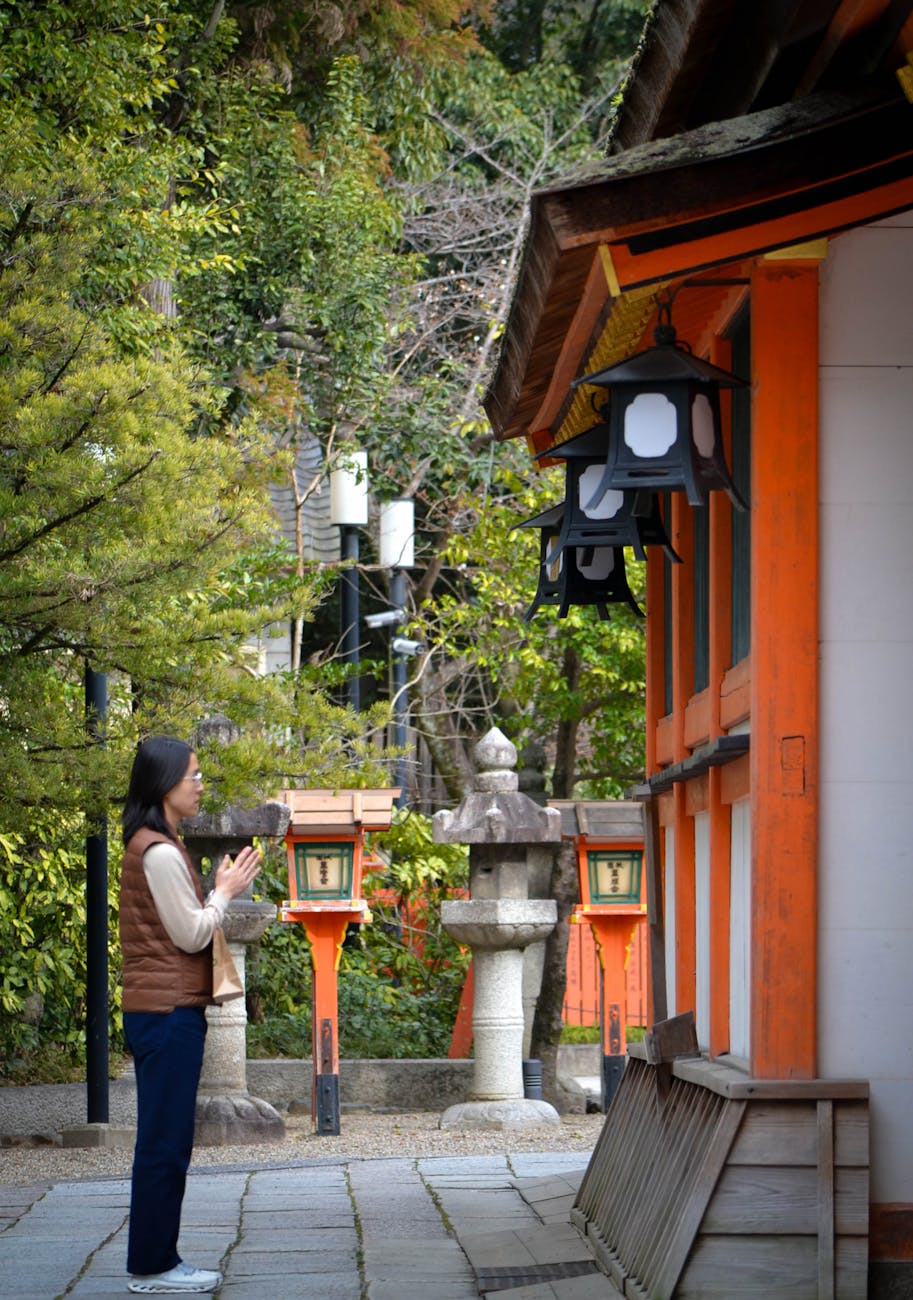
A little etiquette goes a long way, both as a sign of respect and to get more out of the visit. Here’s the short version.
At a Shinto shrine
Bow slightly as you pass through the torii gate, and walk the edges of the path rather than the centre, which belongs to the gods. At the temizuya (purification fountain), rinse your left hand, then your right, then pour water into your left hand to rinse your mouth, never straight from the ladle, then tip the ladle up to rinse the handle before replacing it. At the offering hall, toss a coin (¥5 is lucky, “go-en” sounds like the word for good fortune), bow deeply twice, clap twice, pray silently, then bow once more.
At a Buddhist temple
The temple ritual is simpler. You can light incense (usually ¥100-200) and waft the smoke toward yourself, it’s said to heal. To pray, put your palms together and bow once, and don’t clap; clapping is for shrines only. Going inside a building, take your shoes off and set them neatly in the spot provided. Many temples sell prayer beads (juzu) if you want to join in properly.
General points
Photography is usually fine outdoors but often banned inside main halls, watch for signs. Keep your voice down on the grounds. Dress modestly (nothing formal needed, just skip the very revealing stuff). Don’t touch religious objects unless invited. And if you buy a goshuin (a hand-brushed seal), treat it with respect, a goshuin-cho seal book makes a lovely record of where you’ve been.
Suggested routes
Half-day temple trail (4-5 hours)
Start at Shitennoji around 9am, about 90 minutes for the pagoda, inner precinct, and garden. Walk 10 minutes south to Isshinji for the bone Buddhas and that modern gate (30 minutes). Take the subway from Tennoji to Namba, then walk to Hozenji for a quick look at the moss statue (20 minutes). Carry on to Namba Yasaka for the lion head (20 minutes). Finish with lunch along Hozenji Yokocho or in the nearby Dotonbori food district.
Full-day historical deep dive (7-8 hours)
Open with Osaka Castle at 9am to beat the crowds (two hours for the museum and grounds). JR Loop Line to Tennoji for Shitennoji, and the flea market if it’s the 21st or 22nd (two hours). Drop in on Horikoshi Shrine nearby (30 minutes). After lunch, subway north to Osaka Tenmangu and a stroll down Tenjinbashi-suji (90 minutes). End at Sumiyoshi Taisha via the Nankai Line (90 minutes), the late light there is lovely and the crowds have thinned by then.
Pairing with a day trip
To stretch beyond the city, line up a day trip to Kyoto or Nara. Nara’s Todaiji, with its giant bronze Buddha, is just 35 minutes out by train, and Kyoto’s temple district is under an hour. Travelling as a family with children? Nara’s deer park plus Todaiji makes an easy, kid-friendly temple day. For something further from the city, the mountain temple complex at Koyasan is about two hours south on the Nankai line, and the working monasteries there take overnight guests.
When to go: a seasonal read
Each season changes the experience, and a bit of timing pays off.
Spring (March-May)
Cherry blossom season (late March to mid-April) is the busiest and the prettiest. Osaka Castle Park is the headline hanami spot, 3,000-plus trees around the castle. Shitennoji’s grounds are excellent too, and quieter than the castle. Many temples run spring ceremonies and stay open late for yozakura, nighttime blossom viewing.
Summer (June-August)
Festival season. The Tenjin Matsuri at Osaka Tenmangu (July 24-25) and the Sumiyoshi Matsuri at Sumiyoshi Taisha (July 30-August 1) are the highlights. It’s hot and humid, so go early or late in the day. Sumiyoshi’s shaded grounds are a relief in summer, and an evening at Hozenji beats the midday heat.
Autumn (September-November)
Foliage (koyo) peaks in late November. Osaka Castle Park and Sumiyoshi Taisha are among the best for colour. Cooler air makes for longer temple walks, and the lower humidity means clearer skies for photos. Shitennoji’s monthly market is especially pleasant now.
Winter (December-February)
Hatsumode, the first shrine visit of the new year, is the season’s main event. Sumiyoshi Taisha takes over 2 million visitors in the first three days of January, crowded but unforgettable. Shrines sell New Year charms (omamori) and fortune slips (omikuji). February brings plum blossom at the castle’s plum grove and Osaka Tenmangu, a preview of spring with a fraction of the cherry-season crowds.
Practical tips
- Carry coins. Offerings need small change, and you’ll want ¥5 coins (the lucky ones) for shrines. Temples sell incense and tablets for small cash too. Japan is going cashless fast, but offerings stay firmly coin-based.
- Start early. Most sites open between 6 and 9am, and mornings are the most peaceful and the best for photography, especially east-facing spots like Osaka Castle.
- Get a goshuin book. Collecting goshuin (御朱印), hand-brushed seals unique to each site, makes a lovely keepsake. Each runs ¥300-500 and is brushed by hand while you wait. Start a book at your first stop and add to it as you go, the same book works at temples nationwide.
- Wear easy shoes. Expect gravel, stone steps, and uneven ground, and you’ll be slipping shoes on and off to enter buildings, so go for something simple.
- Use an IC card. An ICOCA or Suica makes hopping between sites by train seamless. Our transportation guide lays out the options, and a day pass can save real money if you’re covering several areas.
- Consider a guide. For the deeper history, English-speaking volunteer guides work several major sites, including Osaka Castle, and they can turn a quick look into a proper education.
Where everything is
The major sites are spread across the city but well linked by transit. A rough geography for planning routes:
- Central / north: Osaka Castle (Chuo-ku), Osaka Tenmangu (Kita-ku, by Tenjinbashi-suji).
- Namba / Minami: Hozenji (off Dotonbori), Namba Yasaka (near Namba Station).
- Tennoji / south: Shitennoji, Isshinji, Horikoshi Shrine.
- Further south: Sumiyoshi Taisha (Sumiyoshi-ku, via Nankai Line or Hankai Tramway).
All of it is reachable on the Osaka Metro and JR lines. Our neighbourhoods guide helps you picture the geography, and the Osaka travel guide covers planning the wider trip.
Frequently asked questions
Are Osaka’s temples worth visiting if I’m also going to Kyoto?
Yes, and they’re a different experience. Osaka’s sites are older in some cases, far less crowded, and tied to the city’s samurai and merchant history rather than the imperial court. Shitennoji and Sumiyoshi Taisha in particular have no real Kyoto equivalent, both predate most of what you’ll see there.
How much does it cost to visit?
Most shrines are free, including Sumiyoshi Taisha and Osaka Tenmangu. Temple grounds are often free too, with small charges for inner precincts or gardens, Shitennoji’s are ¥300 each. Osaka Castle’s museum is ¥600. Budget a little change for offerings and the odd goshuin at ¥300-500.
How many temples and shrines can I see in a day?
Comfortably four or five if you cluster them, the Tennoji group (Shitennoji, Isshinji, Horikoshi) plus a couple in Namba makes an easy day. Spreading out to Sumiyoshi Taisha and the castle as well is doable but full; an IC card or day pass keeps it moving.
What should I wear?
Nothing formal, just modest and comfortable. Cover shoulders and avoid very short hems out of respect, and wear shoes you can slip off easily, since you’ll remove them to enter many temple buildings. Expect gravel and stone steps underfoot.
One last thing
The sites here are a fraction of the hundreds scattered across Osaka. From the 1,400-year weight of Shitennoji to the lion-head facade of Namba Yasaka, each tells a different chapter of the city’s story, and together they’re the quiet counterweight to all that famous noise and neon. Spend half a day on the highlights or several on a proper pilgrimage; either way, work outward from the cluster above and let the calm of these places balance the rest of your trip.
Explore the full Osaka Temples, Shrines & Historical Sites series
Each temple and shrine below has its own guide, with history, access and what to look for:
- Hozenji Temple Osaka: The Hidden Moss Buddha of Dotonbori
- Imamiya Ebisu Shrine: The Commerce Shrine & Toka Ebisu Guide
- Isshinji Temple Osaka: The Bone Buddha Statues Guide
- Katsuo-ji Temple: The Daruma Doll Temple in Minoo
- Namba Yasaka Shrine: The Giant Lion-Head Shrine of Osaka
- Osaka Castle History 2026: 440 Years from Hideyoshi to Today
- Osaka Museum of History 2026: Naniwa Palace Visitor Guide
- Osaka Samurai History 2026: Hideyoshi, the Sieges & Sites to Visit
- Osaka Tenmangu Shrine: Scholar’s Shrine & Tenjin Matsuri Guide
- Shitennoji Temple Osaka: Japan’s Oldest State Temple Guide
- Sumiyoshi Taisha: Complete Guide to Osaka’s Oldest Shrine
The most famous shrine in Kansai is an hour outside the city, and it never closes. Fushimi Inari from Osaka covers what the ten thousand torii gates actually mean, and how to see them without the crowd.