This article contains advertising. Our booking links are routed through a partner that adds commission tracking automatically, so if you book through one we earn a commission from the provider, at no extra cost to you. It never affects what we recommend. Affiliate disclosure
The most common mistake visitors make about Pokemon in Osaka is assuming there is one shop. There are two, they are a fifteen-minute subway ride apart, they stock different things, and one of them has a queue at opening while the other very often has nobody in it at all. Which one you want depends entirely on whether you are here to buy or here to experience — and nearly every guide online blurs them into a single listing, which is how people end up at the wrong Daimaru.
This guide separates them properly, explains the Pokemon Cafe booking system — which defeats a lot of people because it opens at a specific minute and sells out in seconds — and gives an honest answer on whether the cafe is worth the effort. Short version: the shops absolutely are, the cafe is a maybe, and there is a very good reason to visit the quiet one.
Two stores, two very different experiences
| Pokemon Center Osaka DX | Pokemon Center Osaka | |
|---|---|---|
| Where | Daimaru Shinsaibashi, Main Building 9F | Daimaru Umeda, 13F |
| Station | Shinsaibashi, Midosuji line, Exit 4 | Osaka Station / Umeda, direct |
| Size | Flagship, the largest in western Japan | Standard, considerably smaller |
| Pokemon Cafe | Yes, adjacent, reservation only | No |
| Crowds | Heavy, especially weekends and holidays | Usually light |
| Best for | The full experience, cafe, photo spots | Actually buying things without a scrum |
The "DX" suffix means Deluxe, and it is not marketing filler — the Shinsaibashi store is a genuinely different scale of thing, with the cafe attached and installations built for photographs. The Umeda branch is a proper Pokemon Center with the same core stock, on a floor that also holds Nintendo OSAKA and a Capcom store, and it is the one locals actually shop in.
Pokemon Center Osaka DX, Shinsaibashi
Getting there
Daimaru Shinsaibashi Main Building, ninth floor. From Shinsaibashi station on the Midosuji subway line, Exit 4 connects directly by underground passage, so you never surface — useful in August or in rain. From Namba it is one stop north, or a ten-minute walk up the Shinsaibashi-suji arcade. From Umeda, four stops south on the red line; the subway guide covers the network if you are new to it.
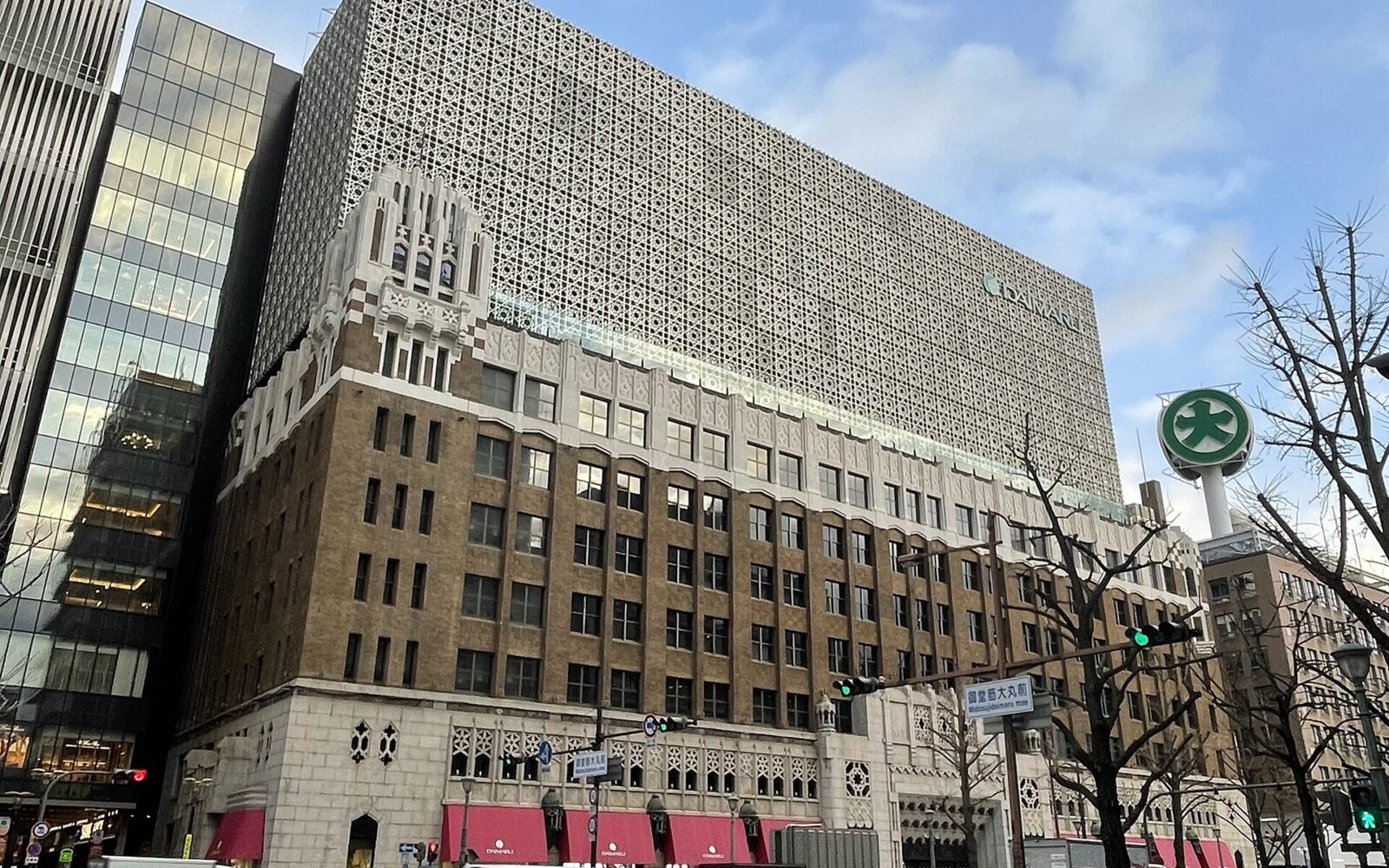
Daimaru’s Main Building is the handsome 1930s Art Deco one designed by William Merrell Vories — worth ten seconds of attention on the way in, because it is one of the few pre-war commercial buildings left in central Osaka. Take the lifts or the escalators to 9F; the store is signposted from the lift lobby and, on busy days, from considerably further away by the queue.
What is actually in there
Roughly: a very large retail floor, a wall of plush, a wall of trading cards, seasonal and regional exclusives, an in-store Pokemon Trading Card Game area, and several built photo installations — the sort of thing where a life-sized Pokemon stands in a diorama and there is a polite queue of people waiting their turn. Staff wear themed uniforms. The soundtrack is the games’ music. It is unashamedly a spectacle, and it works.
Two things worth planning around. First, the trading card section is where the serious crowd is: card releases draw genuine queues, and popular sets sell out on release morning. Second, the store enforces purchase limits on hot items, which is aimed at resellers but applies to everyone.
Regional exclusives
Every Pokemon Center in Japan carries items you cannot buy elsewhere, and the Osaka-specific ones lean hard into local identity: Pikachu in Osaka merchant dress, takoyaki-themed goods, Kansai-dialect phrasing on shirts and towels. These change several times a year and there is no reliable way to check the current line-up before you arrive. If you want one, buy it when you see it — the "I will get it on the way back" approach has ended in disappointment for many people.
When to go
- Best: a weekday morning shortly after Daimaru opens, or the last hour before closing. Both are noticeably calmer.
- Worst: Saturday and Sunday afternoons, Japanese public holidays, and the first weekend after any new card set or game release.
- Also busy: Golden Week and the mid-August holiday, when the whole of Shinsaibashi is at capacity. See the Golden Week guide for what that actually feels like.
Pokemon Center Osaka, Umeda
Daimaru Umeda, thirteenth floor, immediately beside the central entrance of Osaka Station — you can be off a train and in the shop in about four minutes, which is not true of anywhere else on this page.
This is the smaller, older, quieter store, and it is the one to choose if your goal is to buy something rather than to see something. The core range is the same: plush, cards, stationery, apparel, homeware. What you lose is the scale, the cafe and the photo installations. What you gain is the ability to browse a shelf without waiting behind six people.
The thirteenth floor is Daimaru Umeda’s "Characters World" and Pokemon is only part of it. Nintendo OSAKA is on the same floor — the city’s only official Nintendo store, open 10:00 to 20:00 daily, and every bit as good as the Pokemon shop for anyone who grew up with a controller. The ONE PIECE Mugiwara Store, a CAPCOM Store and Cafe, and Tomica and Plarail shops are all up here too. Realistically you should budget an hour for the floor, not twenty minutes for one shop.
If you are staying north of the river this is simply the better trip, and it combines with everything else in the Umeda guide and the department store guide, whose basement food halls are a separate and excellent reason to be in the building.
Pokemon Cafe: how to actually get a table
The Pokemon Cafe sits next to the DX store on the same ninth floor of Daimaru Shinsaibashi. It is reservation-only. There is no walk-in list, no waiting bench, and no amount of politeness at the door will get you in. If you have not booked, you are not eating there.
The booking system
This is the part that catches everybody out, so here it is precisely:
- Reservations open at 18:00 Japan time, exactly 31 days before the date you want.
- Booking is online, in English, for parties of one to eight.
- Slots are fixed, typically 90 to 120 minutes.
- Popular dates — weekends, school holidays, anything in Golden Week — go in the first minute or two. Weekday lunchtimes are far easier.
The practical method: work out your date, count back 31 days, and be at a screen with the page already loaded at 17:55 Japan time. Have your details typed in advance. Do not attempt this on hotel wifi if you can help it, and do not rely on a phone browser — a laptop is measurably better. If you miss it, check back over the following days, because cancellations do reappear.
Opening hours run from around 10:00, with the last seating well into the evening, though the published hours have shifted more than once. Confirm on the official cafe site when you book, rather than trusting any figure you read elsewhere — including this one.
What you get
Themed food, plated as characters: curry rice shaped into a Pokemon, dessert plates, latte art printed onto the foam with a character of your choosing. Expect roughly ¥1,500–2,500 per main and ¥800–1,200 per drink, so a couple will spend somewhere around ¥6,000–8,000 including the exclusive merchandise almost everybody buys on the way out. Each dish comes with a themed plate or coaster you keep, which softens the price a little.
Is it worth it? The honest answer
The food is fine. That is the correct word for it — competent, pleasant, occasionally quite good, and not what you are paying for. What you are paying for is a themed room, an attentive performance, a plate to take home and a genuinely lovely experience if you are eight years old or if you have loved this franchise since you were.
So: if you are travelling with children, or if Pokemon actually means something to you, book it and enjoy it. If you are a general traveller who thinks it sounds like a fun novelty, skip it. The effort of the 31-day booking window, the fixed time slot chaining you to one afternoon of your trip, and the price are all disproportionate to a mildly amusing lunch. Go into the DX store instead, which is free, takes twenty minutes and delivers most of the same delight.
There is a wider version of this verdict for the whole city in our anime and pop culture guide, which covers the character cafes that are easier to get into.
What to buy, and what to skip
Worth it:
- Regional exclusives. The Osaka-only designs are the one thing you genuinely cannot get at home or online, and they are priced normally — usually ¥1,000–3,000.
- Japanese-language trading cards. Cheaper than the Western equivalents, better print quality by most collectors’ reckoning, and the artwork on Japanese-exclusive promos does not exist elsewhere.
- Stationery and small homeware. Light, flat, cheap, and far more distinctive than the plush everyone else buys.
- Seasonal collections. Tied to the calendar and gone within weeks.
Skip:
- Standard plush. Identical worldwide, bulky in a suitcase, and available online at home. Buy it only if you want that specific one now.
- Sealed booster boxes bought in a hurry. Prices at the Pokemon Center are official retail; the card shops in Den Den Town are where the singles, the vintage stock and the actual bargains live. If cards are the point of the trip, go there instead — details in our Den Den Town shopping guide.
- Anything you are buying because you queued. A real risk in the DX store on a Saturday.
If you are here for the cards
Osaka is one of the best cities in Japan for the Trading Card Game, and the Pokemon Center is only the front door of that scene. Understanding the difference between the two kinds of shop saves both money and disappointment.
The Pokemon Center sells sealed product at official retail. Booster packs, boxes, sleeves, the current sets, and promotional cards attached to purchases or in-store play. What it does not do is sell singles, and it does not stock anything that has left print. On release days there will be a queue before opening and per-person limits at the till.
The specialist shops sell singles, vintage and graded cards. Nipponbashi Den Den Town has a dense cluster of them within a few streets, along with the big second-hand chains, and this is where you go if you want a specific card rather than a sealed gamble. Prices are transparent, condition grading is conservative by international standards, and staff will get a card out of the case for you to look at. It is also where Japanese-exclusive promos from years past actually turn up.
Two practical notes. First, singles are almost always cash-friendly but not always card-friendly, particularly at the smaller counters. Second, if you are buying anything expensive, buy it late in the trip — carrying a high-value card around Kansai in a backpack for a week is an unnecessary risk. Our Den Den Town shopping guide maps the district properly.
Playing while you are here
The DX store has an in-store play area and the specialist shops run regular tournaments, most of which are open to anyone who turns up with a legal deck. Japanese-language cards are legal in Japanese events and Western-language cards generally are not, so if you want to play you will need to buy in. It is a friendly scene and the language barrier matters less than you would expect, because the game itself does the talking — but check the shop’s schedule board, since events are posted in Japanese and fill up.
Pokemon beyond the two stores
A few smaller things worth knowing:
- Gachapon. Capsule-toy machines are everywhere in Osaka and a good proportion of them are Pokemon. At ¥300–500 a turn they are the cheapest souvenir in the city, and the machines in Den Den Town and inside the big arcades go far deeper than the ones in the stations.
- Second-hand. The large recycle chains carry retired Pokemon Center plush and merchandise at a fraction of original prices, in good condition. This is the single best-value Pokemon shopping in Osaka and almost no visitor does it.
- PokeLids. Decorated Pokemon manhole covers have been installed across a growing list of Japanese municipalities as small public artworks. The roster changes, so check the official PokeLid map before you plan a walk around one — it is a lovely excuse to end up somewhere in the city you would never otherwise go, which is rather the spirit of the hidden gems guide.
- Pokemon GO. Osaka’s big parks — Osaka Castle Park above all — are dense with stops, and a data SIM makes this workable; see the SIM and wifi guide.
Tax-free shopping: an important 2026 change
Both stores handle tax-free purchases for visitors, and the system changes fundamentally on 1 November 2026. Until then, you show your passport at the till and pay the tax-free price on the spot. From that date the instant exemption ends: you pay the full tax-inclusive price in store, have the export confirmed by customs at an airport kiosk when you leave, and the shop refunds the 10% — within 90 days of purchase and before you leave Japan.
Practically, that means keeping receipts, keeping purchases together, and allowing extra time at the airport. It also means the minimum spend threshold still applies, so it is worth consolidating purchases in one store rather than splitting them between Umeda and Shinsaibashi. Our tax-free shopping guide covers the mechanics, and the shopping guide covers the rest of the city.
Making a day of it

Neither store fills a day on its own. Two routes that work:
The Shinsaibashi day. DX store in the morning, lunch in the Daimaru basement or out in the arcade, then the Shinsaibashi-suji arcade south towards Amerikamura for vintage and streetwear, ending in Dotonbori for the evening. Straight line, all on foot.
The otaku day. Pokemon Center Osaka in Umeda first thing, plus Nintendo OSAKA and Capcom on the same floor, then the Midosuji line south to Namba and a fifteen-minute walk east into Nipponbashi Den Den Town — Osaka’s answer to Akihabara, 150-plus specialist shops with Ota Road as its anime and manga heart. This is by far the better day for anyone whose interest goes past the one franchise.
And if a rainy afternoon is what you are solving for, both stores are entirely indoor and connected to their stations underground — see rainy day Osaka for the rest of the wet-weather list. With children, pair either store with Kids Plaza or read Osaka with kids for the full picture.
The bigger Nintendo pilgrimage, of course, is out at the coast: Super Nintendo World inside Universal Studios Japan, which is a full day and a completely different scale of undertaking.
Frequently asked questions
Do I need a reservation for the Pokemon Center itself?
No. Both stores are walk-in and free to enter. Only the cafe requires a booking.
How far in advance does the Pokemon Cafe open bookings?
Exactly 31 days, at 18:00 Japan time. Popular slots go within minutes. Weekday lunch slots are the realistic target for most visitors.
Can I get into the Pokemon Cafe without a reservation?
No. There is no standby queue and no walk-in allocation. Cancellations do occasionally reappear online, so it is worth re-checking the booking page in the days before your date.
Which store should I go to?
Shinsaibashi for the experience, the cafe and the spectacle. Umeda if you mainly want to buy things, dislike crowds, or are short on time near Osaka Station. Both stock the Osaka regional exclusives.
Are the two stores’ stock identical?
Broadly, though the DX store is larger and carries more of everything, including limited items that sell out before they reach smaller branches. If you are hunting something specific, go to Shinsaibashi.
Can I pay by card?
Yes, at both, and IC cards work too. Cash is still worth carrying elsewhere in the city — small shops and market stalls remain cash-only.
Is there a Pokemon Center at Universal Studios Japan?
No. USJ’s Nintendo tie-in is Super Nintendo World, which is Mario and Donkey Kong rather than Pokemon. The park’s shops sell no Pokemon Center range.
How much time should I allow?
Thirty to forty-five minutes for either store on a quiet day, an hour if you are browsing seriously, and closer to two for the Umeda character floor as a whole. Add ninety minutes to two hours if you have a cafe booking.
Where to go from here
The right way to use these two shops is to treat them as one stop on a bigger day rather than as a destination in themselves. Buy the regional exclusives, skip the plush you can get at home, and go to Umeda rather than Shinsaibashi if crowds bother you at all.
From here, the anime and pop culture guide is the natural next read, then Den Den Town for the district that does this properly. For the wider shopping picture there is the shopping guide and what to actually bring home, and if you are still assembling the trip, start with the itinerary planner or things to do in Osaka.
Photo Credits
Daimaru Shinsaibashi: DAIMARU Shinsaibashi Store Main Building by Tokumeigakarinoaoshima, CC BY-SA 4.0, via Wikimedia Commons.