This article contains advertising. Our booking links are routed through a partner that adds commission tracking automatically, so if you book through one we earn a commission from the provider, at no extra cost to you. It never affects what we recommend. Affiliate disclosure
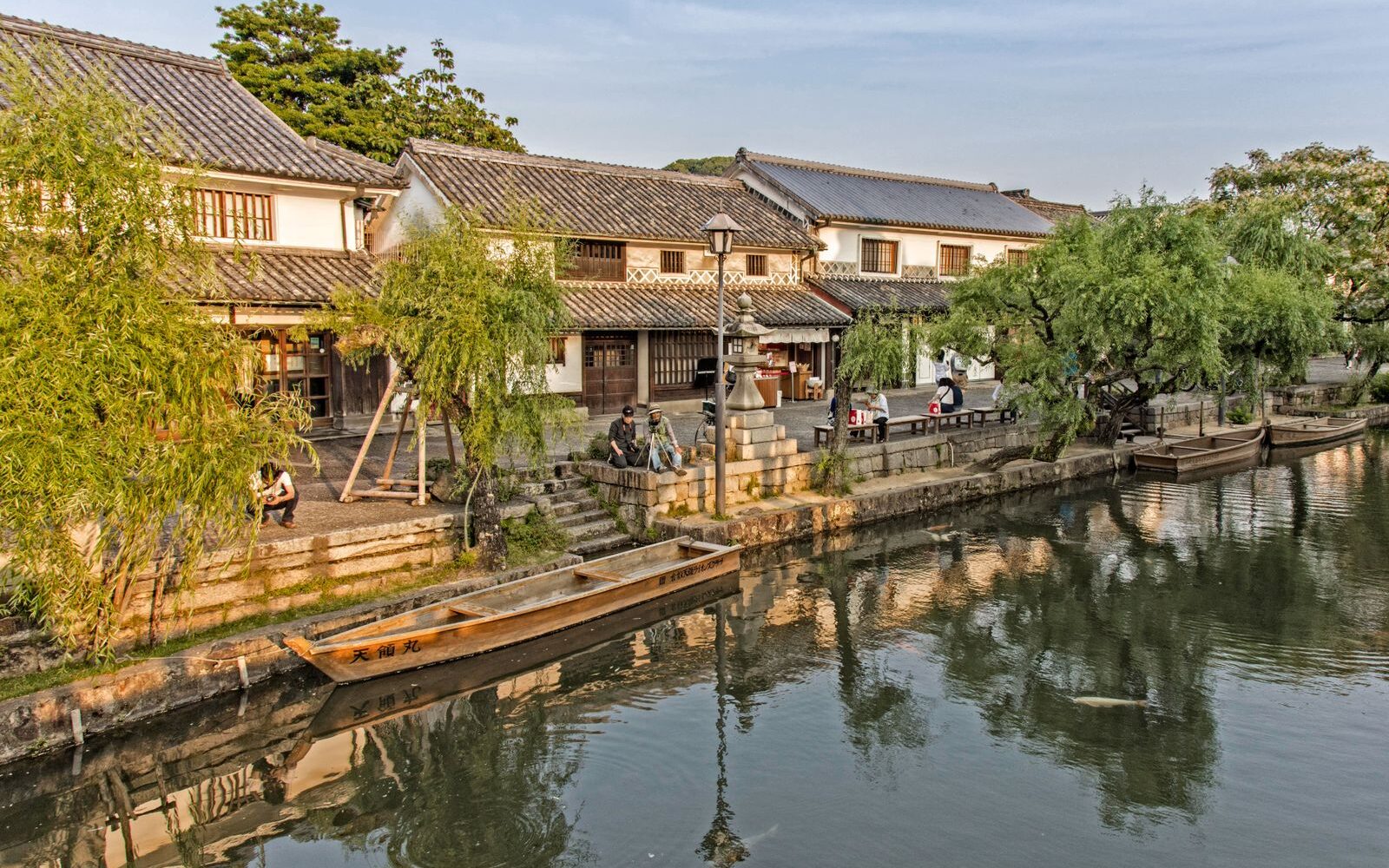
Kurashiki’s famous canal is shorter than most people expect. The stretch that appears on every poster, willows trailing into still water in front of white-walled storehouses, runs for a few hundred metres through the old merchant quarter and then simply stops being pretty. You can walk it end to end in ten minutes. That is not a complaint. It is the reason Kurashiki works so well as a day trip: a small, perfectly preserved place that rewards slowing down, an hour and a half from Osaka, with one of Japan’s great gardens and a black-walled castle twenty minutes up the line in Okayama.
This guide covers the day trip to Kurashiki from Osaka properly: how to get there and what it costs, what to see in Kurashiki’s Bikan Historical Quarter and in Okayama, whether to do both in one day, the order that works, what to eat, and the one honest piece of advice most guides leave out, which is that Kurashiki is at its best after the day-trippers have gone home.
Kurashiki and Okayama at a glance
- Distance: Okayama is about 45 minutes from Shin-Osaka by Nozomi; Kurashiki is a further 17 minutes or so by local JR train.
- Total journey: about an hour and a half from Umeda to the canal, door to door, and a little more from Namba.
- Cost: around ¥5,500 each way between Shin-Osaka and Okayama by Shinkansen, plus a few hundred yen to Kurashiki. The JR Kansai Wide Area Pass covers the whole journey.
- Time needed: three to four hours for Kurashiki, two to three for Okayama’s garden and castle. Both together make a full day.
- Best for: anyone who loved Kyoto’s old streets but not its crowds, art lovers, garden lovers, and anyone with a Kansai Wide Area Pass to use.
- Avoid: Mondays, when the Ohara Museum of Art is closed, and the middle of the day in Kurashiki, when the coach parties arrive.
Getting there from Osaka
The quickest route is the Sanyo Shinkansen from Shin-Osaka to Okayama: about 45 minutes on a Nozomi, a little longer on the Hikari, Sakura and Kodama, with several trains an hour. The fare is around ¥5,500 each way for an unreserved seat, a little more reserved. At Okayama, change to the JR Sanyo line for Kurashiki, about 17 minutes on a local or rapid train, with frequent departures. From Kurashiki station the Bikan Historical Quarter is a flat walk of ten to fifteen minutes south. An ICOCA card covers the local train between Okayama and Kurashiki; the Shinkansen needs a ticket or a pass.
Two cheaper alternatives exist if you have more time than money. Local and rapid JR trains, changing at Himeji, take around three hours each way and save a good part of the Shinkansen fare. Highway buses also connect Osaka with Okayama and Kurashiki; they are cheaper still, slower, and at the mercy of the traffic. For a day trip, the Shinkansen is worth it.
The pass maths. The JR Kansai Wide Area Pass costs around ¥12,000 for five consecutive days and covers the Shinkansen between Shin-Osaka and Okayama, plus the local trains on to Kurashiki. A Kurashiki day trip alone uses most of its value, so if your five days include any other long JR trip, such as Himeji, Kinosaki or the Kii Peninsula, it pays for itself comfortably. The nationwide Japan Rail Pass covers the route too. Our Kansai rail passes guide compares the options, and note that Shin-Kurashiki, the Shinkansen station with “Kurashiki” in its name, is the wrong station: it is some distance from the old town, and changing at Okayama is quicker.
Kurashiki: the Bikan Historical Quarter
In the Edo period Kurashiki was a market town under the direct rule of the shogunate, and its merchants grew rich on rice and, later, cotton, which came in and out by boat along the canal. The name means something like “village of storehouses”, and the storehouses, kura, are still the heart of it: two-storey buildings with thick white plaster walls, black tiled roofs and the distinctive namako-kabe facing of black tiles set in raised white joints, built to keep goods safe from fire and thieves. When the canal trade faded, the town turned to cotton spinning, and in the twentieth century its leading family, the Ohara, poured their fortune into a museum, a hospital and the preservation of the old quarter.
The result is the Bikan Historical Quarter, literally the “beautiful view” district: a compact grid of preserved streets either side of the canal, now full of museums, craft shops, cafes in converted storehouses and small inns. It is touristy, but it is touristy in the gentle, well-kept way of a place that has been protected for decades, and most of the buildings are the real thing.
The canal and the boat
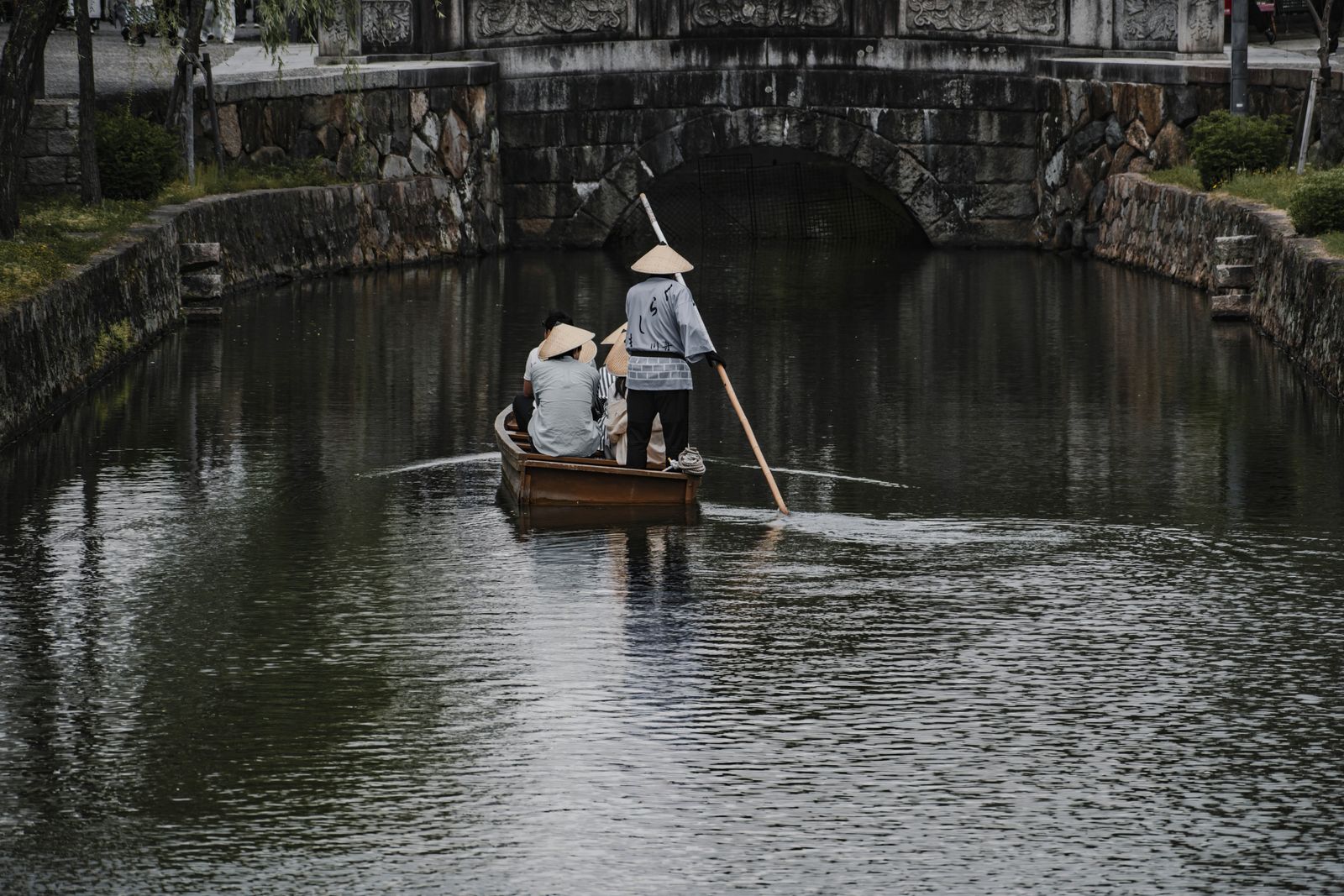
Walk the canal first, from end to end and back on the other bank, and cross the old stone bridges. The light is best early in the morning and in the hour before sunset, and the whole quarter is lit up after dark. For a different angle, the small traditional boats that pole along the canal, with a boatman in a sedge hat, cost around ¥500 for adults and ¥250 for children, for a short, unhurried loop. Tickets can sell out on busy days, so buy one early at the tourist information office by the canal and come back at your time.
The Ohara Museum of Art
The building that looks like a small Greek temple on the canal bank is the Ohara Museum of Art, founded in 1930 by the cotton magnate Ohara Magosaburo as Japan’s first museum of Western art. Its collection was largely bought in Europe by his friend, the painter Kojima Torajiro, and it is remarkable for a town of this size: El Greco’s Annunciation, one of Monet’s water lilies, and works by Gauguin, Renoir, Matisse and many more, alongside later galleries of Japanese painting, crafts and Asian antiquities.
The museum reopened on 25 April 2026 after a closure for renovation work. It opens from 9:00 to 17:00, with last entry at 16:30, and is closed on Mondays, except on some public holidays. Admission is the priciest ticket in town, so check the current price on the museum’s site, and allow at least ninety minutes if you want to see more than the main building. If you have no interest in Western art, you can skip it without guilt; if you do, it is the reason to come. Osaka’s own collections are covered in our Osaka museums guide.
Ivy Square
A few minutes’ walk from the canal, Ivy Square is the former Kurabo cotton mill, a complex of red-brick buildings from the late nineteenth century now covered in ivy and converted into a hotel, shops, small museums and a courtyard cafe. It is the best place to understand how Kurashiki made its second fortune, and on a hot day the ivy-shaded courtyard is the coolest spot in town.
Kurashiki denim
Kojima, a district of Kurashiki on the coast to the south, is where Japan’s first domestic jeans were made in the 1960s, and it remains one of the world’s most respected centres of denim. You do not need to go to Kojima to see it: the Bikan quarter has a cluster of denim shops selling Kojima-made jeans, bags and accessories, some of them very good and none of them cheap. If you are a denim person, budget for it; if not, enjoy the denim-blue soft-serve and move on. For Osaka’s own vintage denim scene, see our guide to vintage shopping in Osaka.
Achi Shrine and the view
Above the quarter, a flight of stone steps climbs through the trees of Tsurugata-yama to Achi Shrine, the guardian shrine of the old town. It is quiet, rarely visited by the tour groups, and from the top you look down over the tiled roofs of the old quarter towards the modern city. In late April and early May the shrine’s old wisteria is in flower. Allow half an hour for the climb and a look round.
What to skip
The souvenir and snack shops on the main streets are pleasant but interchangeable; buy one thing you actually want and leave the rest. And do not spend the middle of the day on the canal itself if you can avoid it: between late morning and mid-afternoon the bridges are crowded with tour groups, and that is the time to be inside the Ohara Museum, at Ivy Square or up at Achi Shrine.
Okayama: Korakuen and the castle
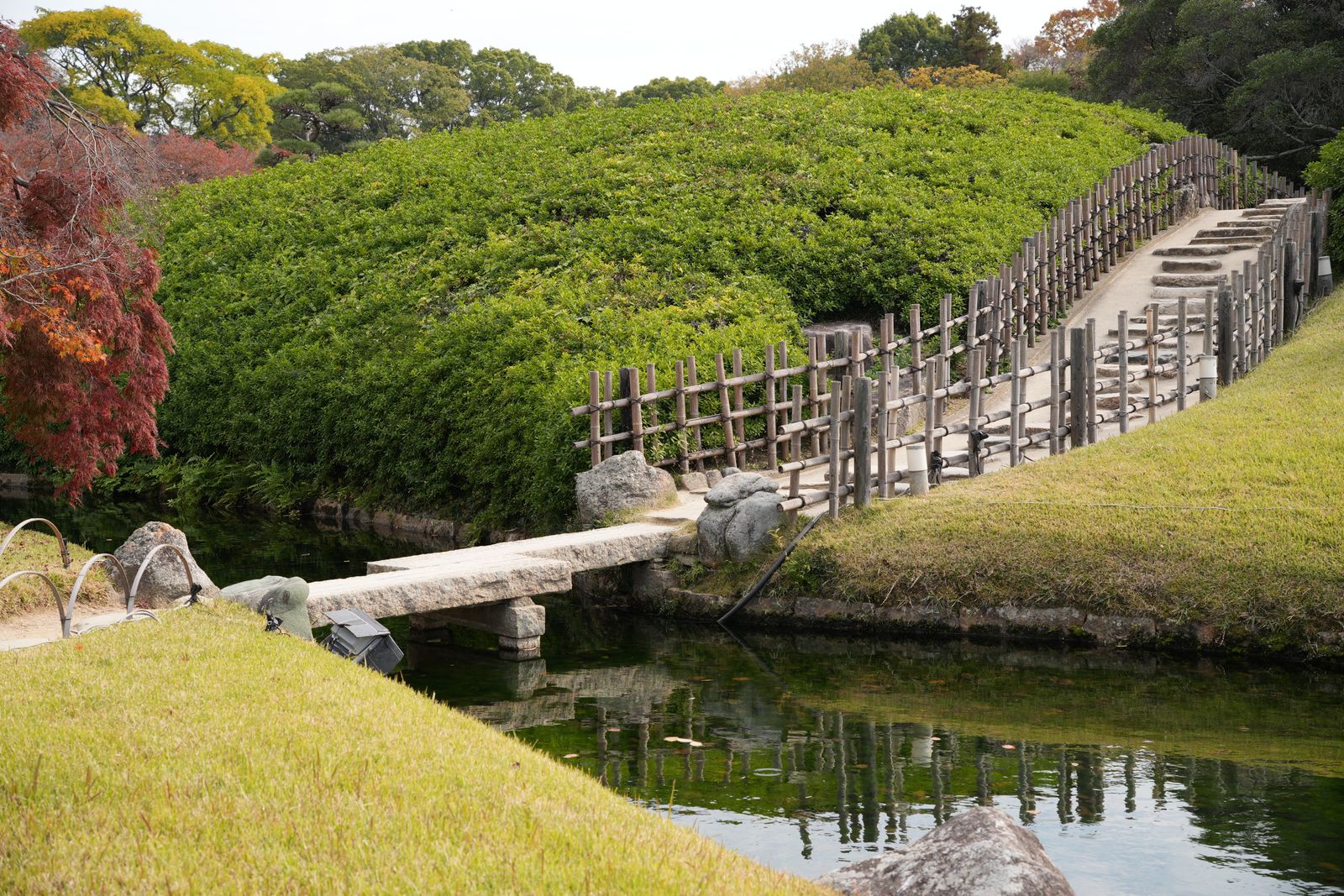
Korakuen is one of the three gardens traditionally counted as the finest in Japan, alongside Kenroku-en in Kanazawa and Kairaku-en in Mito. It was laid out for the local lord, Ikeda Tsunamasa, and completed around 1700, and unlike many Japanese gardens it is built on a broad, open scale: lawns, ponds, streams, a small tea plantation, a rice field, a hill to climb for the view and the castle borrowed as a backdrop across the river. Admission is ¥500 for adults, ¥200 for those 65 and over, and free for children. It opens early, at 7:30 from late March to September and at 8:00 from October to mid-March, and closes at 18:00 and 17:00 respectively, with last entry fifteen minutes before. An hour is enough to walk the main loop; two let you sit down in it.
Okayama Castle stands across the Asahi River, joined to the garden by a footbridge. Its black-lacquered walls earned it the nickname “Crow Castle”, a deliberate contrast with the white “Heron” of Himeji. The original keep was destroyed in the bombing of 1945, and the one you see is a concrete reconstruction of 1966, with a museum inside. From April 2026 admission is ¥500 for adults and free for school-age children, and it opens from 9:00 to 17:30, with last entry at 17:00. It is worth it for the view of the garden and the river from the top, rather than for the exhibits; honest comparison with Osaka Castle says the two interiors are much of a muchness, and the black exterior is the more striking of the two.
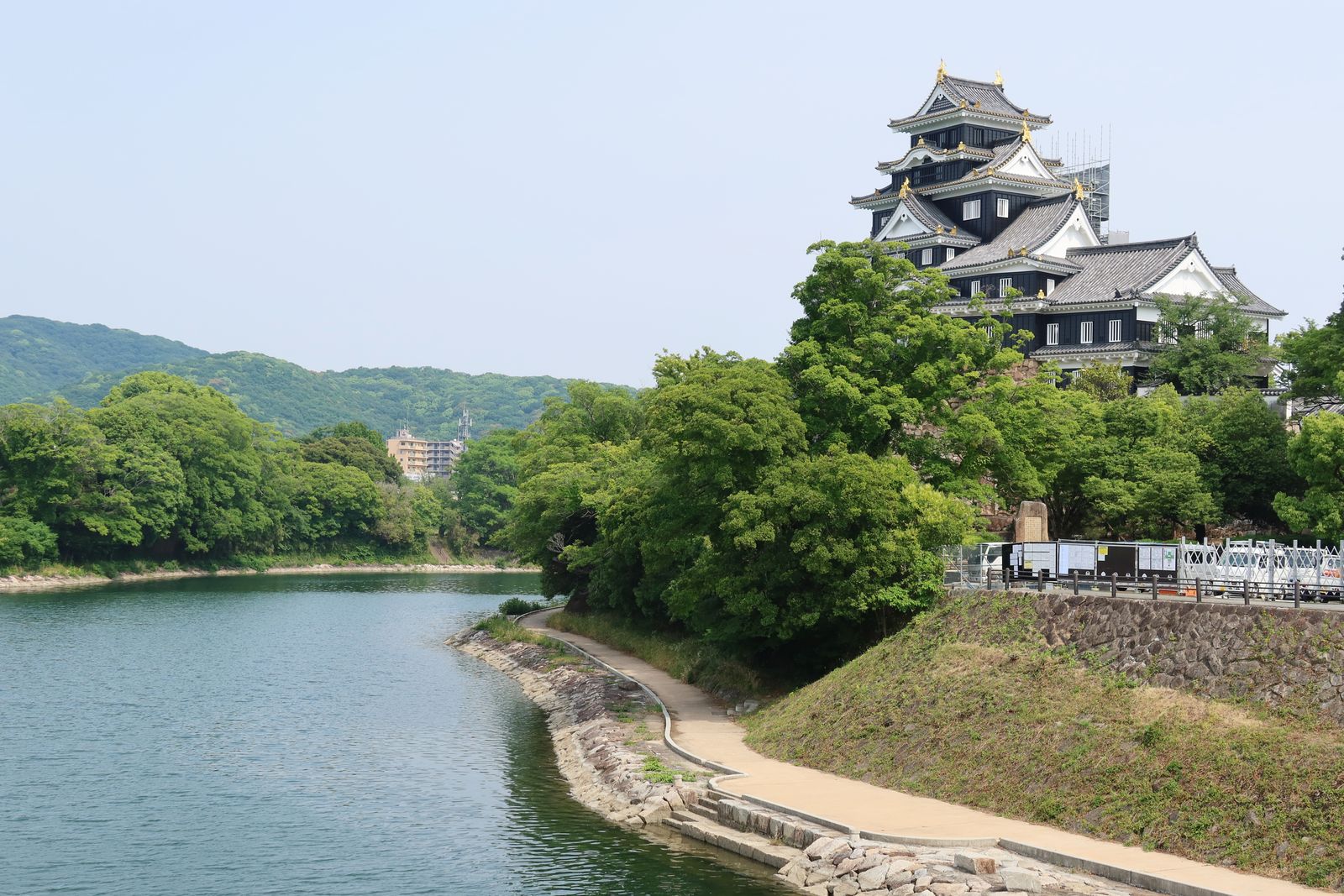
To get there from Okayama station, take the tram to the stop for the castle and garden, a few minutes’ ride followed by a short walk, or walk the whole way in around twenty-five minutes along the main avenue from the station’s east exit, past the statue of Momotaro, the Peach Boy of the folk tale that Okayama claims as its own.
Kurashiki, Okayama, or both?
If you only have time for one, choose Kurashiki. It is the more distinctive place, the one with no equivalent in Kansai, and it has the museum, the canal and the old streets in one walkable package. Choose Okayama on its own only if gardens are your passion, in which case Korakuen in autumn or in the early morning is a genuine highlight of any trip to Japan.
Both together is entirely doable in a day, because the two are only 17 minutes apart by train, but it is a full day and you will be moving at a steady pace. The order that works best is Okayama first, while the garden is fresh and quiet and before the castle crowds, then Kurashiki for the afternoon and evening, when the canal is at its most beautiful and the day-trippers start to leave.
A one-day plan from Osaka
- 07:45 — Shinkansen from Shin-Osaka to Okayama, arriving at about half past eight. Breakfast at the station if you did not eat before.
- 08:45 — Tram or walk to Korakuen. You will have the garden almost to yourself for the first hour.
- 10:15 — Cross the footbridge to Okayama Castle, up to the top for the view, then back towards the station.
- 12:00 — Lunch in Okayama: barazushi, the local scattered sushi, or demi-katsudon, pork cutlet on rice under a demi-glace sauce, an Okayama speciality.
- 13:00 — Train to Kurashiki, 17 minutes, and walk to the Bikan quarter.
- 13:30 — The Ohara Museum of Art, while the canal is at its busiest. Buy your canal boat ticket for later on the way.
- 15:30 — Ivy Square, the denim shops and a coffee in a converted storehouse, then the steps up to Achi Shrine.
- 17:00 — The canal as the crowds thin and the light softens, and your boat ride.
- 18:30 — Dinner in the quarter, then a last walk along the lit canal.
- 20:00 — Train to Okayama and the Shinkansen back, in Shin-Osaka by about half past nine.
On a Monday, swap the museum for a longer stay in Okayama. In winter, when the light goes by five, move the canal walk earlier.
What to eat
Okayama calls itself the “Land of Sunshine”, and it is one of Japan’s great fruit regions. In summer, roughly July and August, its white peaches are among the most prized in the country, and in late summer and autumn its Muscat of Alexandria grapes appear in fruit shops and parfaits all over the city. They are expensive and worth it. Kibi dango, small soft rice-flour sweets tied to the Momotaro legend, are the standard souvenir, light enough to carry home and sold everywhere from the station to the Bikan quarter.
For a meal, look for barazushi, a celebration dish of vinegared rice scattered with seafood and vegetables, and demi-katsudon, Okayama’s version of the pork cutlet rice bowl, made with a rich brown sauce instead of egg. In Kurashiki, many of the best cafes and restaurants are inside converted kura, which is half the pleasure. For souvenirs to take back from Osaka itself, see our guide to Osaka souvenirs.
Stay the night, or add Himeji
Stay the night in Kurashiki if you possibly can. The day-trippers leave in the late afternoon, and by evening the lit canal, the empty streets and the quiet of the old storehouses are what the photographs promised. Early the next morning, before nine, you will have the canal almost to yourself. The quarter has small traditional inns and a handful of hotels, including one in Ivy Square; book ahead for weekends and holidays. Our ryokan guide explains what to expect from a traditional inn.
Add Himeji if you have a Kansai Wide Area Pass and want to see both castles. Himeji is on the Shinkansen line between Osaka and Okayama, about half an hour from Shin-Osaka and twenty minutes from Okayama. Doing Himeji Castle and Kurashiki in one day is possible with a very early start, but it is a rushed day that does neither justice; better to give each its own day within the five-day pass. See our Himeji Castle day trip.
Okayama is also the gateway to Naoshima, the art island in the Inland Sea, and to the coast beyond. That is a separate trip that needs its own day, or better, a night. Our Kansai region guide shows how the longer trips fit together.
When to go
- Spring brings fresh green willows along the canal, cherry blossom at Korakuen and the castle in late March and early April, and wisteria at Achi Shrine a few weeks later.
- Summer is hot and humid, but it is peach season, and early mornings and evenings on the canal are pleasant.
- Autumn, especially November, is the best time for Korakuen, when its maples turn, and the weather is ideal for walking.
- Winter is quiet and often clear, with short days; check the shorter winter hours before you go.
Whatever the season, avoid Mondays if the Ohara Museum matters to you, and remember that Japanese public holidays fill the quarter with domestic visitors. Our guide to the best time to visit Osaka covers the bigger picture.
Kurashiki from Osaka FAQ
How do I get to Kurashiki from Osaka?
Take the Shinkansen from Shin-Osaka to Okayama, about 45 minutes on a Nozomi, then the JR Sanyo line to Kurashiki, about 17 minutes. The Bikan Historical Quarter is a ten to fifteen minute walk from Kurashiki station. Avoid Shin-Kurashiki station, which is further from the old town.
Is Kurashiki worth a day trip from Osaka?
Yes, especially if you want somewhere historic and calmer than Kyoto. It is compact enough to see in an afternoon, and Okayama’s Korakuen garden is just 17 minutes away for a full day. Go on a weekday that is not a Monday.
How much does a day trip to Kurashiki cost?
Around ¥11,000–12,000 in train fares for the Shinkansen round trip and the local connection, plus ¥500 each for Korakuen, Okayama Castle and the canal boat, the Ohara Museum’s admission, and food. A JR Kansai Wide Area Pass, around ¥12,000 for five days, covers the trains and pays off if you take one more long trip.
Does the Kansai Wide Area Pass cover Kurashiki?
Yes. It covers the Shinkansen between Shin-Osaka and Okayama and the local JR trains on to Kurashiki.
Can I visit Kurashiki and Okayama in one day?
Yes. Do Okayama’s Korakuen garden and castle in the morning, then Kurashiki in the afternoon and evening. It is a full day, but the two are only 17 minutes apart by train.
Is the Ohara Museum of Art open on Mondays?
No, except on some public holidays. It reopened on 25 April 2026 after renovation work and opens from 9:00 to 17:00, with last entry at 16:30.
Where to go next
Kurashiki is one of the longer trips in our list of day trips from Osaka; if you are weighing it against the alternatives, Himeji, Hiroshima and Kobe are all on the same Shinkansen line. For how to fit a day out of the city into a longer stay, see the Osaka itinerary hub, and for gardens closer to home, our guide to Osaka’s parks and gardens.