This article contains advertising. Our booking links are routed through a partner that adds commission tracking automatically, so if you book through one we earn a commission from the provider, at no extra cost to you. It never affects what we recommend. Affiliate disclosure
A Hiroshima from Osaka day trip asks a lot of you and gives back more. In one day you can stand inside the Hiroshima Peace Memorial Park, walk up to the Atomic Bomb Dome that somehow stayed standing on the morning of 6 August 1945, and then ride 25 minutes out to a little island where a vermilion torii gate appears to float on the tide. The Sanyo Shinkansen is what makes it possible: about 80 to 100 minutes each way from Shin-Osaka, which leaves you a solid stretch of daylight on the ground.
Let’s be straight about one thing up front. This is a long day — plan for 12 hours, door to door, and don’t pretend otherwise. You’ll be on your feet, you’ll switch between bullet train, local train and ferry, and you’ll spend an hour or more in a museum that will sit with you for the rest of the trip. Done right, it’s one of the most worthwhile days you’ll have in Japan. This guide gives you a realistic 12-hour plan, the exact route, what to expect at the museum, how to time the Miyajima tide, what to eat, and why the train fare math changes completely if you hold a rail pass.

The quick numbers
- Distance: 290 km west of Osaka.
- Train time: 80–100 minutes by Shinkansen, Shin-Osaka to Hiroshima.
- Fare: about ¥10,400 one way, roughly ¥21,000 round trip if you pay cash.
- With a rail pass: the whole round trip is covered — see below.
- Time you need: 12 hours, minimum, for the full day.
- Two halves: the Peace Memorial Park in the city, and Miyajima island offshore.
Getting there: bullet train, local train, ferry
- Shin-Osaka to Hiroshima Station on the Sanyo Shinkansen — about 80 minutes, ¥10,400. Aim for a Nozomi or Sakura service if your pass covers it; the Hikari is fine too, just a touch slower.
- Hiroshima Station to Miyajimaguchi Station on the JR Sanyo Main Line — 25 minutes, ¥420.
- Miyajimaguchi to Miyajima island on the JR ferry — 10 minutes, ¥200.
Roughly two hours each way, gate to gate. One thing worth knowing: the JR-operated ferry runs a route that swings close to the floating torii on certain crossings, so you sometimes get a free photo before you’ve even landed.
The 12-hour plan
The logic here is simple: do Miyajima first, while you’re fresh and the light is good, then come back to the Peace Park for the afternoon and let the day end on reflection rather than tourism. Reverse it if the tide tables tell you to (more on that shortly).
7:00 — Out of Shin-Osaka
Catch an early Sanyo Shinkansen. Reserve your seat ahead of time, especially in cherry-blossom season and over the autumn weekends, when these trains fill.
8:30 — Hiroshima Station
Don’t linger. Cross straight to the JR local for Miyajimaguchi (25 minutes), then the 10-minute ferry.
9:30 — Miyajima
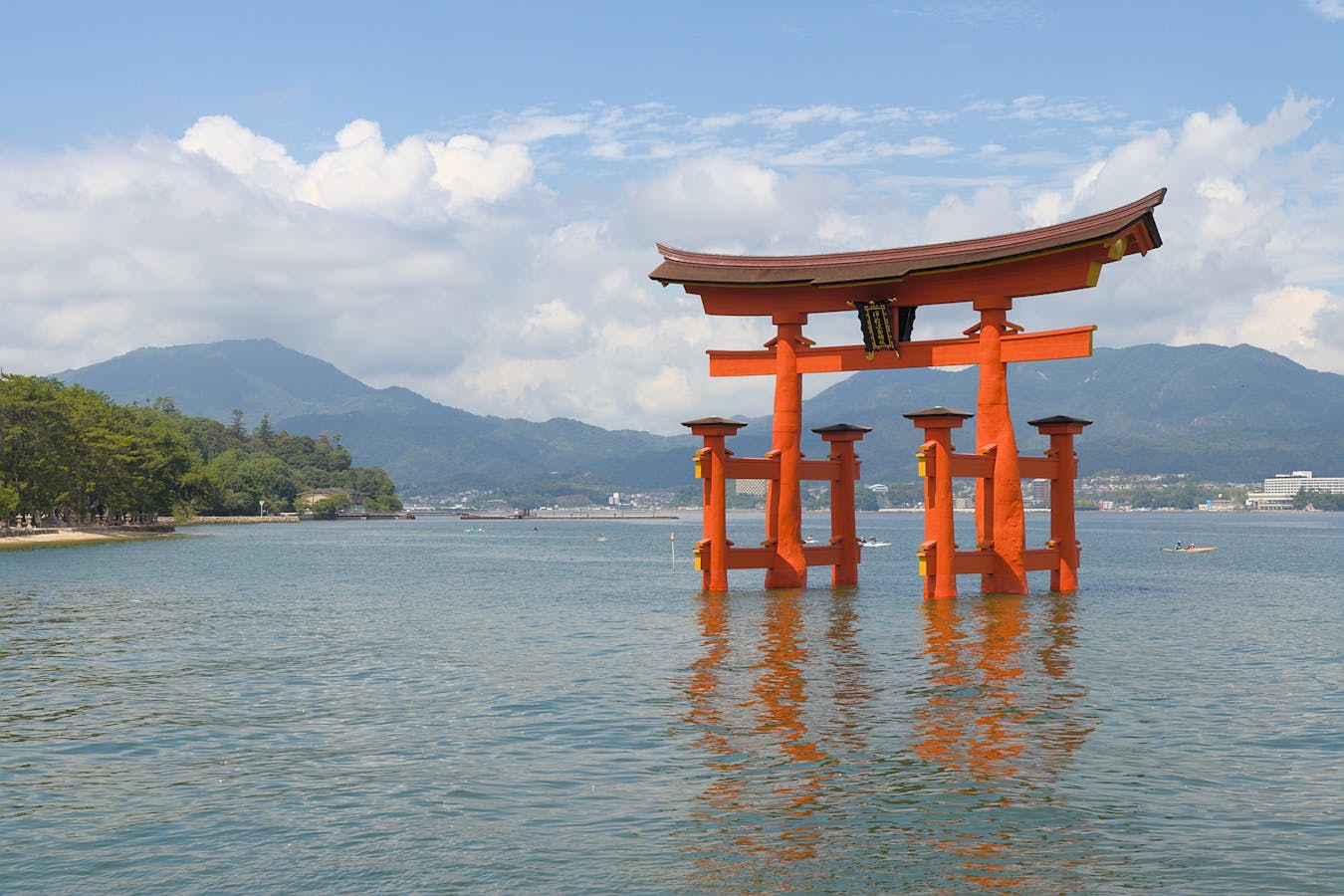
It’s a short walk from the pier to Itsukushima Shrine, past the island’s famously bold deer, who will absolutely investigate your bag. Photograph the torii, then walk the shrine’s covered boardwalks built out over the water (¥300). The whole complex is built on stilts so that at high tide it appears to drift on the sea.
11:00 — Mount Misen, if you’ve the legs for it
A ropeway plus a short hike gets you to the island’s summit and a wide view across the Seto Inland Sea — about ¥2,000 round trip on the ropeway, and budget 90 minutes. It’s optional. If the museum matters more to you than a viewpoint, skip it and bank the time.
12:30 — Lunch on the island
The island specialty is anago meshi, a bowl of rice topped with grilled saltwater eel, sweeter and lighter than the freshwater unagi you’ll have had elsewhere. Around the harbour, vendors grill local oysters to order — Hiroshima Bay is famous for them.
13:30 — Back to the mainland
Ferry and train back toward the city. In peak season there’s sometimes a direct fast boat from Miyajima to the Peace Park pier — handy, though not covered by JR passes.

14:30 — Hiroshima Peace Memorial Park
A 12-hectare park laid out where the bomb fell, dedicated to the memory of that morning and to the case against it ever happening again. The grounds are free to walk. You’ll pass the Children’s Peace Monument, hung with thousands of folded paper cranes, on your way toward the Dome.

15:00 — The Peace Memorial Museum
This is the heart of the day. Entry is just ¥200, and the museum tells the story through the people who lived and died it — a child’s scorched tricycle, a watch stopped at 8:15, photographs and testimony that you won’t shake off. Give it 90 minutes at the very least. It is quiet inside, and it should be. Bring tissues; people cry here, and that’s the point.
16:30 — The Dome at golden hour
Walk the riverside path back to the Atomic Bomb Dome — the Genbaku Dome — and stand with it a while as the light softens. It’s left exactly as it was: a skeletal copper frame over gutted brick, the only building near the hypocentre that didn’t collapse.
17:30 — Okonomiyaki, Hiroshima-style
You’ve earned dinner. Hiroshima okonomiyaki is layered, not mixed like Osaka’s version — a thin crepe, then a mountain of cabbage, then yakisoba noodles, egg and pork, all stacked and pressed on the teppan in front of you. Head to Okonomimura, a building stacked with more than 20 small okonomiyaki counters competing floor by floor. Pull up a stool at whichever one smells best.
19:00 — Shinkansen home
Hiroshima Station back to Shin-Osaka, arriving around 20:30. The last bullet train back runs near 23:00, so even if you linger over a second beer at Okonomimura, you’ve got a comfortable cushion.

The fare math: with and without a rail pass
This is where the trip lives or dies on your budget. Paying cash, the train alone eats most of the day’s spending.
Paying cash
- Round-trip Shinkansen: about ¥20,800.
- Hiroshima local train plus Miyajima ferry: ¥1,240.
- Itsukushima Shrine: ¥300.
- Mount Misen ropeway (optional): ¥2,000.
- Peace Memorial Museum: ¥200.
- Lunch (anago meshi): around ¥1,800.
- Dinner (okonomiyaki): around ¥1,200.
- Total: ¥27,500–¥30,000 per person.
With a rail pass
- Shinkansen: covered.
- Hiroshima local train and the Miyajima ferry: also covered, since both are JR-operated.
- Total non-transit spend: ¥6,000–¥9,000.
If your wider Japan itinerary already makes a rail pass worthwhile, this day trip is one of its single best uses — it can pay back a chunk of the pass in one go. The nationwide JR Pass covers it, and so does the cheaper regional JR Kansai-Hiroshima area pass. We break down which pass suits which trip in our guide to the JR Pass for Osaka and Kansai — read it before you buy, because the right pass for this run isn’t always the obvious one.
Timing the Miyajima tide
The torii gate looks completely different depending on the water, and there’s no wrong version — just know which one you’re getting.
- High tide: the gate stands in the sea and appears to float. This is the postcard shot.
- Low tide: the seabed is exposed and you can walk right out across the flats to the base of the gate and touch it.
- Check a tide table for your date before you finalise the morning. If high tide falls in the afternoon, flip the itinerary and do the Peace Park first.
Practical tips
- Reserve your Shinkansen seats in advance during busy seasons; standing for 80 minutes is no way to start the day.
- Wear shoes you can walk and climb in. Miyajima’s paths run uphill and the Peace Park is a lot of pavement.
- Carry tissues for the museum. It is intense by design.
- Give the museum 90 minutes or more. Rushing it defeats the purpose of the trip.
- Watch the deer on Miyajima — they’ll nose into open bags and have been known to nibble paper maps.
- Know your last train. The final Shinkansen back to Osaka runs around 23:00, so there’s no need to cut the day short.
Hiroshima from Osaka: common questions
Is Hiroshima worth a day trip from Osaka?
Yes — it’s one of the most moving days you can spend in Japan. The Peace Memorial Park gives essential historical context, and Miyajima’s floating torii is among the most photographed scenes in the country. Just go in knowing it’s a full, long day.
How long is the trip from Osaka to Hiroshima?
80 to 100 minutes by direct Shinkansen — the Sanyo line from Shin-Osaka to Hiroshima.
Should I get a rail pass for this?
If your wider trip already justifies a pass, this is one of its best single uses — it can save more than ¥20,000 in a day. Both the nationwide JR Pass and the regional Kansai-Hiroshima pass cover the route.
Can I really do Miyajima and the Peace Park in one day?
Yes, if you leave Osaka by 7:00. That gives you three-plus hours on Miyajima and 90 minutes at the museum without sprinting.
How is Hiroshima okonomiyaki different from Osaka’s?
It’s layered rather than mixed: a thin crepe base, then cabbage, noodles, egg and pork stacked up and griddled in front of you. Okonomimura, a building of more than 20 competing counters, is the classic place to try it.
What time should I leave Osaka?
By 7:00 at the latest, earlier if you can manage it. The full day needs 12-plus hours and you don’t want to feel hurried at the museum.
Plan the rest of your Kansai trips
Hiroshima is the longest haul on our list of day trips from Osaka, so balance it with something closer. A day in Kyoto is a quick hop north, and Himeji Castle sits conveniently on the same Shinkansen line you’ll already be riding — easy to fold into a separate day, or even a stop on the way back.