This article contains advertising. Our booking links are routed through a partner that adds commission tracking automatically, so if you book through one we earn a commission from the provider, at no extra cost to you. It never affects what we recommend. Affiliate disclosure
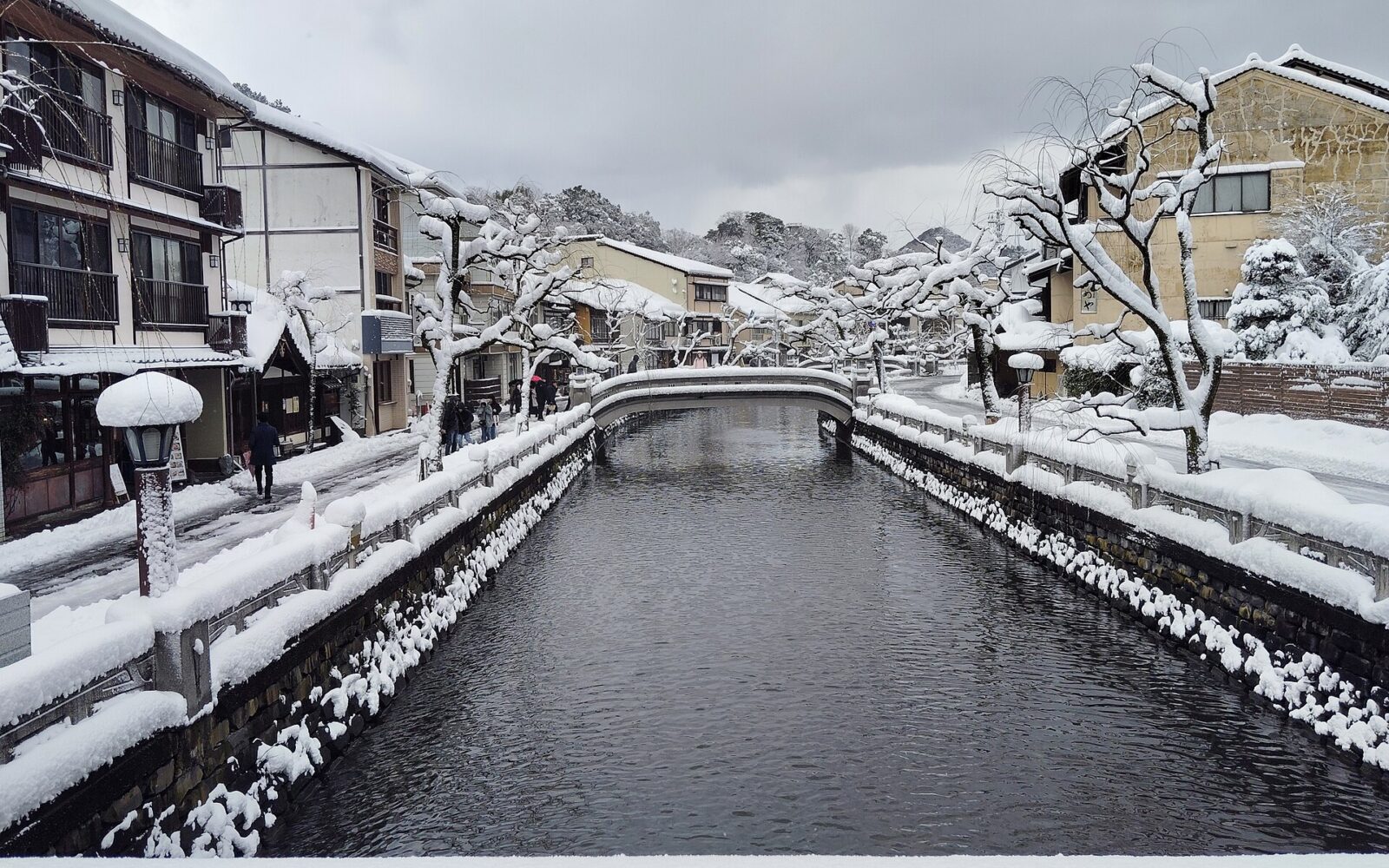
At about eight in the evening, Kinosaki fills with people in cotton robes. They clatter along the willow-lined Otani River in wooden geta sandals, towel bags swinging, drifting from one bathhouse to the next and stopping for a beer or a soft-serve on the way. Nobody is in a hurry, and nobody seems to mind that it is cold. It is one of the few places in Japan where the whole point of the town is to wander it half-dressed, and it is the best reason there is to leave Osaka for a night.
Kinosaki Onsen sits on the Sea of Japan side of Hyogo Prefecture, in the city of Toyooka, about three hours from Osaka by train. It is a small town built around public baths rather than hotel baths: you stay at a ryokan (traditional inn), and the inn hands you a pass that opens the town’s sotoyu, the shared bathhouses strung along the river. This guide covers the trip to Kinosaki Onsen from Osaka the way most people do it best, as an overnight stay: the train and what it costs, whether a rail pass pays, how the bathhouses work and which ones to choose, what else is worth an hour, the winter crab season, where to sleep, and the honest case for and against doing it as a day trip.
Is Kinosaki worth the trip from Osaka?
For most people, yes, with one condition: stay the night. Kinosaki is not a sightseeing town. It has a ropeway, a temple and a couple of small museums, and none of them would justify three hours on a train. What justifies it is the evening, when the day-trippers have gone, the inns have served dinner and the street turns into one long, slow bathhouse crawl in matching robes. That is something you cannot get in Osaka, even at the city’s excellent sento and onsen, and it is the reason the town is so loved by Japanese travellers.
It is less worth it if you have only three or four days in Japan and have not yet seen Kyoto or Nara, if you dislike communal bathing, or if you are travelling on a tight budget in crab season, when ryokan prices peak. If any of those apply, a night at one of the Osaka hotels with their own hot-spring baths gets you some of the feeling for a fraction of the time. Everyone else should go, and go in the cold months if they can: Kinosaki in snow, with steam rising off the river, is the version on the posters for a reason.
Getting to Kinosaki Onsen from Osaka
The Kounotori limited express
The direct way is the JR Limited Express Kounotori, which JR West’s English pages spell Konotori, from Osaka Station to Kinosaki Onsen Station. The journey takes about two hours and forty minutes: in JR West’s timetable for autumn 2026, the daily Kounotori 3 leaves Shin-Osaka at 9:04 and Osaka at 9:10 and reaches Kinosaki Onsen at 11:52. Not every Kounotori runs all the way to Kinosaki, so check that yours does when you book. Every limited express on the line runs with reserved seats only, so book a seat before you board, at a ticket machine or JR ticket office, or online through JR West. There is no unreserved car to fall back on.
The fare is a basic ticket plus a limited express supplement, and JR West’s online fare search gives the current total for your date. The supplement part of the fare moves a little with JR West’s peak and off-peak calendar, so check the exact price when you book. Trains also start or stop at Shin-Osaka on some services, which is useful if you are staying near the Shinkansen station.
Sit on the left-hand side going north if you can. After Fukuchiyama the line follows river valleys through the hills of northern Hyogo, and on a clear winter morning it is a lovely, quiet ride. Bring breakfast from the station: the trains are comfortable but this is not a route with much in the way of on-board catering.
Via Kyoto
From Kyoto Station, the Limited Express Kinosaki runs up the San’in line to Kinosaki Onsen, and the official tourism site puts that journey at about two and a half hours. This is the better option if you are combining Kinosaki with a few days in Kyoto, or if you want to go up from Osaka and come back via Kyoto. Like the Kounotori, it is reserved seats only. Check times in JR West’s journey planner, since not every service runs the whole way.
By highway bus
Zentan Bus operates direct buses between Osaka and Kinosaki, and the tourism office lists them as an alternative to the train. On a winter weekend buses are at the mercy of mountain roads and traffic. Check the current timetable and fare on Zentan Bus’s own site before you plan around one, and note that the JR Kansai Wide Area Pass does not cover highway buses.
Arriving with luggage
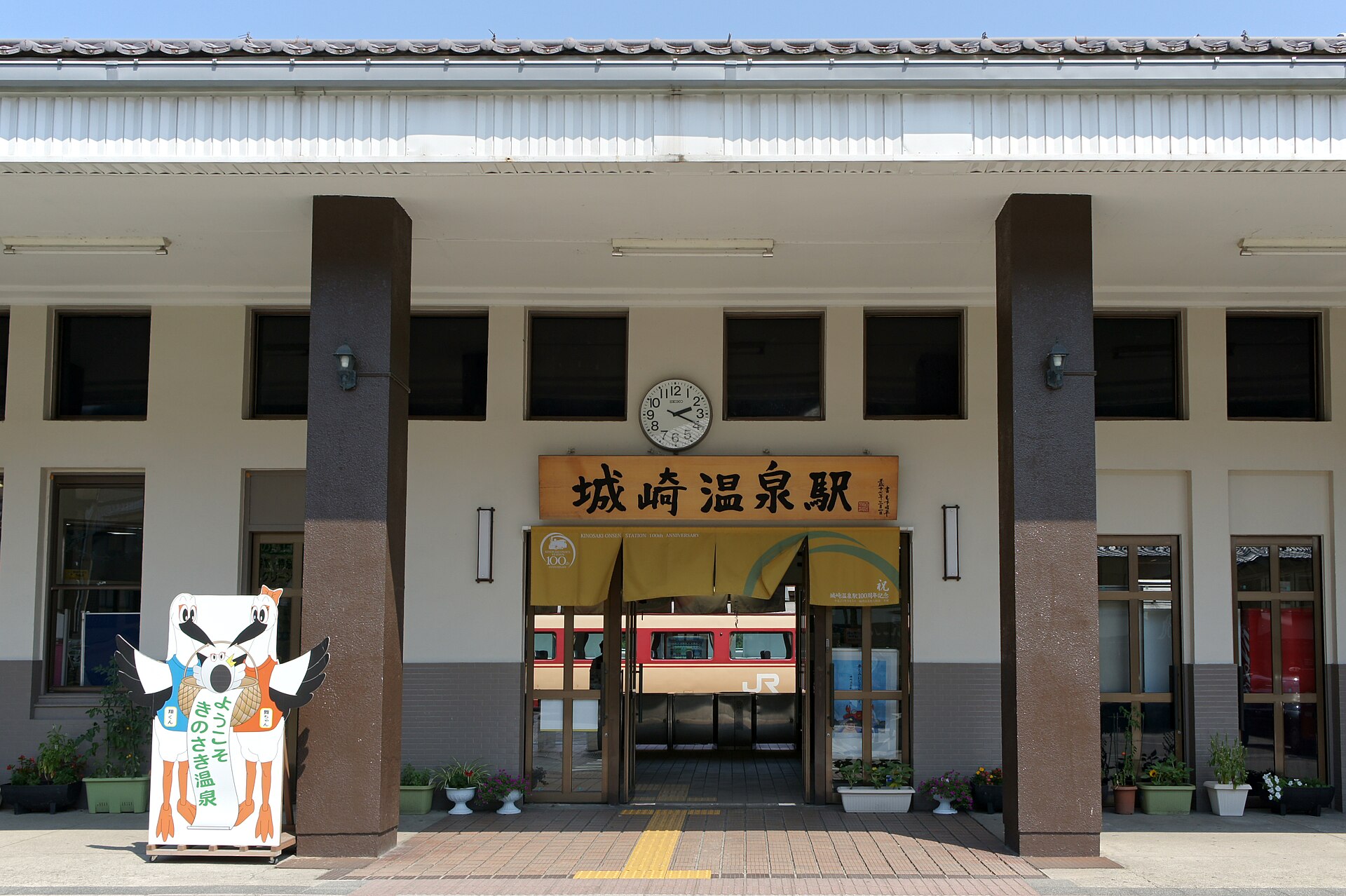
The station sits at the bottom of the town, and the main street runs up from it along the river. Many ryokan will collect bags from the station or meet guests there; ask yours when you book. If you are only staying one night, the easiest thing is to leave the big suitcase behind in Osaka and travel with a small bag. Our luggage storage guide covers lockers and baggage services at Osaka Station and Namba, and most Osaka hotels will hold a bag for a night if you are coming back to them.
Does the JR Kansai Wide Area Pass pay for Kinosaki?
Often, yes. The JR Kansai Wide Area Pass costs ¥12,000 for five consecutive days (¥6,000 for children) and, according to JR West, covers reserved seats on the Kounotori as well as the Haruka airport express, the Sanyo Shinkansen between Shin-Osaka and Okayama, and local and rapid JR trains across a wide area. If Kinosaki is your only long trip, compare the pass price with the return fare in JR West’s fare search before you buy. Add one more long JR trip in the same five days, such as Himeji, Kurashiki and Okayama or the airport run on the Haruka, and the pass comes out ahead far more often than not.
Two things to know. First, this is the Wide Area Pass. The cheaper JR Kansai Area Pass, which never covered limited expresses like the Kounotori anyway, stopped being sold on 30 September 2026. Second, the Wide Area Pass is meant for overseas visitors and has conditions on who can buy it, so read JR West’s page before you count on it. Our Kansai rail passes guide works through the regional passes side by side, and the Japan Rail Pass guide covers the nationwide pass, which also takes you to Kinosaki.
How the bathhouses work
Kinosaki’s tradition is sotoyu meguri, the bathhouse round. Instead of soaking in a hotel bath, you walk between the public baths in your inn’s yukata (cotton robe), a padded jacket on top in winter, and try several over an evening and the next morning. The water is the same hot spring source throughout the town, but each bathhouse has its own building, pool layout and character, and the walk between them is half the pleasure.
There are seven public bathhouses in the tourism office’s list, but one of them, Satono-yu, the big modern bathhouse by the station, has been closed for renovation since April 2024. Check its page on the official site before you plan around it. That leaves six open, close enough together that you can walk the whole line in about twenty minutes.
The Yumepa pass and prices
If you stay the night at an inn in town, you will usually be given a pass at check-in that gets you into every bathhouse free during your stay. Ask your ryokan how theirs works. Day visitors buy the Yumepa all-day pass at any bathhouse for ¥1,500, or pay per visit: a single entry costs ¥800 for adults and ¥400 for children up to 12. Two baths on a single-entry basis already cost more than the day pass, so if you plan to try more than one, buy the pass at the first bathhouse you visit.
The six open bathhouses
Each one closes one day a week, and two of them open only in the afternoon. The hours below come from the official tourism site’s listings in 2026; check the individual pages before you go, because maintenance closures happen.
| Bathhouse | Hours | Closed | Why go |
|---|---|---|---|
| Ichi-no-yu | 7:00–23:00 | Wednesday | The landmark, with a cave bath |
| Goshono-yu | 7:00–23:00 | Thursday | The grandest building, at the top of town |
| Jizo-yu | 7:00–23:00 | Monday | Plain and local, near the station |
| Yanagi-yu | 15:00–23:00 | Thursday | The smallest; a quick hot dip |
| Mandara-yu | 15:00–23:00 | Wednesday | Quiet, up a side street, with a small outdoor tub |
| Kono-yu | 7:00–23:00 | Tuesday | Furthest out, by the ropeway, with outdoor baths |
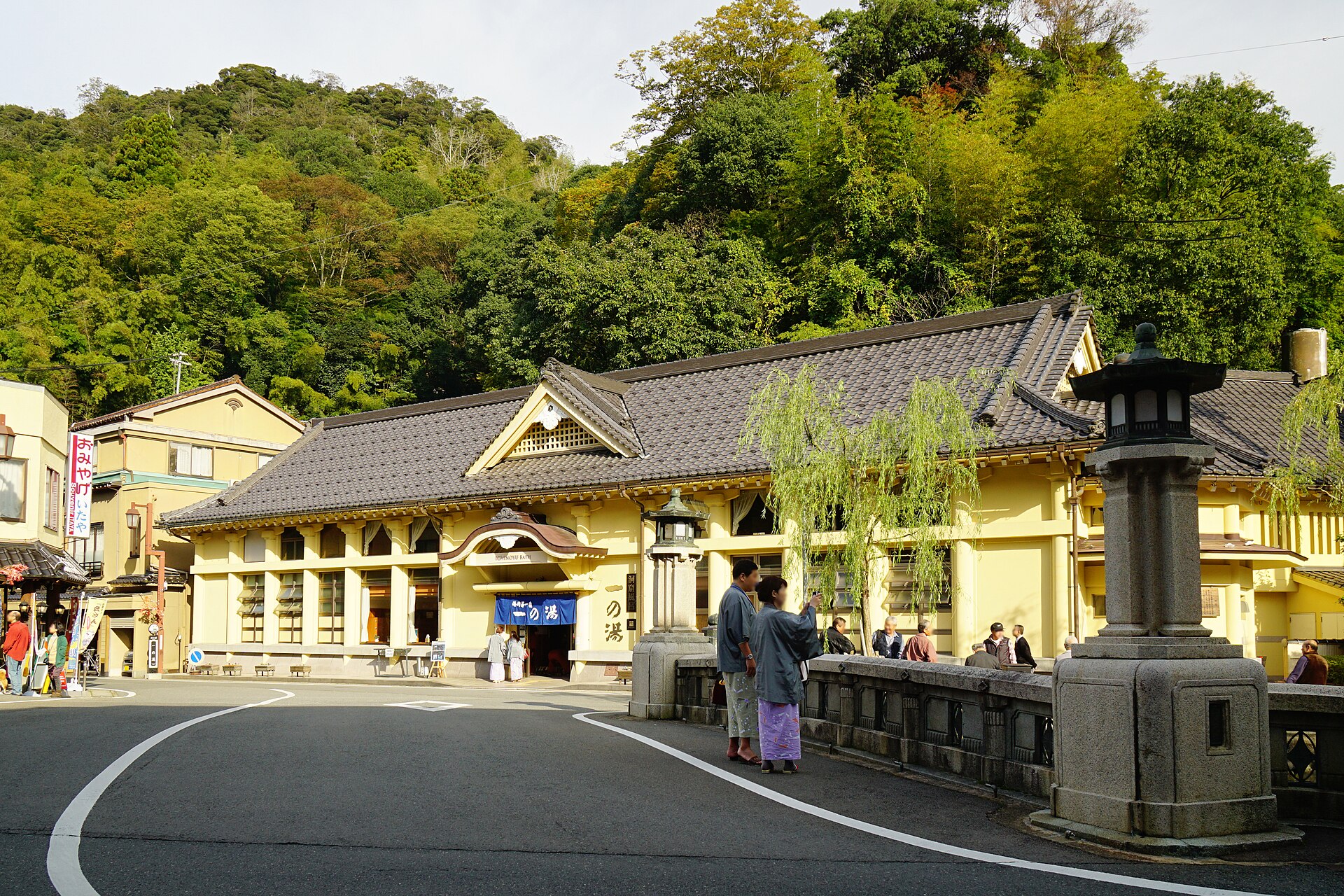
Ichi-no-yu is the bathhouse on the postcards, a pale yellow building with a curved, temple-like gable on the main street. Its signature is a bath set into a rocky grotto. It is also the busiest, so go early in the morning or late in the evening rather than straight after dinner.
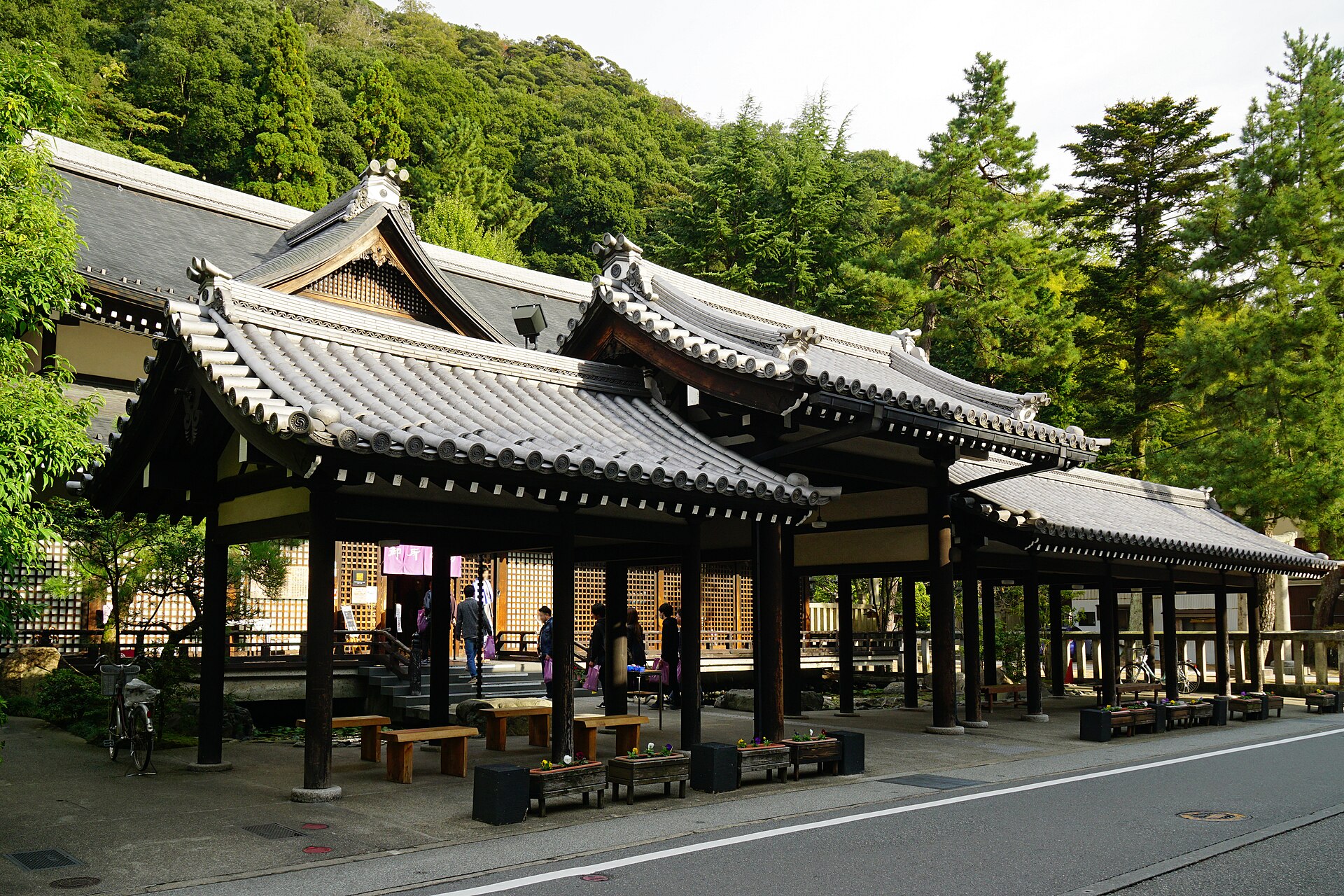
Goshono-yu, further up the river, is the most elegant of the six, entered through a gate and a wooden walkway. If you have time for only one bath in the evening, make it this one. Kono-yu, which the tourism office calls the oldest bathhouse building in Kinosaki (the name means “stork bath”, after the bird said to have discovered the spring), sits at the quiet far end of town near the ropeway. Its outdoor pool makes it a good choice on a crisp morning.
Jizo-yu and Yanagi-yu are smaller, simpler places, and the locals’ choice. Yanagi-yu has a single small tub and is worth a ten-minute dip on the way past rather than a destination. Mandara-yu, up a lane off the main street, is usually the quietest. Both Yanagi-yu and Mandara-yu open at 15:00, so they are not options for a morning round.
Do not try to do all six in one evening. Hot spring water is tiring, and after three baths most people are ready for bed. Two or three in the evening and one or two the next morning is the rhythm that works.
Bath etiquette, tattoos and the yukata
The rules are the same as at any Japanese public bath. You wash thoroughly at the shower stools before you get into the water, keep your small towel out of the bath (people fold it on their heads), tie up long hair, and do not swim, splash or take photos inside. Baths are separated by gender and you bathe without a swimsuit. If you have not done this before, our guide to Osaka’s onsen and sento walks through it step by step, and the etiquette guide covers the rest of what to expect in Japan. Drink water between baths, and skip the bath if you have been drinking heavily.
Tattoos are fine. This is one of Kinosaki’s great advantages. The official tourism site says all seven public bathhouses welcome guests with tattoos, which is far from the norm in Japan. Your ryokan’s own bath may have a different rule, so ask when you book if it matters.
The yukata. Your inn will give you one, usually with a choice of patterns, plus a sash and geta. Wrap the left side over the right (right over left is how the dead are dressed), and tie the sash at the waist. Wearing it out in the street is not just allowed in Kinosaki, it is the custom. In winter, the padded tanzen jacket goes over the top. Geta are noisy and slippery on wet stone, so take the river path slowly after dark.
Beyond the baths
You can fill a gentle afternoon in Kinosaki without getting wet. None of these is a reason to make the trip on its own, but each is a good way to spend the hours between check-in and dinner.
The ropeway and Onsenji temple
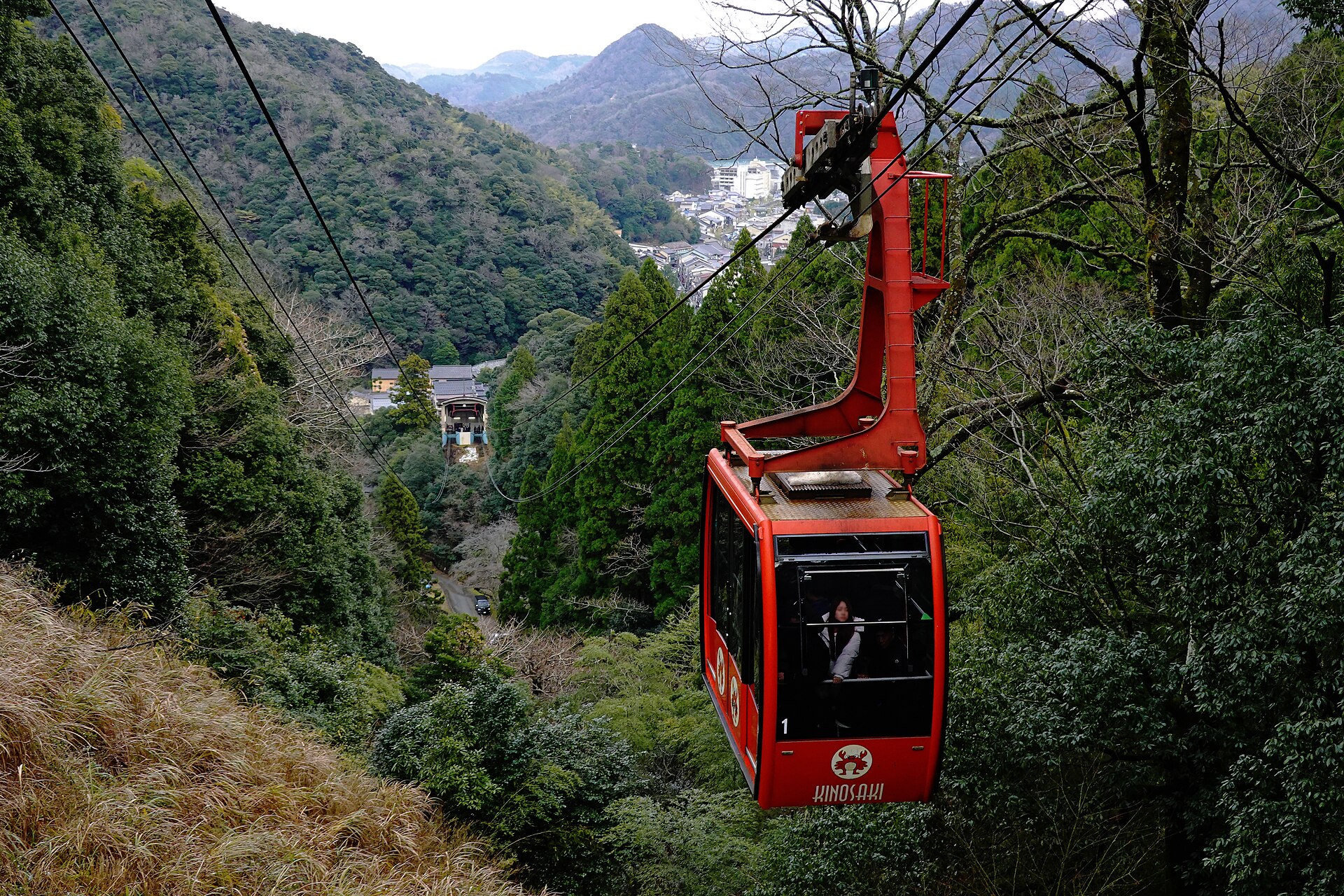
The Kinosaki Onsen Ropeway climbs from the top of town to the summit of Mount Daishi in about seven minutes, stopping halfway at Onsenji, the temple dedicated to the town’s hot springs. The tourism office dates the temple to 738. From the top there is a broad view over the town, the Maruyama River and out towards the Sea of Japan, and the ropeway notes that the view holds a star in the Michelin Green Guide Japan.
- Fares (2026): ¥1,200 return to the summit for adults (junior high age and over), ¥600 for children; ¥750 return to the Onsenji station.
- Times: cars leave at 10, 30 and 50 minutes past the hour from 9:00 to 16:50, with a last car down at 17:10.
- Closed: the second and fourth Thursday of the month, unless it is a public holiday. Bad weather can change the schedule.
A good plan is to ride to the top, then come down to the Onsenji station and walk down to town through the temple grounds. Check the ropeway’s own site on the day.
The literature museum
Kinosaki has an outsized place in Japanese literature, mostly thanks to the novelist Shiga Naoya, whose short story Kinosaki nite (“At Kinosaki”) came out of a stay here and is still read in Japanese schools. The town’s museum, on a small residential street, which the tourism office’s English pages now call the Kinosaki Onsen Heritage Museum, tells that story and the history of the hot springs. It opens 9:00 to 17:00 and closes on Wednesdays, admission is ¥500 for adults, and there is an English audio guide at the desk. It is a pleasant, compact hour, best on a wet afternoon.
Genbudo Park
Genbudo Park, near Kinosaki, is a set of cliffs made of strikingly regular basalt columns, formed by cooling lava. Admission is ¥500 for adults. By train you get off at Genbudo Station and cross the river by a small boat, which runs from 9:00 to 17:00 and may not run in bad weather. Call the museum with your arrival time first, and check the boat fare on the park’s page on the tourism office site. It is genuinely impressive rock, but with the boat and the trains it takes most of an afternoon. Worth it if geology appeals or you have a car; skip it if your time in Kinosaki is short and you would rather be in a bath.
The street itself
The rest is browsing. The main street and the lanes off it are lined with souvenir shops, small cafes, a few bars, an old-style shooting gallery or two and stands selling local sweets and soft-serve. Shops start closing in the early evening, and the town is quiet by eleven, when the bathhouses shut. It is not a nightlife town and does not pretend to be.
Crab season and what to eat
From November to March, Kinosaki is a crab town. Snow crab from the nearby Sea of Japan ports, sold under local names such as Matsuba-gani, is the centre of the winter kaiseki dinner at most inns: boiled, grilled, raw, in a hotpot and finished as rice porridge in the broth. The tourism office says crab kaiseki appears at most inns from November to March, and Tsuiyama Port, the fishing harbour at the mouth of the Maruyama River, holds a crab festival each November, according to the tourism office. Check Hyogo Prefecture’s or the tourism office’s pages for the season’s fishing dates and the festival date.
Crab is the main reason ryokan rates rise in winter, and a crab dinner plan is usually the most expensive option an inn offers. It is worth having once if you like crab, but it is a lot of crab, and many inns offer a cheaper plan with less of it or none. If you are not a seafood person, ask for a Tajima beef plan instead: Tajima cattle, raised in this part of Hyogo, are the bloodline behind Kobe beef. Our wagyu guide explains the connection.
Outside the inns, food in Kinosaki is simple. There are casual places on the main street for lunch, crab and seafood shops near the station, and plenty of snacks to graze on between baths. Most people eat dinner and breakfast at their ryokan, so restaurant choice matters less here than almost anywhere else in Japan. Day visitors should eat lunch early: a few places close in the afternoon.
Where to stay in Kinosaki
Almost everyone stays in a ryokan with dinner and breakfast included, and that is the right call. Kinosaki’s inns range from historic wooden buildings on the river to plain, friendly family-run places a street back. All of them hand out the bath pass. What changes with price is the size of the room, whether it has a private bath or a river view, and the dinner.
- Nishimuraya Honkan is one of the town’s best-known inns, a traditional ryokan with a 165-year history. It is the splurge option. Note that it does not take guests under ten.
- Mid-range and budget: there are many smaller inns and a few guesthouses. The tourism office’s accommodation listings are the best starting point, and booking direct sometimes gets you a better plan than a booking site.
Three practical points. Book early for crab season, and earliest of all for Saturday nights and the New Year period. Check whether your room price is per person (it usually is in ryokan, unlike Western hotels). And if you have a strong preference about tattoos in your inn’s private bath, about dinner times or about dietary needs, ask before you book, not on arrival. Our ryokan guide explains how inn stays work in more detail.
Day trip or overnight?
You can do Kinosaki in a day from Osaka. With three hours each way on the train, though, that leaves you perhaps four or five hours in town, most of it in daylight, without the evening that makes the place special. The Yumepa pass costs ¥1,500 for the day, so the bathing is cheap; it is the six hours of travel that hurt.
A day trip makes sense if you have a rail pass to use, are in Japan for a long stay, or simply want a taste before committing to a night another time. Take the earliest train you can face, buy the Yumepa pass at the first bath, try two or three baths, ride the ropeway, have a crab lunch and catch a late-afternoon train back.
For everyone else, one night is the answer. Arrive in the early afternoon, check in, change into your yukata, do the evening round, eat a huge dinner, and then do the morning round before breakfast while the town is quiet. Two nights is luxurious and lets you add Genbudo or a slower day, but it is more than most itineraries need.
An overnight plan from Osaka
- Morning: leave Osaka on a mid-morning Kounotori with a station breakfast.
- Early afternoon: arrive at Kinosaki Onsen, leave bags at your ryokan, and have lunch on the main street.
- Afternoon: ride the ropeway to the summit, walk down past Onsenji, then spend an hour in the museum or the shops.
- Around 15:00–16:00: check in, change into your yukata and take a first bath at Goshono-yu or Mandara-yu.
- Evening: ryokan dinner, then a walk along the river and two more baths before they close at 23:00.
- Next morning: an early bath at Ichi-no-yu or Kono-yu, while it is quiet, then breakfast at the inn.
- Late morning: check out, browse the shops, and take a train back to Osaka, or on to Kyoto.
Remember the closing days when you plan the round: on a Wednesday, both Ichi-no-yu and Mandara-yu are shut, and on a Thursday, Goshono-yu and Yanagi-yu are, along with the ropeway on the second and fourth Thursdays.
When to go
Winter, from late November to February, is peak season, for the crab and for the chance of snow. The Sea of Japan coast is much snowier and greyer than Osaka in winter, so pack warm layers and shoes with grip, and expect the occasional weather delay on the train. Our packing guide and Osaka in winter guide cover the colder months. Prices and crowds are highest at weekends and over the New Year holiday.
Spring brings willows in new leaf and cherry blossom along the river, and autumn is mild and often less busy before crab season starts. Summer is hot and humid for bathing and the ryokan are cheaper, though a cold beer after a hot bath on a warm night has its fans. Weekdays are calmer at any time of year. The best time to visit Osaka guide has the bigger seasonal picture for a Kansai trip.
Kinosaki Onsen from Osaka: FAQ
How long is the train from Osaka to Kinosaki Onsen?
About two hours and forty minutes on the direct Kounotori limited express from Osaka Station; the daily Kounotori 3, for example, leaves Osaka at 9:10 and arrives at 11:52 in JR West’s autumn 2026 timetable. From Kyoto, the Limited Express Kinosaki takes about two and a half hours. Every seat on the limited express is reserved, so book before you travel.
Can you visit Kinosaki Onsen as a day trip from Osaka?
Yes, but it is a long day, with about six hours of travel for a few hours in town and none of the evening atmosphere. Buy the ¥1,500 Yumepa pass if you do. If you can, stay one night.
Is Kinosaki tattoo-friendly?
Yes. The official tourism site says all of the town’s public bathhouses welcome guests with tattoos. Ryokan baths set their own rules, so ask your inn.
Is the JR Kansai Wide Area Pass worth it for Kinosaki?
Often. It costs ¥12,000 for five consecutive days and covers reserved seats on the Kounotori. A return trip to Kinosaki uses a large part of its value, and any other long JR trip in the same five days, such as Himeji or Okayama, tips it into profit.
How many bathhouses are open?
The town has seven public bathhouses, but Satono-yu by the station has been closed for renovation since April 2024, so six are open. Each closes one day a week. Check the tourism office’s pages before you go.
Does it snow in Kinosaki?
It often does in winter. The town is on the Sea of Japan side of Honshu, which gets far more snow than Osaka. Bring warm clothes and good shoes from December to February.
Do I need to speak Japanese?
No. The tourism office runs an English-language site, the bathhouses are easy to use once you know the routine, and inns used to overseas guests will explain the bath pass and meal times. A few basic phrases are always appreciated.
Where to go next
Kinosaki is the far north of a Kansai trip. For more ideas beyond the city, start with our Kansai region guide and the full list of day trips from Osaka, including Himeji Castle, which sits on the way if you take a train via Himeji, and Kurashiki and Okayama, the other long trip the Wide Area Pass covers well. For more time in the mountains, there is Mount Koya and the Kumano Kodo. Back in the city, our Osaka itinerary helps you fit a night away into a longer stay.
Bathhouse hours and prices, ropeway fares and the rail pass price checked in November 2026 against the Kinosaki tourism office, the ropeway’s own site and JR West.
Photo Credits
Otani River in snow: Kinosaki Onsen Otani River 2026-02 ac (3) by Asturio Cantabrio, CC BY-SA 4.0, via Wikimedia Commons.
Kinosaki Onsen Station: 100722 Kinosaki-Onsen Station Toyooka Hyogo pref Japan02s3 by 663highland, CC BY 2.5, via Wikimedia Commons.
Ichi-no-yu: 161030 Kinosaki Onsen Toyooka Hyogo pref Japan03s3 by 663highland, CC BY 2.5, via Wikimedia Commons.
Goshono-yu: 161030 Kinosaki Onsen Toyooka Hyogo pref Japan04s3 by 663highland, CC BY 2.5, via Wikimedia Commons.
Kinosaki Ropeway: 241230 Kinosaki Ropeway Toyooka Hyogo pref Japan01s3 by 663highland, CC BY-SA 4.0, via Wikimedia Commons.