This article contains advertising. Our booking links are routed through a partner that adds commission tracking automatically, so if you book through one we earn a commission from the provider, at no extra cost to you. It never affects what we recommend. Affiliate disclosure
Nobody plans this. You arrive in Osaka with a list that says castle, Dotonbori, takoyaki, day trip to Kyoto, and you leave with four kilograms of face wash, painkillers and sheet masks that you bought over three separate unplanned visits to a shop with a yellow sign. Every returning visitor recognises the pattern. Japan drugstore shopping is the single most reliable souvenir habit in the country, and Osaka — where a covered arcade can hold six competing drugstores in eight hundred metres — is one of the best cities in Japan to do it in.
This guide covers which chain to walk into, what is genuinely worth buying, what is overhyped, roughly what things cost in 2026, and — most importantly — the tax-free system, which changes fundamentally on 1 November 2026 in a way that will catch out anybody following older advice.
First, what a Japanese drugstore actually is
It is not a pharmacy. It is a shop that happens to contain a pharmacy counter, wrapped in a general store selling cosmetics, skincare, toiletries, household goods, snacks, soft drinks, instant noodles, socks, and quite often beer. The floor is bright, the shelves are chest height, everything is labelled with a large price and a larger sticker shouting about the price, and there will be a small speaker looping a jingle you will be humming for the rest of your trip.
Prices are low because the category is fiercely competitive and margins are thin. That is the whole reason this works: Japanese-made skincare and cosmetics that cost ¥3,000 as an import at home cost ¥700 on a shelf in Namba, and the formulation is identical.
The chains, and which one to walk into
| Chain | Look for | Best for | Notes |
|---|---|---|---|
| Matsumoto Kiyoshi | Yellow and black | Cosmetics, skincare, testers | Widest beauty range; app coupons |
| Don Quijote | Blue penguin, chaos | Snacks, sundries, bulk, late night | Often 20–30% cheaper on tourist favourites |
| Daikoku Drug | Yellow, Kansai-only | Everyday prices, late opening | Osaka-based; genuinely cheap |
| Kokumin | Green | Higher-end brands, SK-II, Shiseido counters | Multilingual staff on Shinsaibashi-suji |
| Sundrug | Blue and orange | Medicine, everyday basics | Reliable, unglamorous, everywhere |
| Tsuruha / Cosmos | Red / green | Bulk and household | More suburban; good for volume |
The practical shortcut: Matsumoto Kiyoshi for cosmetics, Don Quijote for everything else. Matsukiyo has the shade ranges, the testers and the organised shelving that make cosmetics buying possible; Don Quijote has the price and the opening hours but shelving that can only be described as an avalanche in progress.
Two Osaka-specific notes. Daikoku Drug is a Kansai chain headquartered here, it is not something you will have seen in Tokyo, and it is consistently one of the cheapest options in the city — the Shinsaibashi branches run late. And Don Quijote’s Dotonbori store, the one with the ferris wheel built into its facade, is a genuine sight in its own right as well as a shop; it is open extremely late and it is chaos after 22:00 in a way that is either delightful or exhausting depending on your temperament.
Where to shop in Osaka
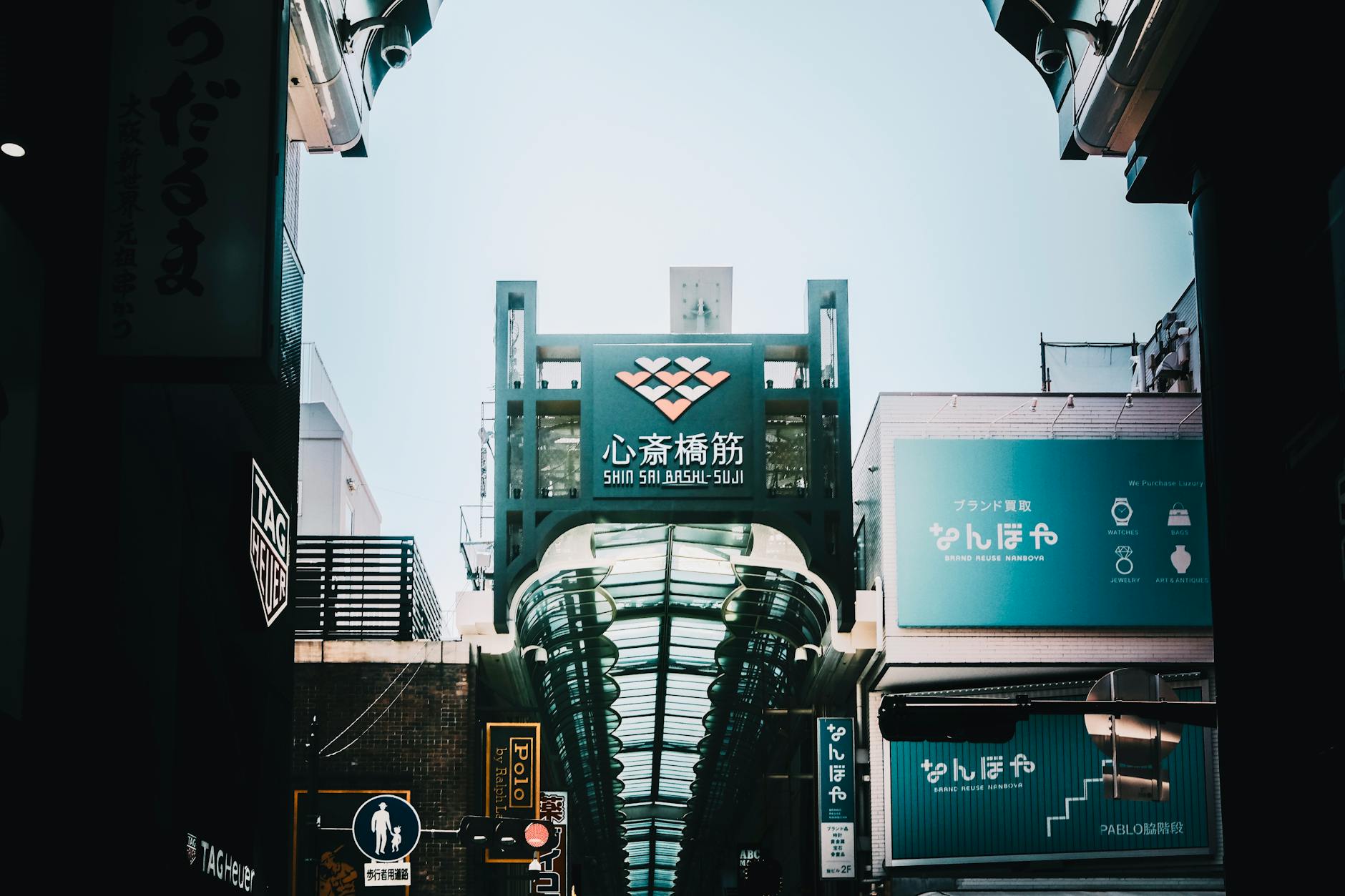
Shinsaibashi-suji is the answer for most people. The covered arcade running north from Dotonbori holds Kokumin, Sundrug, Tsuruha, Daikoku and at least one Matsumoto Kiyoshi within a few hundred metres of each other, which means you can price-check the same item three times in five minutes. It is also entirely under cover, which matters in August and in the rain. See the Shinsaibashi shopping guide for the rest of the street.
Dotonbori and Namba for late-night shopping, particularly the big Don Quijote. Prices here are aimed at visitors and are still good, but they are not the best in the city. The Dotonbori guide covers the area, and Namba the district around it.
Umeda for a calmer experience. The drugstores under and around Osaka Station and in the Whity Umeda underground mall are less frantic, the queues are shorter, and if you are staying north of the river you can do the whole thing on your way back to the hotel. The Umeda guide has more.
Tennoji and Abeno for the same thing with a local rather than a visitor crowd, which shows in the pricing — see the Tennoji and Abeno guide. And Den Den Town if you are already down there, where a couple of large branches sit alongside the electronics shops.
Anywhere else. Genuinely — every station, every arcade, every neighbourhood. If you find yourself in a residential district with a drugstore and no other tourists, prices there will be the lowest you see all trip, because they are set for people who shop weekly rather than once. This is one of the small rewards of wandering off the main routes, which is rather the point of seeing Osaka like a local.
A wet afternoon is the ideal time for all of it, since the arcades are covered end to end — rainy day Osaka has the rest of the indoor list, and the money-saving guide covers where else the savings are hiding on a trip.
What is actually worth buying

Skincare
This is the strongest category and the reason most people come.
- Hada Labo Gokujyun hyaluronic acid lotion — around ¥600–800, and cheaper at Don Quijote. Japan’s best-selling toner-essence for years running. If you buy one thing, buy this.
- Senka Perfect Whip cleansing foam — Shiseido’s, around ¥500–700 for 120g, and the best-selling face wash in the country. There are several variants; they are all fine.
- Sunscreen. Japanese sunscreen is genuinely better than most Western equivalents — lighter, higher protection, no white cast. Biore UV Aqua Rich and Anessa are the two names to look for, roughly ¥800–3,000 depending on brand.
- Sheet masks — from ¥100 each individually to around ¥1,000 for a box of 30. The bulk boxes are the value buy and they are flat, which your suitcase will appreciate.
- Melano CC vitamin C serum — about ¥900, and a cult item for good reason.
Medicine and health
- Salonpas and similar pain-relief patches (Hisamitsu) — the classic Japanese medicine-cabinet item, around ¥600–1,200 a pack, and genuinely useful after a fortnight of walking.
- Rohto eye drops — the cooling ones are famous, sting enthusiastically, and cost about ¥400–800.
- Kabanoanahime and Kobayashi’s household range — heat patches, cooling sheets, blister plasters, foot patches. All cheap, all better designed than the equivalent at home.
- Cooling body sheets (Gatsby, Biore) — about ¥400 a pack and close to essential in an Osaka August. The summer guide is not exaggerating about the humidity.
Cosmetics
Canmake, Cezanne, KATE and Excel are the four names to know at drugstore prices — typically ¥600–1,500 per item, for quality that competes with mid-range Western brands at three times the price. Canmake’s cream blushes and Cezanne’s tone-up bases are the perennial recommendations. Kokumin also carries the higher-end counters, including SK-II and the Shiseido lines, if you want the premium end.
One genuine caution: shade ranges are narrow and skew light and pink-toned. Foundation and concealer are the two categories where a lot of visitors buy hopefully and end up with something unusable. Use the testers, in daylight if possible, and buy powder and blush rather than base products if you are unsure.
Hair
Tsubaki, Ichikami and Kracie’s Himawari range, around ¥600–1,200 a bottle, and heavy. If you are flying with a carry-on only, buy the sachets — single-use packets of everything are sold on the shelf edge for ¥50–150 and are a much better souvenir than a bottle you have to check in.
The snack aisle
Drugstores are quietly one of the cheapest places in Japan to buy Kit Kats, Pocky and regional confectionery — usually below convenience-store prices and often below the airport by half. If you are buying omiyage gifts to take home, this is the move nobody makes. The souvenir guide covers what is actually worth carrying.
What to skip
- Anything you can buy at home for a similar price. Global brands are not cheaper in Japan. The value is entirely in Japanese domestic brands.
- Bulk bottles of shampoo and lotion. Heavy, liquid, and you will pay for the weight at the airport. Sachets and travel sizes exist for exactly this reason.
- Foundation bought without testing. See above.
- "Collagen" drinks and beauty supplements. Widely sold, heavily marketed, and the evidence for them is thin. Buy them for fun, not for results.
- Airport drugstores. Convenient, comprehensively more expensive, and a bad place to discover that the thing you wanted is out of stock.
- Anything bought in the first shop you enter on Shinsaibashi-suji, before you have seen the next one. Price differences of 20–30% on identical items across two shops fifty metres apart are completely normal.
Tax-free shopping changes on 1 November 2026
This is the most important thing on the page, and most guides online have not been updated for it.
Until 31 October 2026, the system works as it has for years: you spend over the threshold in one shop on one day, show your passport at the till, and pay the tax-free price on the spot. Consumables — and cosmetics, skincare and medicine count as consumables — get sealed into a bag you are not supposed to open until you leave Japan.
From 1 November 2026, the instant exemption ends. Instead:
- You pay the full tax-inclusive price in the shop.
- The export is confirmed by customs at a kiosk at the airport when you leave.
- The shop then refunds you the 10%.
- From 1 November 2026, customs must confirm your export within 90 days of purchase; the shop then refunds the tax once that is confirmed.
- The special sealed packaging requirement for consumables goes away — but you still may not use or consume the goods in Japan if you want the refund.
The change exists because the old instant system was being exploited to buy tax-free and resell domestically. The practical consequences for an ordinary visitor are: keep every receipt, keep purchases accessible rather than buried at the bottom of a checked bag, allow extra time at the airport, and understand that the refund mechanism will vary between retailers. Our tax-free shopping guide tracks the detail as it settles.
The practical tax-free rules either way
- Bring your physical passport. Not a photo of it, not a photocopy. The system reads the chip.
- Minimum spend applies per shop, per day — usually ¥5,000 before tax. Consumables and general goods are counted in separate baskets, so buying ¥3,000 of skincare and ¥3,000 of socks may qualify for neither.
- Consolidate. One large purchase in one shop beats four small ones spread across the district. This is the single easiest way to save 10%.
- Look for the sign. Not every branch of every chain is registered for tax-free, though almost all central Osaka ones are.
- Some chains stack coupons on top. Matsumoto Kiyoshi’s app and the paper coupons handed out on the street are worth 5–20% and combine with the tax exemption.
What things roughly cost
| Item | Typical 2026 price |
|---|---|
| Hada Labo hyaluronic acid lotion | ¥600–800 |
| Senka Perfect Whip cleanser, 120g | ¥500–700 |
| Biore UV Aqua Rich sunscreen | ¥800–1,200 |
| Sheet mask, box of 30 | ¥800–1,500 |
| Canmake blush or eyeshadow | ¥700–1,000 |
| Salonpas patches, standard pack | ¥600–1,200 |
| Rohto eye drops | ¥400–800 |
| Shampoo, full bottle | ¥600–1,200 |
| Single-use sachet of anything | ¥50–150 |
These are 2026 estimates rather than quotes, and drugstore prices vary between chains and between branches of the same chain on the same street. Check the shelf.
How to plan the run
Doing this properly takes about ninety minutes and saves both money and suitcase space. The method:
- Make the list on day one, buy on the last full day. Every drugstore in Osaka stocks essentially the same range, so there is no urgency and no reason to carry it around for a week. Photograph anything that catches your eye as you pass, and keep the photos in one album.
- Do one price-check walk. Take the Shinsaibashi-suji arcade north from Dotonbori and look at the same two or three items in three different shops. Ten minutes of this tells you which chain is cheapest that week, and it does change.
- Buy it all in one shop, in one transaction. This is what gets you over the tax-free threshold in both the consumables and general-goods baskets, and it is the difference between saving 10% and saving nothing.
- Ask about coupons before the till rings. Matsumoto Kiyoshi’s app and the paper coupons handed out on the arcade both stack with the tax exemption. Nobody will offer; you have to ask.
- Weigh the bag that night, not at the airport. If it is close, the hotel front desk will help you post a box home.
Drugstore, konbini, department store or Loft?
Four different shops sell overlapping things at very different prices, and knowing which is which saves real money:
- Drugstore — cheapest for skincare, medicine, toiletries and, surprisingly, snacks. The default for everything on this page.
- Convenience store — open at all hours, stocks a thin emergency range at a noticeable premium. Fine at 03:00, wasteful at 15:00.
- Department store beauty floor — the premium brands, proper consultations, gift wrapping, and prices to match. Worth it for a specific high-end purchase, not for a haul. The department store guide covers the rest of the building.
- Loft and Tokyu Hands — the interesting middle ground. Design-led toiletries, stationery, kitchen gadgets and the genuinely odd Japanese household inventions that make the best gifts. More expensive than a drugstore, far more browsable, and the place to go if you want something nobody at home will already own.
Osaka or Tokyo for this?
Osaka, marginally, and for a specific reason: Kansai’s drugstore market is more competitive, Daikoku Drug exists only here, and the density on Shinsaibashi-suji makes price comparison trivial in a way it is not in Shinjuku. The difference is a few per cent rather than a transformation, and the ranges are identical. But if your trip covers both cities and you are deciding where to do the big shop, do it here.
Practical notes
- Weight. This is the constraint nobody plans for. Liquids are heavy and airlines are unsentimental. Weigh your bag before the airport, and if it is close, post the excess home — Japan Post’s international parcel service is reliable and reasonably priced.
- Carry-on liquids. Anything over 100ml goes in the hold, sealed tax-free bag or not. This catches people out at Kansai constantly.
- Payment. Cards and IC cards work at every major chain. Small independent pharmacies may not.
- Hours. Most chains run roughly 09:00 or 10:00 to 22:00 or 23:00. Don Quijote runs much later, sometimes around the clock.
- Staff. The big central branches have Chinese and English-speaking staff and multilingual shelf labels. Point at your phone and you will be fine anywhere else.
- Behind the counter. Some medicines are classified as requiring a pharmacist and can only be sold when one is on duty, which is not all opening hours. If a shelf is empty with a card on it, that is why.
Bringing medicines home
Worth ten minutes of your attention before you buy in bulk. Japanese over-the-counter medicines sometimes contain compounds that are controlled or restricted elsewhere — certain cold and sinus remedies in particular. Some countries limit the quantity of any OTC medicine you may import for personal use, and a few require a doctor’s letter.
Check your own country’s customs rules before you fill a suitcase with medication. This is not a Japanese restriction, it is a destination one, and it is the sort of thing that is entirely fine until it is not.
Frequently asked questions
Which drugstore chain is cheapest in Osaka?
Don Quijote and Daikoku Drug are generally the cheapest on popular items, often 20–30% below the big cosmetics-led chains. Matsumoto Kiyoshi closes the gap with app coupons and beats them on range and testers.
Do I need my passport?
Yes, the physical passport, for any tax-free purchase. Photos and copies are not accepted.
What is the minimum spend for tax-free?
Usually ¥5,000 before tax, per shop, per day, with consumables and general goods counted separately. Consolidating purchases in one shop is the easiest way to reach it.
Is it cheaper than buying Japanese brands at home?
Dramatically, for domestic Japanese brands — often a third or a quarter of the imported price. Not at all for international brands, which cost roughly the same everywhere.
Can I open the sealed tax-free bag before I leave Japan?
Under the pre-November 2026 system, no — the seal is meant to stay intact until you have left. After the change, the sealed-packaging requirement goes away, but the goods still must not be used or consumed in Japan if you want the refund.
Where is the best place in Osaka for this?
The Shinsaibashi-suji arcade, for the density of competing shops in one covered street. Umeda if you want the same range with fewer people.
Can I buy prescription medicine?
No, not without a Japanese prescription. Drugstores sell over-the-counter medicines only; the pharmacy counter dispenses against Japanese prescriptions.
Are drugstores open late?
Most until 22:00 or 23:00, Daikoku Drug’s central branches later, and Don Quijote very late or continuously. Useful if your days are full — see late night Osaka for what else is open.
Where to go from here
The trick with all of this is to do it once, deliberately, near the end of the trip, in one shop, over the tax-free threshold, with a list. Doing it in four impulsive visits is how you end up over your baggage allowance with three bottles of shampoo you did not need.
Read the tax-free guide next for the mechanics of the November change, and the Osaka shopping guide for the rest of the city — the department stores, Kuromon Market, vintage and the outlets. For what to actually bring home, the souvenir guide is the honest list.
More on paying for it in our guide to cash, cards and IC cards in Osaka.