This article contains advertising. Our booking links are routed through a partner that adds commission tracking automatically, so if you book through one we earn a commission from the provider, at no extra cost to you. It never affects what we recommend. Affiliate disclosure
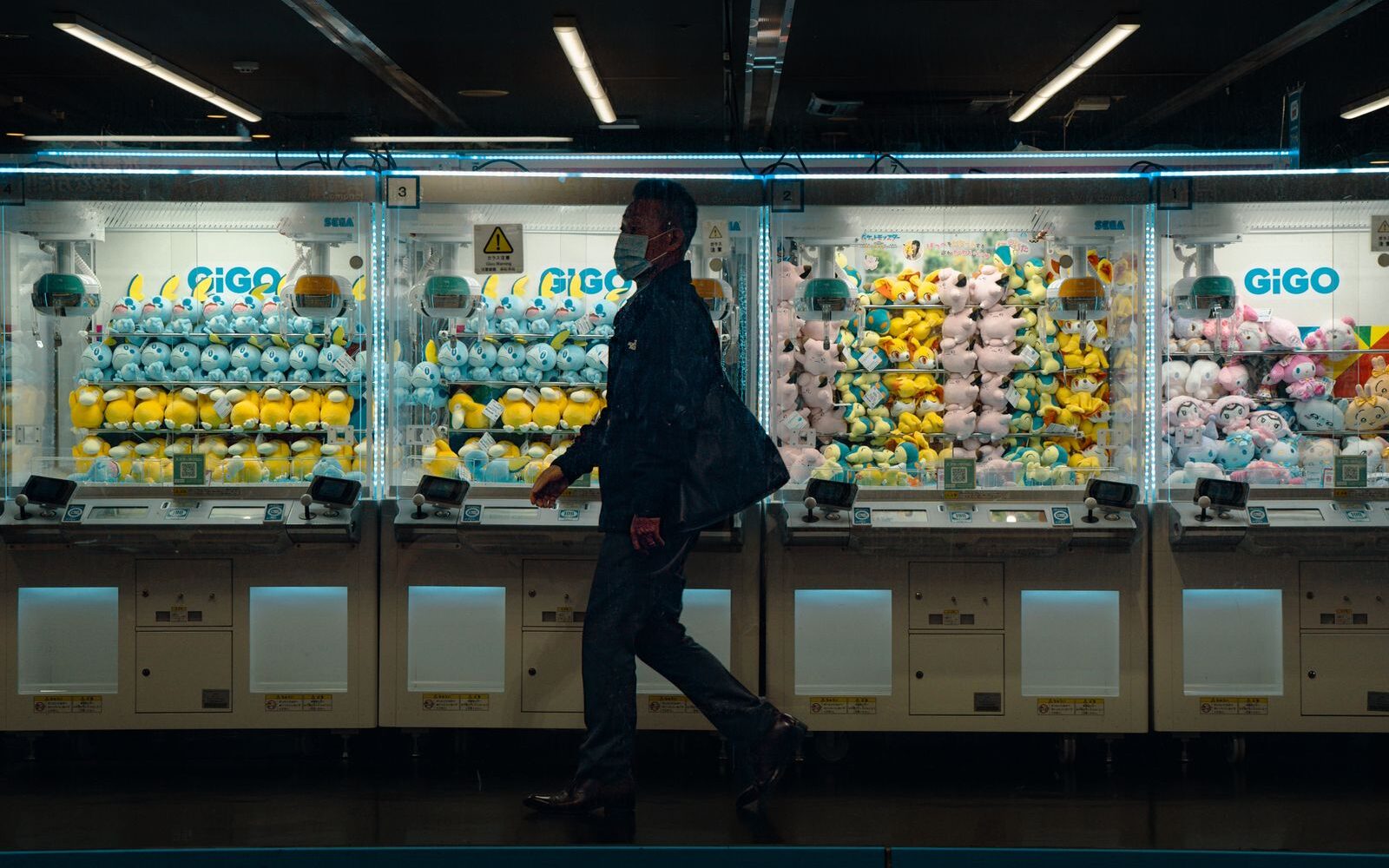
Japanese arcades were supposed to be finished. Smartphones had eaten their audience, the pandemic emptied them, and in 2020 SEGA, the most famous name in the business, began selling off its entire chain of game centres. Then, in August 2024, the company that bought them opened a three-floor, 300-machine flagship on Dotonbori, and it was full. Osaka arcades did not die. They changed shape, and the new shape is built mostly out of glass boxes full of plush toys.
Walk into any big game centre in Namba and the ground floor will be wall-to-wall crane games. Go upstairs and it is a different world: rhythm-game players hammering drums and touchscreens with frightening precision, fighting-game regulars sitting back to back at linked cabinets, teenagers queuing for photo-sticker booths, and older men feeding medals into pusher machines with the concentration of chess players. It is loud, bright, cheap by the minute and one of the most enjoyable ways to spend a wet evening in the city.
This guide explains how Japanese arcades work, what each kind of game is and whether it is worth your coins, which arcades are worth seeking out in Namba, Dotonbori, Den Den Town and Umeda, and — most usefully — how to avoid spending ¥5,000 trying to win a plush toy worth a fraction of that.
The short answer
- Biggest and brightest: GiGO Osaka Dotonbori, opened in 2024 with more than 300 machines across three floors.
- Everything under one roof, late: Round1 Stadium Sennichimae in Namba, with arcade floors, bowling, karaoke and the Spo-Cha sports zone.
- Rhythm and crane games, central: Taito Station Namba, open until midnight.
- Retro and fighting games: Athena Nippombashi in Den Den Town, and the retro floor at Super Potato.
- With young children: namco Namba Parks, inside the shopping mall.
- In the north: namco Umeda, near Osaka Station.
How Japanese arcades work
Japanese game centres — gēsen in slang — follow a pattern so consistent that once you have been in one, you can navigate them all.
- Entry is free. You pay per game, usually from ¥100 a play.
- Floors are sorted by type. Crane games and prize machines at street level, rhythm games a floor or two up, then fighting and racing cabinets, photo-sticker booths, medal games, and sometimes darts at the top. The directory by the lift tells you where everything is.
- ¥100 coins are the currency. Every floor has change machines that break ¥1,000 notes, and many machines still take coins only. Some chains now take IC cards such as ICOCA or Suica on certain machines, and Round1 also accepts QR payments and credit cards — but keep coins on you. Our money guide explains the rest.
- Save your progress with a card. Regular players carry a membership card for each maker: SEGA’s Aime, Konami’s e-amusement pass, Bandai Namco’s Banapassport. They cost a few hundred yen from machines on the floor and save your scores and unlocks. Worth it only if you will play the same game more than once.
- Age rules are enforced. By law, under-18s cannot be in an arcade after 22:00, and younger teenagers need an adult with them in the evening. Staff check.
- They are non-smoking. Smoking indoors is restricted to designated smoking rooms, so the air is far better than the arcades of twenty years ago.
Etiquette
- Watching is fine; crowding the player is not. The best rhythm-game players attract small audiences, who stand back.
- Do not film other players close up without asking. Filming the room is normal.
- Take turns. On a busy evening there may be a queue for a popular rhythm game; wait behind it, and do not hog a machine for an hour when others are waiting.
- Tidy up. Take your drinks, bags and prize bags with you. Staff hand out free plastic bags for prizes.
Crane games: the honest guide
Crane games, which Japan calls UFO catchers after a SEGA brand name, are what keep Japanese arcades alive. The prizes are extraordinary: plush toys of every character in existence, huge cushions, boxed snacks, and above all prize figures, anime figures made specifically for crane games and not sold in shops. The machines are also designed, like every game of skill with a prize, to take more money than they give.
That does not mean you cannot win. It means you should understand what you are playing.
How the machines work
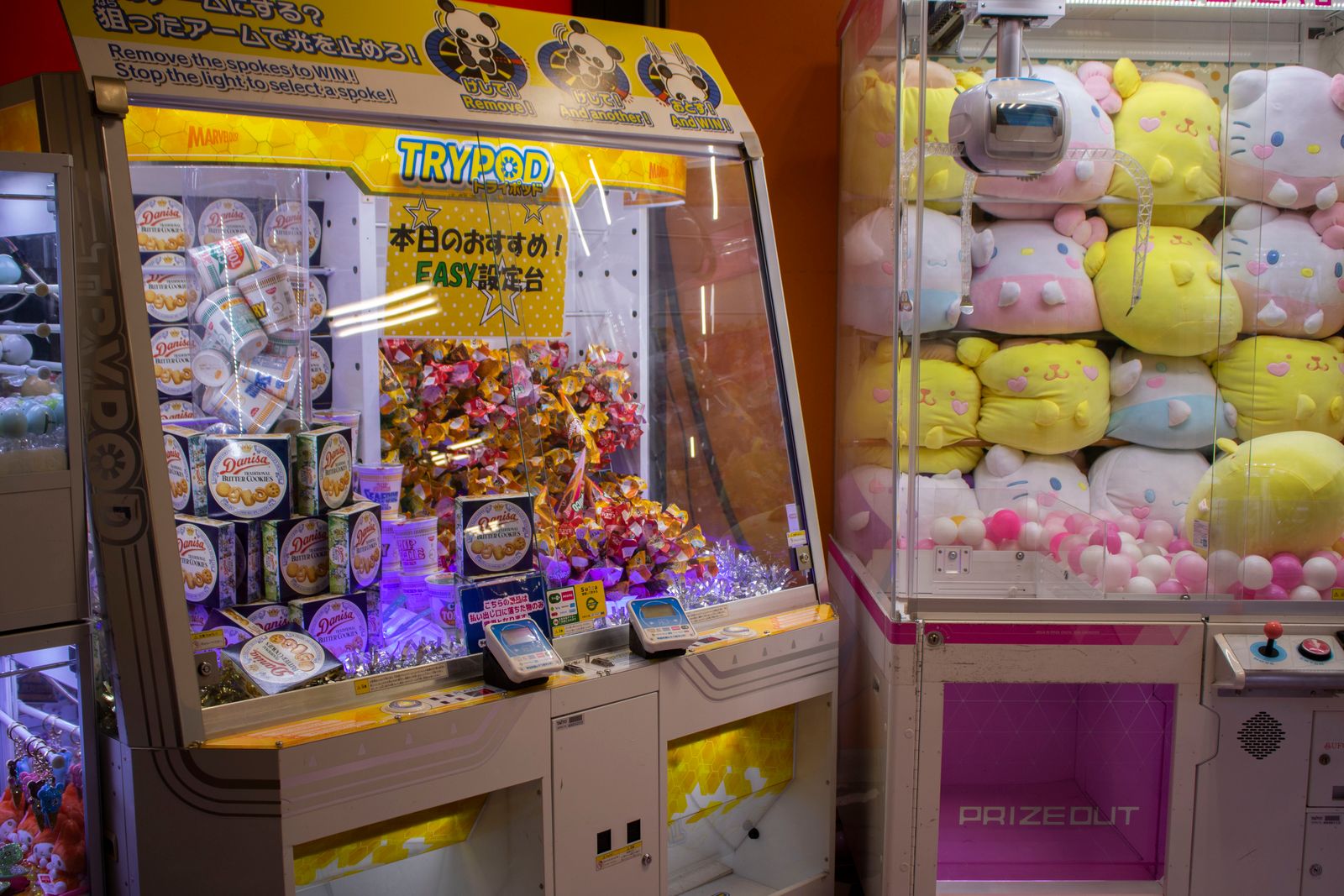
- Most prizes are not grabbed; they are pushed. Japanese crane games are usually set up so that the arm cannot lift the prize outright. Instead you nudge it, a few centimetres per play, until it tips into the chute. Boxes sit across two bars — the “bridge” setup — and are walked forward corner by corner; plush toys are rolled or dragged.
- Price per play: usually ¥100, sometimes ¥200 for bigger prizes, and many machines give six plays for ¥500. That bonus is how they keep you at the machine.
- Staff will help. If a prize has become stuck in an impossible position, or you have made progress and want a better angle, ask a member of staff. They will often reposition it to give you a better chance. This is normal, and it is the single most useful thing a first-timer can know.
- Use the call button. Many crane machines have a small staff-call button on the front panel. Press it and someone will come; there is no need to hunt for an attendant.
- Look for the easy machines. Many arcades mark certain machines as easier or recommended for the day. They exist to get you playing, and they are the best place to start.
How not to lose a fortune
Set a budget before you start, and stop when you reach it. The pattern that empties wallets is always the same: the prize moves a little, then a little more, and after ¥3,000 it is so close that walking away feels impossible. It is designed to feel that way.
Here is the honest arithmetic. Many of the prizes in these machines turn up afterwards in the second-hand shops of Den Den Town, where resellers sell them for less than most people spend winning them. If you want a specific prize figure, buy it. If you want the fun of winning something, play the easy machines and the small prizes, set a limit of, say, ¥1,000 a machine, and enjoy the game for what it is.
Two more rules. The biggest-ticket prizes — games consoles, designer headphones — sit in some of the hardest machines in the building. And the moment you think “just one more go” for the third time, it is time to go and play something else.
Rhythm games
Upstairs is where Japanese arcades still show what they can do that nothing at home can. Rhythm games are built around physical controllers that you cannot replicate on a sofa, and the best players are astonishing to watch.
- Taiko no Tatsujin — hit a big drum in time to the music. The best game in the building for beginners and children; everyone can play it, and everyone has fun.
- maimai — a circular touchscreen ringed with buttons, which looks rather like a washing machine. Energetic, and fun to watch.
- CHUNITHM — a touch slider with air sensors above it, for players who want to wave their hands about in public.
- beatmania IIDX — the DJ game: seven keys and a turntable. Brutally difficult at higher levels, and home to some of the most skilled players in any arcade.
- Sound Voltex — buttons and two knobs, with loud electronic music and a devoted following.
- Dance Dance Revolution — the dance game that made rhythm games famous abroad. Less common in Japan than it was, but still around.
Our advice: play Taiko no Tatsujin first, because it is impossible not to enjoy, and then go and watch the beatmania players for ten minutes. Weekday afternoons are the time to get a turn on the popular machines; weekend evenings belong to the regulars.
Fighting games, retro, and the versus cabinet
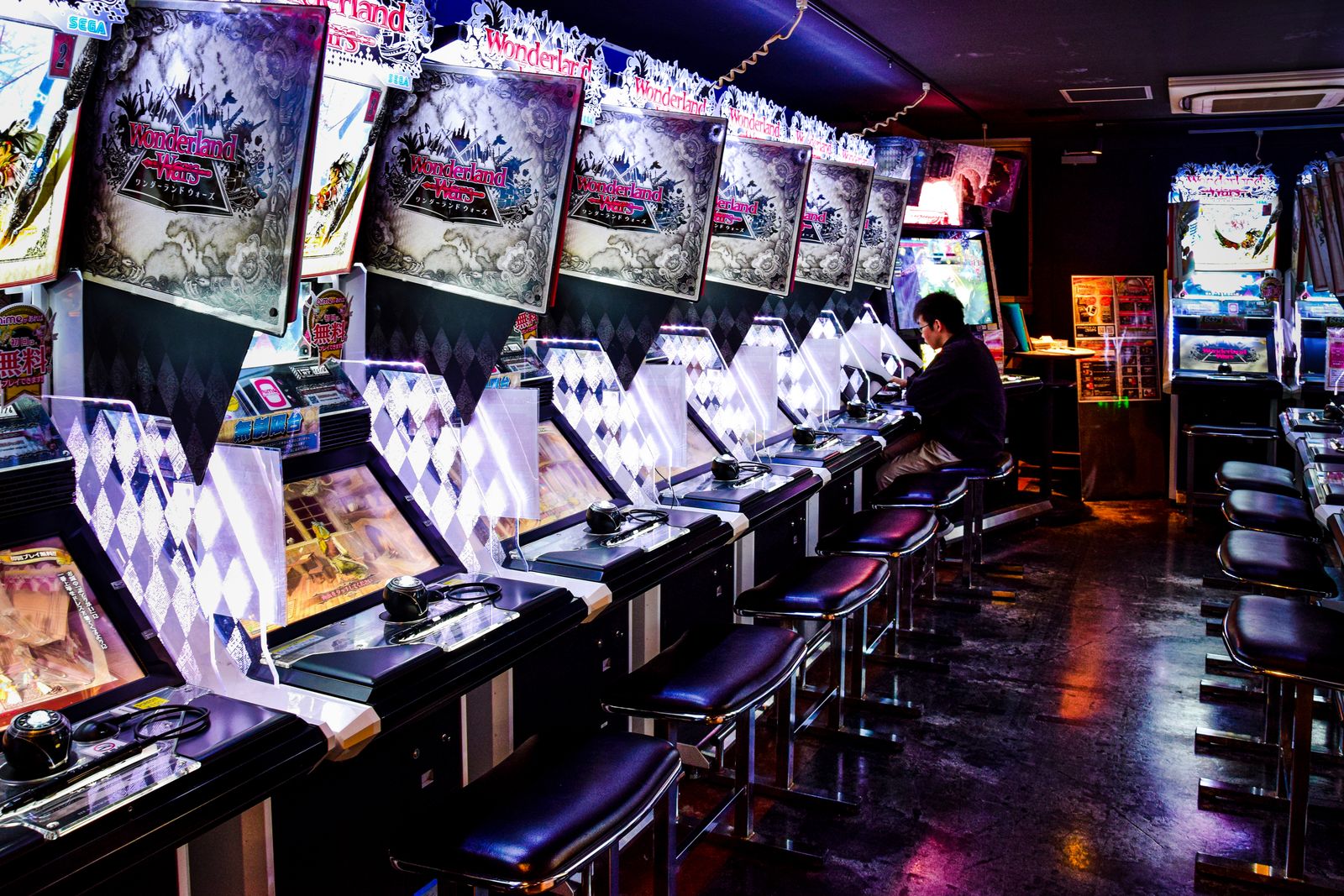
Fighting games in Japanese arcades are played on linked cabinets set back to back. You do not challenge the player next to you; you sit down at the cabinet on the other side, put your coin in, and the match starts. You may be playing someone who has spent years on that one game. Losing quickly is part of the experience. Winners stay on.
For older games, Den Den Town is the place. Athena Nippombashi is known for its retro and fighting-game cabinets, and Super Potato, the retro-game shop on Ota Road, has a floor of playable old cabinets above its shelves of Famicom and Super Famicom cartridges. Our Den Den Town guide covers the district, and Osaka anime and pop culture puts it in context.
Purikura: photo stickers
Purikura are photo-sticker booths: you pose in a brightly lit booth, then decorate the results on a touchscreen with stickers, text and filters that enlarge eyes, smooth skin and slim faces to cartoonish effect, and print them out as sticker sheets. Most booths also let you download the images to your phone. A session costs around ¥400–500.
- They are for groups and couples. Many arcades bar all-male groups from the purikura floor, to keep it comfortable for the teenage girls who are its main customers. Mixed groups and couples are fine.
- Move fast. The booth counts you down between shots, and the editing time is limited. First attempts are always chaotic, which is half the fun.
- It is the best cheap souvenir in the building — better than any plush toy.
Medal games and the rest
Medal games — coin pushers, horse-racing simulators, bingo-style machines — use tokens bought with yen. Medals cannot be exchanged back for money or prizes, which is what keeps them on the right side of Japan’s gambling laws, but many arcades let you bank them for another day. They are soothing, surprisingly social, and a cheap way to spend an hour. You will also find racing games such as Mario Kart Arcade, card-based games, mahjong cabinets and, at Round1, bowling, karaoke and sports.
The best arcades in Osaka, by district
Namba, Dotonbori and Sennichimae
The densest cluster in the city, and the easiest to combine with dinner and a walk along the canal. Our Dotonbori guide and Namba guide cover the neighbourhood.
- GiGO Osaka Dotonbori — the flagship, opened in August 2024 in a big corner building on Dotonbori, with more than 300 machines across three floors. Open roughly 09:00–01:00. Heavy on crane games; the place to see what a modern Japanese arcade looks like.
- GiGO Namba — a second GiGO a short walk from Namba Station, open roughly 09:00–23:30.
- Taito Station Namba — in Sennichimae, open 10:00 to midnight. A classic Japanese arcade: cranes, rhythm games, purikura.
- Round1 Stadium Sennichimae — a few minutes’ walk from Namba, and the one to choose if you want more than games: bowling, karaoke and the Spo-Cha all-you-can-play sports zone alongside the arcade floors. Its listed hours are round the clock, which makes it the default for a very late night — though under-18s still have to be out by 22:00. See karaoke in Osaka too.
- namco Namba Parks — inside the Namba Parks mall, open roughly 11:00–22:00. Smaller, calmer and family-friendly.
Den Den Town (Nipponbashi)
Osaka’s otaku district, fifteen minutes’ walk south-east of Namba, with arcades alongside the anime shops and figure resellers.
- Taito Station Osaka-Nippombashi — a big, busy Taito, open 10:00 to midnight.
- Athena Nippombashi — open roughly 09:00 to midnight, and the arcade for retro and fighting games.
- Super Potato — on Ota Road, open roughly 11:00–20:00. A retro-game shop first and an arcade second, but the playable cabinets upstairs make it a pilgrimage for anyone who grew up with them.
Umeda
namco Umeda, in the OS Building near Osaka Station, is open 10:00 to midnight and makes a good hour’s diversion on a wet evening in the north. The character stores on the thirteenth floor of Daimaru Umeda — Nintendo OSAKA, the smaller Pokemon Center and the CAPCOM Store — are not arcades, but they are the other half of any gaming afternoon in Umeda. See Pokemon Center Osaka and the Umeda guide.
Tennoji and Abeno
In the south, Capcom’s interactive attraction CAPCOMIX opened at Abeno Hoop in March 2026 — less an arcade than a playable exhibition built around the company’s games. It pairs with a trip up Abeno Harukas, across the road.
An arcade night in Namba
- 18:30 — GiGO Osaka Dotonbori. Walk every floor, try the easy crane machines with a strict ¥1,000 limit, and do one round of purikura.
- 19:30 — dinner in Dotonbori or Sennichimae: takoyaki, okonomiyaki, or anything from our late-night food guide. Our takoyaki guide explains which stalls are worth the queue.
- 20:45 — Taito Station Namba for Taiko no Tatsujin, and ten minutes watching the rhythm-game regulars.
- 21:45 — Round1 Stadium Sennichimae for bowling or karaoke, if you have energy left.
That is a full evening for two for the price of a single cocktail in a hotel bar, and it works as well in pouring rain as on a clear night. For the rest of the neighbourhood after dark, see Dotonbori after dark, and for wet-weather ideas across the city, rainy day Osaka.
Arcades with children
Children love Japanese arcades, and Japanese families use them the same way. Taiko no Tatsujin, the simpler crane games and the racing games are all child-friendly. Go in the afternoon: the under-18 rule means everyone underage has to leave by 22:00, and younger children need an adult with them in the evening in any case. namco Namba Parks is the calmest option, Round1 the one with the most to do. See Osaka with kids for the rest of a family day, and if the gaming theme is the draw, Super Nintendo World is the obvious next stop.
What to skip
- The “just one more go” spiral on a crane game. Set the limit before you start.
- Chasing a specific prize figure through a machine when a Den Den Town shop sells it for less.
- The big electronics prizes, unless you are very lucky or very good.
- Weekend evenings on the popular rhythm games if you want a turn rather than a spectacle.
- Buying membership cards for games you will play once.
A short arcade glossary
Signs on the floors and machines are often in Japanese only. A few words make the whole place easier to read.
- Gēsen (ゲーセン) — game centre, the everyday word for an arcade.
- UFO kyacchā (UFOキャッチャー) — crane game, after SEGA’s brand name; also kurēn gēmu.
- Keihin (景品) — prize. Puraizu figyua are the figures made only as crane-game prizes.
- Ryōgaeki (両替機) — change machine. There is one on every floor.
- Otogē (音ゲー) — rhythm games, the upstairs floors full of drums, buttons and touchscreens.
- Taisen (対戦) — a versus match, as in fighting games on back-to-back cabinets. Renchan is a winning streak.
- Medaru gēmu (メダルゲーム) — medal games, played with tokens that cannot be cashed out.
- Purikura (プリクラ) — photo-sticker booths, short for “print club”.
- Dansei nomi no go-nyūjō wa go-enryo kudasai — “no all-male groups, please”, the sign you will see at the entrance to many purikura floors.
Two useful phrases at a crane game: ichi o naoshite moraemasu ka?, “could you reposition it?”, and sumimasen, which covers everything else. Our Japanese phrases for Osaka has more.
Osaka arcades: FAQ
What is the best arcade in Osaka?
For sheer scale, GiGO Osaka Dotonbori, with more than 300 machines across three floors. For everything under one roof, including bowling and karaoke, Round1 Stadium Sennichimae. For retro and fighting games, Athena Nippombashi in Den Den Town.
How much do arcade games cost in Japan?
Most games start at ¥100 a play. Many crane games give six plays for ¥500, and a purikura photo-sticker session costs around ¥400–500.
Are Osaka arcades open late?
Most close around midnight, and GiGO Osaka Dotonbori runs to about 01:00. Round1 Stadium Sennichimae runs late for adults. Under-18s must leave all arcades by 22:00.
Can you win at Japanese crane games?
Yes, especially on machines marked as easy and with help from staff, who will often reposition a prize if you ask. But the machines are designed to take more than they give, so set a budget and stick to it.
Do Osaka arcades take cards?
Increasingly, but not everywhere. Some machines take IC cards and Round1 accepts QR payments and credit cards, but many games still run on ¥100 coins. Every floor has change machines.
Can men use purikura booths?
In mixed groups or as couples, yes. Many arcades do not allow all-male groups onto the purikura floor.
Are arcades good for a rainy day in Osaka?
Among the best. They are warm, dry, cheap by the hour and clustered around Namba and Dotonbori, close to everything else you might want to do.
Where to go next
For the rest of the city’s gaming and anime culture, start with Osaka anime and pop culture and the Den Den Town guide. For the evening beyond the arcades, see Osaka nightlife and unusual things to do in Osaka.
Then plan the rest of the trip with things to do in Osaka and the Osaka itinerary hub.