This article contains advertising. Our booking links are routed through a partner that adds commission tracking automatically, so if you book through one we earn a commission from the provider, at no extra cost to you. It never affects what we recommend. Affiliate disclosure
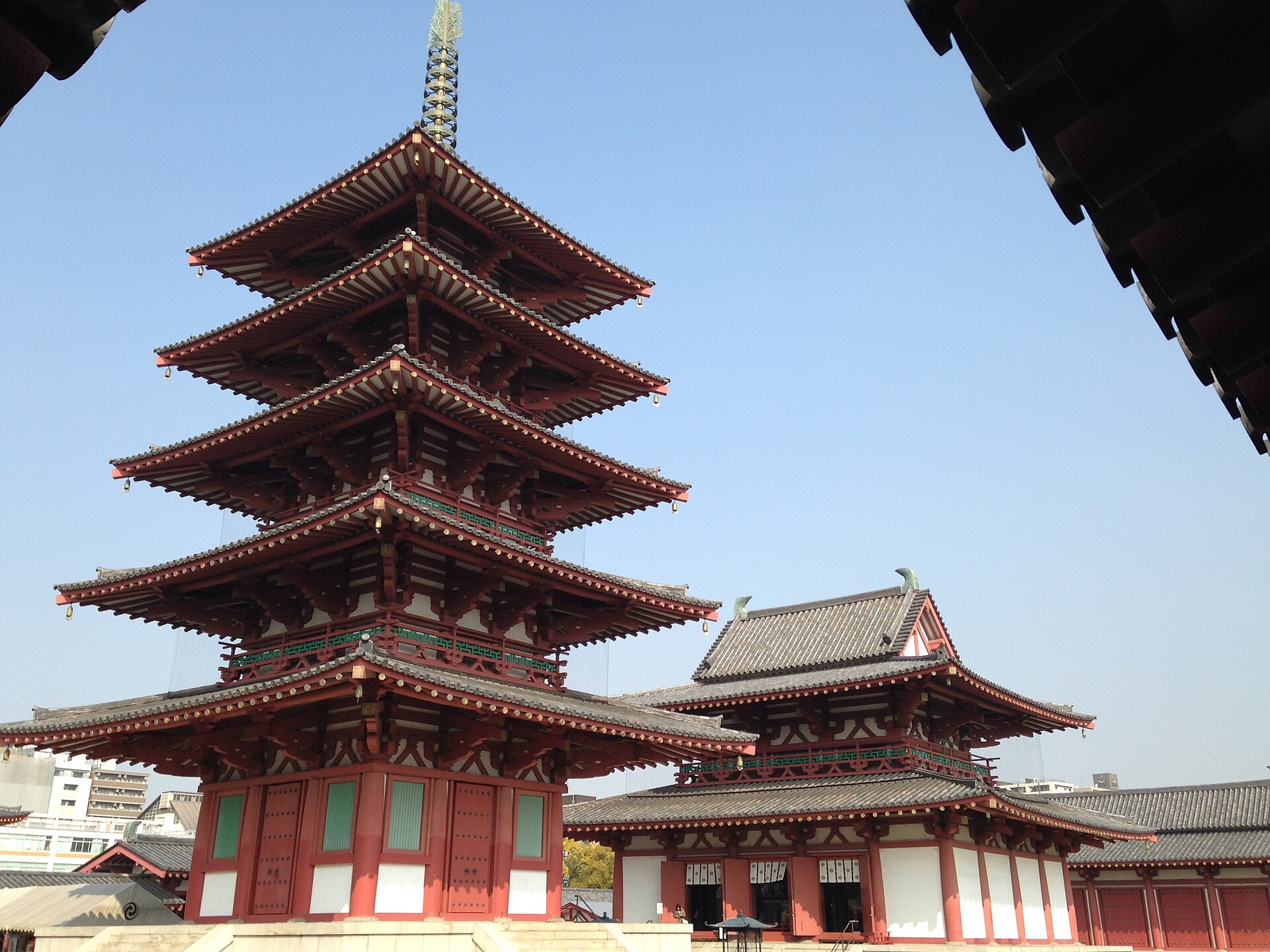
Shitennoji Temple is Japan’s oldest officially administered Buddhist temple, founded in 593 AD by Prince Shotoku to commemorate his clan’s victory over the anti-Buddhist Mononobe clan. Predating Horyu-ji and the great Kyoto temples, Shitennoji preserves the original Asuka-period layout – middle gate, pagoda, Kondo (Golden Hall) and Kodo (lecture hall) all aligned in a straight north-south line – which set the template for Japanese temple architecture for the next thousand years. The site sits in central Osaka’s Tennoji district and is one of the city’s most important historical landmarks. This 2026 guide covers the temple’s history, the climbable five-story pagoda, the monthly flea market, festivals, and how to plan your visit.
Quick Facts: Shitennoji Temple
- Address: 1-11-18 Shitennoji, Tennoji-ku, Osaka 543-0051
- Access: 5-min walk from Shitennoji-mae Yuhigaoka Station (Osaka Metro Tanimachi Line); 12-min walk from Tennoji Station (JR Loop, Midosuji)
- Hours: 08:30-16:30 (Apr-Sept); 08:30-16:00 (Oct-Mar); on the 21st of each month the temple opens at 08:00 and closes at 17:00 (Apr-Oct) or 16:30 (Nov-Mar)
- Admission: Outer grounds FREE; Inner Precinct (Chushin Garan with pagoda + Kondo) JPY 500 adult, JPY 300 high school; Treasure House JPY 500 / 300; Honbo Garden JPY 300 / 200
- Founded: 593 AD by Prince Shotoku
- Site size: 11 hectares (27 acres) – approximately 3x the size of Koshien Stadium
- Visit duration: about 40 minutes for the central precinct and treasure house, plus about 20 minutes for the garden
The History of Shitennoji
The temple was founded in 593 AD by Prince Shotoku Taishi (574-622 AD), a regent and an important patron of Buddhism in Japan. According to tradition, Prince Shotoku prayed to the Four Heavenly Kings (Shitenno) for victory in the war against the Mononobe clan, who opposed the introduction of Buddhism. After winning, Shotoku built Shitennoji (“Temple of the Four Heavenly Kings”) to honor his vow.
The temple has been destroyed and rebuilt many times – by fires, wars, and most catastrophically in the 1945 firebombing of Osaka. The central precinct was reconstructed in 1963.
The Asuka-Period Layout (Shitennoji-Garan)
What makes Shitennoji architecturally significant is the layout. The original 593 AD plan placed the middle gate (Chumon), 5-story pagoda, Kondo (Golden Hall), and Kodo (lecture hall) in a straight north-south line, all surrounded by a roofed corridor, with the Great South Gate (Nan-daimon) standing outside this central enclosure. This is the “Shitennoji-garan” – one of three foundational temple layouts in Japan, and the precursor to most subsequent Buddhist temple designs. The central precinct still follows that south-to-north line. Several later temples in our Osaka temples and historical sites guide repeat the same south-to-north alignment.
The Climbable Five-Story Pagoda
Shitennoji’s 5-story pagoda lets visitors up to its upper gallery, and the temple advertises that access on the 21st and 22nd of each month. The interior contains Buddhist images on each level, and the climbing stairs lead to the top floor where you can look out over Tennoji. The pagoda is part of the Inner Precinct admission (JPY 500).
What to See at Shitennoji
Inner Precinct (Chushin Garan)
The inner precinct contains the pagoda, Kondo (Golden Hall) with the principal Buddha statues, and the Kodo (lecture hall). Admission JPY 500. Climbing the pagoda is the headline experience.
Treasure House (Homotsuden)
Houses 6th-19th century Buddhist art including ancient sculptures, sutras and ritual implements. Climate-controlled. Separate JPY 500 admission.
Gokuraku-Jodo Garden (Honbo)
The “Pure Land Garden” recreates Buddhist paradise as imagined in 13th-century Japanese cosmology. Pond, bridges, mossy stones. Separate JPY 300 admission. Best in autumn for foliage. It is one of the smallest and quietest entries in our guide to Osaka’s parks and gardens.
Outer Grounds (Free)
The outer grounds are entirely free and include the south gate, the turtle pond (Kameike with hundreds of resident turtles), and several smaller halls. Wandering for 30-45 minutes without paying anything is a perfectly worthwhile visit.
The Famous Monthly Flea Market
On the 21st of every month (the death anniversary of Kobo Daishi), Shitennoji hosts the Garakuta-Ichi flea market, with around 300 vendors. Vendors sell antiques, vintage kimono, ceramics, Buddhist art, second-hand books, garden plants, and Showa-era curiosities. The market opens around 08:00 and runs until 16:00. The market runs again on the 22nd. The market is free to browse; bring cash for purchases.
If you visit Osaka and the 21st falls during your trip, plan around it – the market is one of the city’s most under-publicized cultural experiences. Kobo Daishi, whose death anniversary sets that date, is enshrined at Mount Koya’s temples and overnight lodgings, a day trip south on the Nankai line.
Doya-Doya Festival (January 14)
Each year on January 14, Shitennoji holds the Doya-Doya, a ceremony that closes its New Year prayer services. Check the temple’s website for the year’s timetable.
Other Notable Events at Shitennoji
- Spring Higan (March 17-23, 2026): Ancestor memorial observances around the spring equinox
- Shoryoe Bugaku Daihoyo (April 22): Memorial service for Prince Shotoku with court dance
- Bon Candle Memorial (August 9-16): Candles lit in the central precinct in the evening
- Autumn Higan (September 20-26, 2026): Ancestor memorial observances around the autumn equinox
- Hatsumode (New Year): First temple visit of the year
Etiquette at Shitennoji
- Bow at the south gate before entering
- Light incense at the burner if available – waft the smoke over your body for purification
- At the main hall: place hands together (gassho), bow once, pray silently, bow once – do not clap
- Photography permitted in outer grounds; prohibited inside the Treasure House and inner halls
- Shoes off in the Kondo and pagoda interior – bring socks
- Modest dress; no swimwear
Best Time to Visit Shitennoji
- Early morning (08:30-10:00): Calmest, best for photos
- The 21st of any month: Garakuta-Ichi flea market
- January 14: Doya-Doya Festival
- Late March – early April: Cherry blossoms on the grounds
- Late November: Autumn foliage in the Honbo Garden
- Avoid: Hatsumode peak (Dec 31 – Jan 3) if you don’t like crowds
Combine With Other Stops
Isshinji Temple
Famous for the “Bone Buddha” statues built from human cremated remains. Striking modernist concrete main hall. Our Isshinji Temple write-up explains how the statues are made.
Tennoji Park and Tennoji Zoo
Zoo admission is JPY 800 for adults and JPY 200 for elementary and junior-high school pupils; preschool children enter free. Combines well with Shinsekai food crawl.
Tsutenkaku Tower and Shinsekai
Retro Showa-era district with kushikatsu restaurants and cheap drinks.
Abeno Harukas
Osaka’s tallest building (300m, 60 floors), and Japan’s tallest until 2023. Harukas 300 observation deck about ¥2,200.
Suggested Half-Day Itinerary
- 09:00: Arrive at Shitennoji-mae Yuhigaoka Station, walk to Shitennoji
- 09:15: Outer grounds, turtle pond, south gate
- 10:00: Inner Precinct – climb pagoda, see Kondo
- 10:45: Treasure House (if interested in Buddhist art)
- 11:30: Walk to Isshinji
- 12:00: Lunch at one of the small temple-area restaurants or walk to Shinsekai for kushikatsu
- 13:30: Tennoji Park or Abeno Harukas observation deck
Practical Tips
- Cash for amulets, omikuji and goshuin (no card)
- Restrooms on the grounds
- Bring socks – the pagoda and Kondo require shoes off
- The 21st flea market is cash-only and crowded – go early
- Goshuin (temple stamps) are given at the nokyo office – JPY 500 for a stamp in your own stamp book
- Wheelchair accessible at the outer grounds; the pagoda interior is stairs only
- Photography is allowed but flash inside the inner halls is prohibited
- Combined inner-precinct + treasure-house ticket can save a small amount
Final Word: Shitennoji Temple
Shitennoji Temple rewards visitors who understand its historical weight – this is not just an old temple, it’s the temple, the model that subsequent Buddhist architecture in Japan followed for over a millennium. The climbable pagoda is a highlight, the monthly flea market is one of Osaka’s best-kept cultural secrets, and the surrounding Tennoji district makes a natural full-day combination with Isshinji, Tennoji Park, and Shinsekai. Plan around the 21st of the month if your dates allow. Osaka Castle and its park sit two stops north on the Tanimachi Line if you want the secular half of the city’s history.
Photo Credits
Shitennoji five-storey pagoda: Kondo and Gojunoto Tower of Shitennoji Temple by そらみみ, CC BY-SA 3.0, via Wikimedia Commons.